

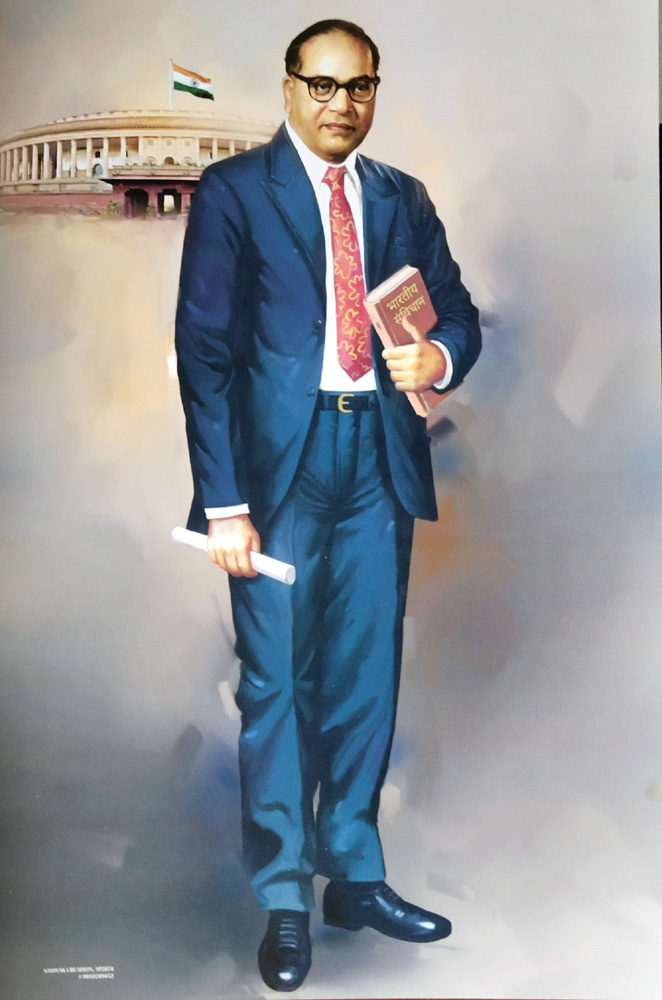
Dr. Bhimrao Ramji Ambedkar — lovingly called Babasaheb (Respected Father) by millions — was one of the greatest Indians of the 20th century. He was a jurist, economist, social reformer, political leader, Buddhist revivalist, and the chief architect of the Constitution of India. Born into the "untouchable" Mahar community at the very bottom of India's caste hierarchy, he faced relentless caste discrimination from birth — yet rose to become one of the most educated persons of his era and the principal drafter of the document that governs the world's largest democracy.
Ambedkar held multiple PhDs and advanced degrees from Columbia University (New York) and the London School of Economics — a feat almost unheard of for a person of his background in the early 20th century. He spent his life fighting to dismantle the caste system that he called "a system of graded inequality" — a social hierarchy that condemned millions to lifelong poverty, humiliation, and exclusion by the accident of birth.
As India's first Law Minister and Chairman of the Constitution Drafting Committee, he enshrined equality, liberty, fraternity, and justice into the fundamental law of India. He also fought for the rights of workers, women, and religious minorities. On 14 October 1956, weeks before his death, he converted to Buddhism along with 500,000 followers — a historic act of protest against caste Hinduism.
Bhimrao Ramji Ambedkar was born on 14 April 1891 in the town of Mhow (now Dr. Ambedkar Nagar) in the Central Provinces (present-day Madhya Pradesh), where his father, Ramji Maloji Sakpal, served as a Subedar (military officer) in the British Indian Army. He was the 14th and youngest child of his parents.
The family belonged to the Mahar community — classified as an "untouchable" caste in Maharashtra, considered so low in the Hindu caste hierarchy that they were forbidden from using the same wells, temples, schools, and even roads as upper-caste Hindus. The Mahar community had traditionally served as village servants and were assigned the most degrading tasks including disposing of dead animals and cleaning.
Despite this background, Ramji Sakpal was a remarkably progressive father. His military service had exposed him to modern education, and he was deeply influenced by the social reform writings of Mahatma Jyotirao Phule. He insisted that all his children receive an education — a radical act at the time when most untouchable children were denied school entry entirely.
Despite his father's position as a military officer, young Bhimrao experienced caste discrimination with devastating regularity from his earliest years. These experiences shaped his entire worldview and fueled his lifelong mission.
These experiences were not isolated incidents but the daily reality of being born Dalit in India. Yet rather than breaking him, they fueled an extraordinary determination to fight the system that created them.
"I was born a Hindu untouchable. It is beyond my power to prevent myself from being born an untouchable. But it is within my power to refuse to be a Hindu."
— Dr. B. R. AmbedkarDespite extraordinary obstacles, Ambedkar secured an education at every level. He was the first "untouchable" to attend Elphinstone High School in Bombay. In 1907, he passed the matriculation exam and entered Elphinstone College, Bombay — again, the first untouchable to do so.
In 1913, the Maharaja of Baroda — Sayajirao Gaekwad III, a progressive ruler who supported education for lower castes — awarded Ambedkar a scholarship to study abroad. Ambedkar sailed to the United States and enrolled at Columbia University, New York, where he completed:
He then went to England and enrolled at the London School of Economics and was called to the Bar at Gray's Inn (qualified as a barrister). He later returned and completed:
He also briefly attended the University of Bonn in Germany (1922) to study economics. In total, Ambedkar earned 32 degrees across multiple disciplines. His personal library in Delhi reportedly contained over 50,000 books — one of the largest personal libraries in Asia at the time.
On returning to India in 1917, Ambedkar was appointed Military Secretary to the Maharaja of Baroda as required by his scholarship bond. But caste discrimination followed him even at this position. No upper-caste clerk in the office would deliver files to him; no colleague would share a water glass with him; when he returned to his lodgings in the city, his Parsi landlord threw him out upon discovering he was a Mahar. He slept on the street for several days.
This experience convinced him that economic advancement alone would not overcome caste — the entire social system had to be dismantled. He returned to Bombay and began simultaneously practicing as a barrister, teaching economics at Sydenham College of Commerce and Economics, and engaging in social and political work.
In 1920, he launched the newspaper Mooknayak (Leader of the Silent), the first newspaper run by a Dalit person in India — funded partly by the Maharaja of Kolhapur, Shahu Maharaj, another progressive ruler who supported Dalit education and rights.
On 20 March 1927, Ambedkar led thousands of Dalit followers to the Chavadar Tank in Mahad, Maharashtra — a public water tank that was legally open to all but socially forbidden to "untouchables." This peaceful march to draw water from a public tank — an act available to any animal but denied to Dalits — was a landmark moment in Indian civil rights history.
The march was violently attacked by upper-caste mobs after the protesters had drawn water and left. Ambedkar organized a second conference at Mahad in December 1927. At this conference, he publicly burned the Manusmriti — the ancient Hindu legal text that codified the caste hierarchy and prescribed brutal punishments for lower castes who dared to read scriptures or drink from upper-caste wells.
The Manusmriti burning was a symbolic act of extraordinary power — it declared that Dalits would no longer be bound by a religious text that sanctioned their own oppression. It shocked the nation and marked Ambedkar as the most radical social reformer of his generation.
"Caste is not a physical object like a wall of bricks or a line of barbed wire which prevents the Hindus from co-mingling and which can be pulled down. Caste is a notion; it is a state of the mind."
— Dr. B. R. Ambedkar, Annihilation of Caste (1936)Ambedkar entered national politics in the 1930s and became a central figure at the Round Table Conferences (1930, 1931, 1932) in London, where Indian political leaders negotiated with the British for constitutional reforms.
At the Second Round Table Conference (1931), he clashed directly with Gandhi over the representation of Dalits. Ambedkar demanded separate electorates for "untouchables" — separate constituencies where only Dalits could vote, to ensure they had genuine political representation. Gandhi opposed this, fearing it would permanently divide Hindu society.
When the British (Ramsay MacDonald's Communal Award, 1932) granted Dalits separate electorates, Gandhi began a fast unto death, framing it as a protest against the division of Hindus. Under enormous pressure and with Gandhi's life at stake, Ambedkar signed the Poona Pact (1932) — agreeing to give up separate electorates in exchange for a larger share of reserved seats in general constituencies.
Ambedkar later expressed deep regret about the Poona Pact, believing Gandhi's fast had been a form of emotional blackmail that denied Dalits true political independence. He maintained that reserved seats within general constituencies did not give Dalits real political power since they still depended on upper-caste majority votes to win.
Dr. Ambedkar's greatest contribution to India — and to humanity — is the Constitution of India. When India became independent in 1947, PM Nehru appointed Ambedkar as the first Law Minister of India and Chairman of the Constitution Drafting Committee. He was chosen because no one in India had his depth of expertise in constitutional law, economics, and political philosophy.
The Constitution Drafting Committee worked for 2 years, 11 months, and 17 days (December 1946 to November 1949). Ambedkar studied constitutions from around the world — United States, UK, Ireland, Canada, Australia, Germany, and others — and synthesized the best elements into the Indian Constitution.
Key provisions Ambedkar fought for and embedded in the Constitution:
On presenting the final draft to the Constituent Assembly on 25 November 1949, Ambedkar delivered one of the most remarkable speeches in Indian parliamentary history — warning that political democracy without social and economic democracy was a "life of contradictions" that would put democracy itself at risk.
"On the 26th of January 1950, India will have equality in politics and inequality in social and economic life. We must remove this contradiction at the earliest possible moment, or those who suffer from inequality will blow up the structure of political democracy which this Assembly has so laboriously built up."
— Dr. B. R. Ambedkar, Constituent Assembly, 25 November 1949As Law Minister, Ambedkar drafted the landmark Hindu Code Bill — a comprehensive reform of Hindu personal law that would grant women the right to divorce, property inheritance, adoption rights, and abolish caste restrictions in marriage. It was arguably the most progressive reform of Hindu social law ever attempted in India.
The Hindu Code Bill faced fierce opposition from orthodox Hindus, Congress conservatives, and President Rajendra Prasad — all of whom considered it an attack on "Hindu tradition." When PM Nehru agreed to split the bill into smaller parts and defer key provisions, Ambedkar was outraged.
In September 1951, Ambedkar resigned from the Cabinet — a dramatic gesture of protest against what he saw as the government's cowardice in the face of conservative Hindu opposition and its failure to protect the rights of women and scheduled castes.
He stated that his resignation was because the Hindu Code Bill — which would give women equal rights — had been shelved, and because the government had failed to deliver on the promises of social justice embedded in the Constitution.
Ambedkar was also a pioneering economist and labour rights advocate. His doctoral work at Columbia and LSE focused on monetary policy, finance, and economic development. He was an early advocate for the Reserve Bank of India — his doctoral thesis laid the groundwork for the RBI's establishment in 1935.
As Labour Member of the Viceroy's Executive Council (1942-46), he introduced landmark labour reforms:
His economic thought combined Keynesian interventionism, welfare state principles, and a strong critique of economic exploitation based on caste. He argued that the caste system was not just a social evil but an economic system that ensured a captive cheap labour force and perpetuated poverty among lower castes through the division of labour by birth rather than merit.
In 1936, Ambedkar wrote what is considered his most radical text: Annihilation of Caste. This was a speech he had been invited to deliver at the annual conference of a Lahore-based social reform organization — but the organizers cancelled the invitation upon reading the speech's content, which they found too radical. Ambedkar published it himself.
In this speech, Ambedkar argued that caste could not be reformed — it had to be annihilated entirely. His key arguments:
Gandhi publicly responded to this speech, and the resulting debate between Gandhi and Ambedkar on caste remains one of the most important intellectual debates in Indian history. Annihilation of Caste is today recognized as one of the greatest works of political philosophy produced in South Asia in the 20th century.
In 1935, Ambedkar had declared publicly at the Yeola conference: "I was born a Hindu, but I will not die as a Hindu." For over two decades, he studied various religions — Islam, Christianity, Sikhism, and Buddhism — to find one that offered equality and dignity without caste hierarchy.
On 14 October 1956 — just 7 weeks before his death — Ambedkar chose Buddhism. At a historic ceremony in Nagpur, he took Deeksha (Buddhist vows) from the Sri Lankan monk Mahasthavir Chandramani and then administered the same vows to approximately 500,000 of his followers — making it the largest mass religious conversion in modern history.
He chose Buddhism for specific reasons:
He also wrote The Buddha and His Dhamma — a comprehensive reinterpretation of the life and teachings of the Buddha — which was published posthumously in 1957 and became the scripture of the Navayana (New Way) Buddhism movement in India.
"The religion that regards millions of people as untouchables is not a religion but a disease. I will not accept any religion that does not teach the three principles of liberty, equality, and fraternity."
— Dr. B. R. AmbedkarAmbedkar was a prolific writer across economics, law, history, religion, and political philosophy. His collected writings run to over 20 volumes:
By late 1956, Ambedkar's health had severely deteriorated. He had been diabetic for years, suffered from eye problems, and his body was exhausted from decades of relentless work. He spent his last months completing The Buddha and His Dhamma — dictating the final pages on 2 December 1956.
On the morning of 6 December 1956, Dr. Bhimrao Ramji Ambedkar was found dead in his sleep at his home in Delhi — 26 Alipur Road. He was 65 years old. The cause was diabetes-related complications.
His body was taken to Mumbai (then Bombay), where hundreds of thousands of people lined the streets. His Buddhist funeral — conducted at Chaitya Bhoomi, Dadar, Mumbai — was attended by an estimated 600,000 people. It was one of the largest funeral gatherings in Indian history.
6 December is observed every year as Mahaparinirvan Diwas (Day of Great Passing into Nirvana) — observed by millions of Dalits and Buddhists across India with prayers, processions, and gatherings at Chaitya Bhoomi in Mumbai.
Dr. B. R. Ambedkar's legacy is immeasurable. He is revered across India and the world as the champion of the oppressed and the architect of modern India's democratic and egalitarian foundations.
His influence extends far beyond India:
"I measure the progress of a community by the degree of progress which women have achieved."
— Dr. B. R. AmbedkarDr. Bhimrao Ramji Ambedkar — Babasaheb — was born at the very bottom of the social order that India's caste system had created. He rose to reshape the fundamental law that governs India, ensuring that the Constitution he wrote gave every Indian citizen — regardless of caste, creed, religion, or gender — the equal dignity and rights that he himself had been denied from birth. His life is proof that injustice can be fought with education, reason, and organized action. His Constitution remains the most powerful weapon against caste discrimination in India's history.