
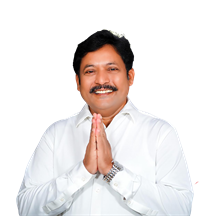
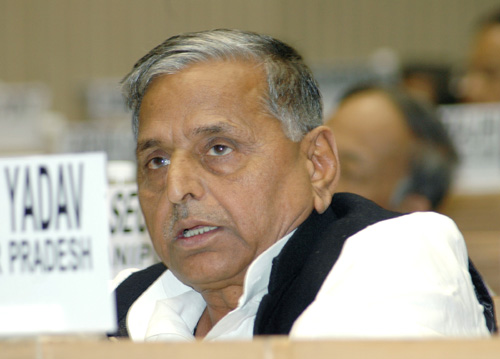
Mulayam Singh Yadav (22 November 1939 – 10 October 2022) was an Indian politician, schoolmaster, lecturer and a socialist figure and the founder of the Samajwadi Party. Over the course of his political career spanning more than six decades, he served for three terms as the Chief Minister of Uttar Pradesh, and also as the Union Minister of Defence in the Government of India. A long-time parliamentarian, he was a seven-time Member of Parliament representing Mainpuri, Azamgarh, Sambhal and Kannauj constituencies in the Lok Sabha, a ten-time member of the Legislative Assembly, member of the Legislative Council and the Leader of Opposition several times as well. Yadav was often referred to as Netaji by his party leaders and workers.[3][4] In 2023, he was posthumously conferred with Padma Vibhushan, India’s second highest civilian award by the Government of India.[5]
Early life and career
Mulayam Singh Yadav was born to Murti Devi and Sughar Singh Yadav on 22 November 1939 in Saifai village, United Provinces, British India (present-day Etawah district, Uttar Pradesh, India).[6][7] Akhilesh Yadav is his only son from his first marriage to Malti Devi.[8]
Yadav paternally belonged to Itoli village, Jasrana Block, Firozabad District, Uttar Pradesh, India.[9][10]
Yadav earned three degrees in political science — a B.A. from Karm Kshetra Post Graduate College in Etawah, a B.T. from A. K. College in Shikohabad, and an M.A. from B. R. College, Agra University.[6]
Teaching career
Before joining politics, Yadav was engaged in teaching profession. In 1963, he was a schoolmaster[11] at Jain Inter-College in Karhal, Mainpuri. In 1974, he was promoted to a lecturer after attaining his master's degree.[12][13]
Earlier political career
He started his career with student politics which he began at K.K. Degree College in Etawah, where he became the students’ union president, marking his entry into politics. Groomed by leaders such as Ram Manohar Lohia, Raj Narain, Anantram Jaiswal and Chandra Shekhar, Yadav was first elected as a Member of the Legislative Assembly in Legislative Assembly of Uttar Pradesh in 1967 from Jaswantnagar on a ticket of Samyukta Socialist Party (SSP), the party founded by Anantram Jaiswal and George Fernandes.[14] In 1975, during Indira Gandhi's imposition of the Emergency, Yadav was arrested and detained for 19 months.[15]
He first became a state minister in 1977. Later, in 1980, he became the president of the Lok Dal (People's Party) in Uttar Pradesh, which became a part of the Janata Dal (People's Party) afterwards. In 1982, he was elected leader of the opposition in the Uttar Pradesh Legislative Council and held that post until 1985. When the Lok Dal party split, Yadav launched the Krantikari Morcha party.[16]
Chief Minister
First term
Following the demolition of the Babri Masjid, Kanshi Ram and Mulayam Singh formed a coalition government in Uttar Pradesh in 1993, with the slogan “Mile Mulayam-Kanshi Ram, hawa mein ud gaye Jai Shri Ram” (When Mulayam & Kanshiram come together, Jai Shri Ram vanishes). [17] Yadav first became Chief Minister of Uttar Pradesh in 1989.[18]
In 1990, a large body of Sangh Parivar and Vishwa Hindu Parishad supporters reached Ayodhya and attempted to attack the 16th-century Babri mosque built on occupied land. They organised a march towards the mosque in an attempt to reclaim the land for a grand temple for Hindu god Rama. This resulted in a pitched battle with the paramilitary forces. Yadav allowed police to use live rounds in an attempt at crowd control. The state government's official records report that at least 17 marching religious volunteers, or kar sevaks were killed.[19][20][21][22][23][24] The BJP withdrew its support to the V. P. Singh ministry, necessitating fresh elections. The BJP substantially increased its tally in the union parliament, as well as winning a majority in the Uttar Pradesh assembly.[25]
After the collapse of the Union government led by V. P. Singh in November 1990, Yadav joined Chandra Shekhar's Janata Dal (Socialist) party and continued in office as chief minister with the support of the Indian National Congress (INC). His government fell when the INC withdrew its support in April 1991 in the aftermath of developments at the national level where it had earlier withdrawn its support for Chandra Shekhar's government. Mid-term elections to Uttar Pradesh assembly were held in mid-1991, in which Mulayam Singh's party lost power to the BJP.[26]
Second term
In 1992, Yadav founded his own Samajwadi Party (Socialist Party). In 1992, Hindu right wing mob was involved in the demolition of the Babri Mosque, which caused violence across India.[27] In 1993, he allied with the Bahujan Samaj Party for the elections to the Uttar Pradesh assembly due to be held in November 1993.[28] The alliance between Samajwadi Party and Bahujan Samaj Party prevented the return of BJP to power in the state.
In 1993, Yadav became the Chief minister of Uttar Pradesh for the second time.[27] Yadav became chief minister of Uttar Pradesh with the support of Congress and Janata Dal. His stand on the movement for demanding separate statehood for Uttarakhand was as controversial as his stand on the Ayodhya movement in 1990 was. There was a firing on Uttarakhand activists at Muzaffarnagar on 2 October 1994, something for which Uttarakhand activists held him responsible. He continued holding that post until his ally opted into another alliance in June 1995.[29]
Third term
In 2002, following a fluid post-election situation in Uttar Pradesh, the Bharatiya Janata Party and Bahujan Samaj Party joined to form a government under Dalit leader Mayawati, who was considered to be Yadav's greatest political rival in the state.[30] The BJP pulled out of the government on 25 August 2003, and enough rebel legislators of the Bahujan Samaj Party left to allow Yadav to become the Chief Minister, with the support of independents and small parties.[31] He was sworn in as chief minister of Uttar Pradesh for the third time in September 2003.[6][31]
Yadav was still a member of the Lok Sabha when he was sworn in as chief minister. In order to meet the constitutional requirement of becoming a member of state legislature within six months of being sworn in, he contested the assembly by-election from Gunnaur assembly seat in January 2004. Yadav won by a record margin of 1,83,899 votes, polling 90.45 per cent of the votes.[32]
Union Politics, Defence Minister and Member of Parliament
He was elected to the Uttar Pradesh Legislative Assembly ten times and to the Parliament of India, Lok Sabha seven times.[33]
1996 Lok Sabha election (Minister of Defence)
In 1996, Yadav was elected to the eleventh Lok Sabha from Mainpuri constituency.[6] In the United Front coalition government formed that year, his party joined and he was named India's Defence Minister in the Deve Gowda ministry. That government fell in 1998 as India went in for fresh elections, but he returned to the Lok Sabha that year from Sambhal parliamentary constituency.[34] After the fall of Atal Bihari Vajpayee union government in April 1999, he did not support the Congress party in the formation of the union government.[35]
1998, 1999 Lok Sabha election
He contested the Lok Sabha general elections of 1999 from two seats, Sambhal Lok Sabha constituency. Later following year 1999, he contested also in Kannauj Lok Sabha constituency, and won both seats. He resigned from the Kannauj seat for his son Akhilesh in the by-elections and retained Sambhal.[36][34]
2004 Lok Sabha election
With the hope of playing a major role at the centre, Yadav contested the 2004 Lok Sabha elections from Mainpuri while still Chief Minister of Uttar Pradesh. He won the seat and his Samajwadi Party won more seats in Uttar Pradesh than all other parties. However, the Congress party, which formed the coalition government at the centre after the elections, had the majority in the Lok Sabha with the support of the Communist parties.[37] As a result, Yadav could not play any significant role at the centre. Yadav resigned from the Lok Sabha and chose to continue as chief minister of Uttar Pradesh until the 2007 elections, when he lost to the BSP.[38]
2009 Lok Sabha election
2014 Lok Sabha election
He was elected in the 2014 Indian general election. He became an MP in the 16th Lok Sabha from Azamgarh and Mainpuri.[34] The competing party BJP did not field a strong candidate in the election from Mainpuri.[39] In June 2014 he resigned from Mainpuri seat and continued to represent Azamgarh in Parliament.[40]
In May 2017, two Indian soldiers were killed and their bodies were mutilated by Pakistan's Border Action Team. When Yadav, who had served as the Defence Minister in past, was asked by journalists to comment on the attacks, he responded by saying "Defence Minister (Arun Jaitley) is weak and coward can never take on enemies. I have one question for the union government and the minister concerned: why are you not able to muster courage to show the enemy their place." He also said that during his term as defence minister in the Deve Gowda ministry, he had ordered the Indian Army to cross into Pakistan in response to attacks.[41]
2019 Lok Sabha election
He was re-elected in the 2019 Indian general election from Mainpuri for a fifth time. This was his fourth consecutive victory from the same constituency.[42][34] He died in 2022, two years before the end of his term.[43]
Samajwadi Party
In 1992, Yadav founded his own Samajwadi Party (Socialist Party). Muslims make a sizeable minority in the Uttar Pradesh state. Samajwadi Party and Yadav emerged as the advocates for Muslims.[27]
Since Akhilesh Yadav became Chief Minister of Uttar Pradesh in 2012, surpassing Mulayam's brother Shivpal Singh Yadav, the Yadav family was divided into two feuding groups. One of the groups, led by Akhilesh, enjoyed the support of his father's cousin and National General Secretary Ram Gopal Yadav. The rival group was led by Mulayam Singh and supported by his brother and State Chief of Party, Shivpal Yadav, and a friend, former MP Amar Singh. Akhilesh had fired his uncle twice from his cabinet as it was seen by many as a direct challenge to his father, who has steadily supported Shivpal over Akhilesh.[44] On 30 December 2016, Mulayam Yadav expelled his son Akhilesh and his cousin Ram Gopal from the party for six years on the grounds of indiscipline, only to revoke the decision 24 hours later. Akhilesh, in response, stripped his father of the party presidency and instead named him the chief patron of the party following the national convention of the party on 1 January 2017. Mulayam termed the national convention illegal and directly expelled his cousin, Ram Gopal Yadav, who had convened the national executive convention. But the Election commission of India ruled that Ram Gopal Yadav had the right to convene that executive convention, and reversed Mulayam's order. Hence Akhilesh Yadav officially became the new national leader of the party.[45]
Positions held
Mulayam Singh Yadav had been elected 10 times as MLA and 7 times as Lok Sabha MP.[34][46][47][33]
# From To Position Party
1. 1967 1969 MLA (1st term) from Jaswantnagar in 4th Vidhan Sabha Samyukta Socialist Party
2. 1974 1977 MLA (2nd term) from Jaswantnagar Bharatiya Kranti Dal
3. 1977 1980 MLA (3rd term) from Jaswantnagar Bharatiya Lok Dal
4. 1982 1985 MLC (1st term) in Uttar Pradesh Legislative Council Lok Dal
5. 1985 1989 MLA (4th term) from Jaswantnagar Lok Dal
6. 1989 1991 * MLA (5th term) from Jaswantnagar
* Chief Minister (1st term) in Government of UP Janata Dal
7. 1991 1993 MLA (6th term) from Jaswantnagar, Nidhauli Kalan Assembly constituency and Tilhar (by-poll) Samajwadi Janata Party
8. 1993 1996 * MLA (7th term) from Jaswantnagar and Shikohabad
* Chief Minister (2nd term) in Government of UP (1993–1995) Samajwadi Party
9. 1996 1996 MLA (8th term) from Sahaswan (resigned in 1996) Samajwadi Party
10. 1996 1998 * MP (1st term) in 11th Lok Sabha from Mainpuri
* Minister of Defence in Government of India Samajwadi Party
11. 1998 1999 MP (2nd term) in 12th Lok Sabha from Sambhal Samajwadi Party
12. 1999 2004 MP (3rd term) in 13th Lok Sabha from Sambhal and Kannauj (resigned from Kannauj in 2000) Samajwadi Party
13. 2003 2007 * Chief Minister (3rd term) in Government of UP
* MLA (9th term) from Gunnaur by-poll (2004–2007) Samajwadi Party
14. 2004 2004 MP (4th term) in 14th Lok Sabha from Mainpuri (resigned in 2004) Samajwadi Party
15. 2007 2009 MLA (10th term) from Gunnaur and Bharthana (resigned in 2009) Samajwadi Party
16. 2009 2014 MP (5th term) in 15th Lok Sabha from Mainpuri Samajwadi Party
17. 2014 2019 MP (6th term) in 16th Lok Sabha from Azamgarh and Mainpuri (resigned from Mainpuri in 2014) Samajwadi Party
18. 2019 2022 MP (7th term) in 17th Lok Sabha from Mainpuri (died in 2022) Samajwadi Party
Election Contested
Uttar Pradesh Legislative Assembly Elections
Year Constituency Party Votes % Opponent Opponent Party Opponent Votes % Result Margin %
1967 Jaswantnagar SSP 21,990 39.65 J.S. Lal RPI 10,196 18.39 Won 11,794 21.26
1969 19,282 Bishambhar Singh Yadav INC 24,559 Lost -5,277
1974 BKD 31,587 42.87 Vishambhar Singh Yadav 17,329 23.52 Won 14,258 19.35
1977 JP 41,985 64.26 Gorey Lal Shakya IND 15,523 23.76 Won 26,462 40.50
1980 JP(S) 36,695 42.29 Balram Singh Yadav INC(I) 44,306 51.06 Lost -7,611 -8.77
1985 LKD 49,390 57.32 Shivraj Singh Yadav INC 23,916 27.75 Won 25,474 29.57
1989 JD 65,597 59.26 Darshan Singh 39,160 35.38 Won 26,437 23.88
1991 SJP 47,765 45.96 Darshan Singh 30,601 29.44 Won 17,164 16.52
1993 SP 60,242 46.88 Darshan Singh Yadav 59,081 45.98 Won 1,161 0.90
Shikohabad 55,249 42.43 Ashok Yadav 39,558 30.38 Won 15,691 12.05
Nidhauli Kalan Assembly constituency 41,683 38.77 Sudhakar Verma BJP 34,620 32.20 Won 7,063 6.57
1996 Sahaswan 81,370 61.92 Mahesh Chand 27,211 20.71 Won 54,159 41.21
2007 Gunnaur 54,696 60.54 Arif Ali BSP 23,049 25.52 Won 31,647 35.02
Bharthana 62,799 48.22 Shiv Prasad Yadav 53,328 40.94 Won 9,471 7.28
Lok Sabha
Year Constituency Party Votes % Opponent Opponent Party Opponent Votes % Result Margin %
1996 Mainpuri SP 273,303 42.77 Updesh Singh Chauhan BJP 221,345 34.64 Won 51,958 8.13
1998 Sambhal 376,828 50.04 Dharampal Yadav 210,146 27.90 Won 166,682 22.14
1999 259.430 41.85 Ch. Bhupendra Singh 143,596 23.17 Won 115,834 18.68
Kannauj 291,617 42.63 Arvind Pratap Singh ABLTC 212,478 31.06 Won 79,139 11.57
2004 Mainpuri 460,470 63.44 Ashok Shakya BSP 122,600 17.03 Won 337,870 46.93
2009 392,308 56.44 Vinay Shakya 219,239 31.54 Won 173,069 24.90
2014 595,918 59.63 Shatrughan Singh Chauhan BJP 231,252 23.14 Won 364,666 36.49
Azamgarh 340,306 35.43 Ramakant Yadav 277,102 28.85 Won 63,204 6.58
2019 Mainpuri 524,926 53.75 Prem Singh Shakya 430,537 44.09 Won 94,389 9.66
Political positions
Socialism
He followed Socialism. In the 1980s the Union Government of India had appointed Mandal Commission, a federal commission to identify the "socially backward classes" in India. The appointment led to protests across the country. During these protests Yadav defended the demands of the backward castes and religious minorities. Through these protests Yadav emerged as a socialist leader.[48]
Support for a sovereign independent Tibet
Yadav said it is necessary for India to support a sovereign and independent Tibet. He said that a past government had made a "big mistake" on the issue and noted that he had spoken against it at the time.[49] He believed that Tibet was a traditional buffer between China and India[50] and that India should support the Dalai Lama and Tibetan independence.[51] Claiming that China had secreted nuclear weapons in Pakistan, he cautioned that "China is our enemy, not Pakistan. Pakistan can do us no damage".[52]
Controversies
Comment on rape
The crime of rape became a capital offence in India following the 2012 Delhi gang rape incident; Yadav had opposed changing this law. Following the trial in the Shakti Mills gang rape, on 10 April 2014, in an election rally, Yadav said, "When boys and girls have differences, the girl gives a statement that 'the boy raped me,' and that poor boy gets a death sentence."[53] Referring to the Mumbai gang rape he stated, "... later they had differences, and the girl went and gave a statement that I have been raped. And then the poor fellows, three of them have been sentenced to death. Should rape cases lead to hanging? Boys are boys, they make mistakes. Two or three have been given the death sentence in Mumbai."[54] His statements led to complaints being filed against Yadav with the Election Commission and the National Commission for Women (NCW).[54] His comments were denounced by the Indian media,[53] women's groups, women's rights activists,[55][56] public prosecutor in the Shakti Mills gang rape case Ujjwal Nikam,[57] Bollywood celebrities, and politicians like Narendra Modi and Raj Thackeray.[58][59]
"Ladke, ladke hain. Galti ho jati hai" he said while campaigning in Moradabad during the 2014 general elections, Yadav opposed the death penalty for rape convicts, suggesting it was an "unfair" law that should be amended. "Handing death sentence for rape is not fair... boys make mistakes... there will be changes in the law if we come to power,'" he reportedly said, external at an election rally in Uttar Pradesh.[60] Newspapers and websites are criticising Mr Yadav for his "insensitive and unfortunate" comment, which came on a day India was voting in the third phase of the general election. "Mulayam Singh Yadav sinks to a new low, defends rapists to woo voters," says The Times of India.[61] "Even by his misogynistic standards, he seems to have sunk to a new low… The change in the laws was brought on after months of selfless demonstration by citizens striving to bring about a change in India's social outlook, by terming rape as 'just another mistake boys make, Mulayam has just rendered a slap in the face of their efforts" the website says.
While distributing free e-rickshaws at a government event in Lucknow, Yadav attempted to defend the law-and-order situation in Uttar Pradesh by disputing the reporting of gang rape cases. He says "It is practically impossible for four people to commit a rape." Yadav claimed that while a crime is committed by a single individual, the names of three or four others are falsely included in the complaint. He further alleged that incidents of rape were being utilized as part of a "smear campaign" aimed at tarnishing the image of the Uttar Pradesh administration. As a result of this statement—and following widespread outrage among activists and across the political spectrum— a Judicial Magistrate in Lucknow issued a summons against him in 2015. [62][63]
In response to 2014 Badaun gang rape and Yadav's comments, UN Secretary-General Ban Ki-moon said "We say no to the dismissive, destructive attitude of, 'Boys will be boys'".[64] On 19 August 2015, Yadav remarked that gang-rapes are impractical and rape-victims in those cases tend to lie.[65] He was summoned by the Judicial Magistrate of Mahoba district court in Uttar Pradesh for that remark.[66] As a result of these statements, several media outlets described Yadav and the Samajwadi Party as "Defenders of Rape."[67]
Phone Threat case
On 10 July 2015, ex Indian Police Service officer and President Adhikar Sena, Amitabh Thakur allegedly got a phone call from Yadav. Thakur alleged that Yadav had threatened him over the phone call. He released the audio of the phone call, in which Yadav is allegedly heard saying certain sentences, which Thakur called as being threatening in nature. Thakur alleged that Mulayam Singh was unhappy about the complaint lodged by his wife activist and advocate Nutan Thakur against the then state mining minister Gayatri Prasad Prajapati.[68][69][70][71]
On 11 July 2015, Thakur presented a complaint before Hazratganj police station for registration of FIR against Yadav as regards the alleged phone threat, which the Police refused to register. On the contrary, in the same night of 11 July, a rape case was registered against Thakur by the Lucknow police at Gomtinagar police station, which raised political storm. Later FIR was registered in this case on Court intervention, which the Police closed but Thakur went on pursuing it before Court. The matter remained inconclusive till the end.[72][73][74]
During Thakur's tenure as the Superintendent of Police of Ferozabad in 2006, he refused to obey some of the wrongful dictates of then MLA Ramveer Singh Yadav, who was a close aid of Yadav. The refusal led to an incidence of alleged assault and manhandling with Thakur. Despite Mulayam's orders, Thakur got a First Information Report (FIR) registered in this matter at Eka police station. This led to Thakur extensively suffering at the hands of Mulayam Singh Government.[75][76]
Support for Criminals
In 2004, Deputy Superintendent of Police Shailendra Singh arrested Samajwadi Party leader and alleged gangster Mukhtar Ansari and booked him under the Prevention of Terrorism Act, 2002 in connection with an alleged attempt to procure a light machine gun. According to Singh, after the arrest, he and his senior officers came under pressure from the state government, then headed by Yadav as the Chief Minister of Uttar Pradesh. Singh later resigned from service, alleging political pressure.[77]
Remarks on the Women’s Reservation Bill
In March 2010, during a debate on the Women’s Reservation Bill, which proposed 33% reservation for women in legislative bodies, Yadav opposed the measure and stated that “if the bill is passed it will fill Parliament with the kind of women who invite catcalls and whistles”.[78] The remarks were criticised by leaders across several parties and described as sexist in media reports and by some of his own party colleagues.[79] Following the comments, Samajwadi Party leaders Amar Singh and Jaya Prada urged the National Commission for Women to take action.[80]
Personal life and death
Yadav was married twice. His first wife, Malti Devi, was in a vegetative state from 1974 until her death in May 2003 following complications while giving birth to their only child, Akhilesh Yadav. Akhilesh was Chief Minister of Uttar Pradesh from 2012 to 2017.[8][81]
Mulayam had a relationship with Sadhana Gupta while still married to Malti Devi in the 1990s.[82][83] Gupta was not well known until February 2007, when the relationship was admitted in India's Supreme Court.[84] Sadhana Gupta had a son named Prateek Yadav who died on 13 May 2026 due to lung disease. Sadhana Gupta died in July 2022 after a brief illness