

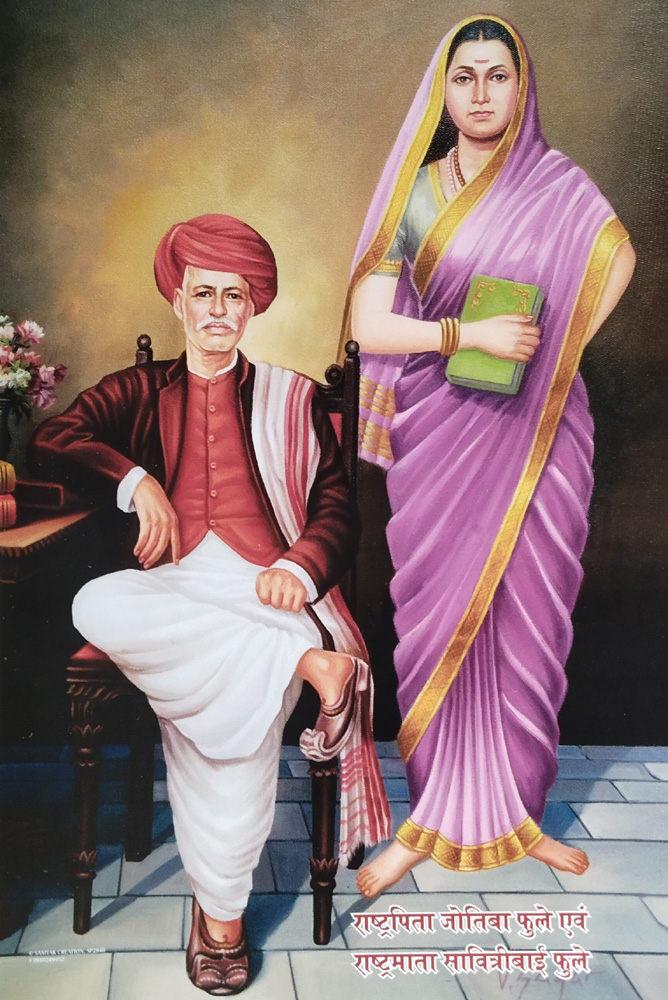
Mahatma Jyotirao Govindrao Phule was one of India's greatest social reformers, thinkers, and activists of the 19th century. Born into the Mali (gardener) community — classified as a "backward caste" — he experienced caste discrimination firsthand and dedicated his entire life to fighting social injustice, untouchability, and the oppression of women and lower castes under the Brahminical social order.
Phule was the first person in India to open a school for girls (1848) and for lower-caste children. He founded the Satyashodhak Samaj (Society of Seekers of Truth) in 1873 to promote rational thinking, reject the authority of priests, and unite the oppressed Shudras and Ati-Shudras. He was posthumously conferred the title "Mahatma" (Great Soul) in 1888, decades before Mohandas Gandhi received the same title.
His wife, Savitribai Phule, was equally a legend — the first female teacher in India — and together they transformed education for women and marginalized communities. Phule's work laid the ideological foundation for the Bahujan movement and greatly influenced Dr. B.R. Ambedkar, who called him one of his three Gurus.
Jyotirao Govindrao Phule was born on 11 April 1827 in Katgun village, Satara district, Maharashtra (then part of the Bombay Presidency under British India). His family belonged to the Mali (florist/gardener) community, which was classified under the Shudra varna and considered a socially backward caste by the prevailing Hindu caste system.
His mother, Chimna Bai, passed away when Jyotirao was barely nine months old. He was raised by his father, Govindrao, a vegetable vendor. Despite financial difficulties, Govindrao recognized his son's sharp intellect and enrolled him in school — a rare opportunity for a child of their community at the time.
As a child, Jyotirao witnessed the daily humiliation and segregation that people of lower castes endured. They were denied access to wells, temples, and educational institutions. These early experiences of injustice planted the seeds of his lifelong mission for social equality.
Phule attended a Scottish Mission School in Pune and received a modern, Western-style education. He was an outstanding student, well-read in both Marathi and English. However, his schooling was briefly interrupted when upper-caste neighbors pressured his father to pull him out of school, considering it inappropriate for a lower-caste boy to receive formal education.
A defining turning point came in 1848. Phule was invited to a friend's wedding procession. The groom was a Brahmin, and upon discovering that Phule — a Shudra — was walking in the procession, the groom's family publicly humiliated and expelled him. This deeply personal insult ignited his revolutionary consciousness.
Inspired by the writings of American abolitionist Thomas Paine (Rights of Man) and by the education movements in the West, Phule resolved to dedicate himself to eradicating caste discrimination and creating a just, equal society through education, reason, and organized social action.
In 1848 — the same year he was humiliated at the wedding — Jyotirao Phule opened the first school for girls in India at Bhide Wada, Pune. He was just 21 years old. This was a revolutionary act at a time when educating women was considered taboo, particularly for women of lower castes.
He trained his wife, Savitribai Phule, to be the teacher — making her India's first female teacher. Savitribai faced fierce opposition. She was pelted with stones, cow dung, and verbal abuse on her way to school every day. She would carry a spare sari to change into, and still showed up to teach. Jyotirao stood firmly behind her.
By 1851, Phule had established three more schools for girls from various castes. In 1852, he opened the first school specifically for children of "untouchable" (Mahar and Mang) communities — a direct challenge to the caste order that denied them all education.
On 24 September 1873, Phule founded the Satyashodhak Samaj (Society of Seekers of Truth) in Pune. This was one of the most important social reform organizations in Indian history. Its founding members included people from all castes, including some Brahmins and Muslims, and also British officers who admired Phule's mission.
The Satyashodhak Samaj had a clear mission: to liberate the Shudras and Ati-Shudras (Dalits) from Brahmin domination, to reject the authority of priests and religious texts that justified caste hierarchy, and to establish a society based on reason, equality, and brotherhood.
Phule rejected the Vedic authority and the idea that Brahmins were divinely ordained rulers of society. He argued that the caste system was a man-made oppressive system, not a divine order. He promoted the idea that all human beings are equal children of one God — whom he called Nirmik (the Creator).
In 1873, the same year he founded Satyashodhak Samaj, Phule published his landmark book Gulamgiri (Slavery). He dedicated this book to the American people who had just fought and won a civil war to abolish Black slavery, drawing a direct parallel between the slavery of African Americans and the caste slavery of India's Shudras and Ati-Shudras.
In Gulamgiri, Phule argued that the caste system was a system of slavery more insidious than American Black slavery because it was enforced not by chains but by religion, texts, and a deeply internalized social order. He attacked the Brahminical interpretation of Hindu scriptures that justified the subjugation of lower castes.
The book was groundbreaking because it was the first Indian text to compare caste oppression to racial slavery, and to call for a total dismantling of the Brahminical social order. It became a foundational text for anti-caste movements in India.
From Gulamgiri: "All human beings are children of one God and no one has been made superior or inferior by birth. Caste is not divine — it is a human invention to oppress and exploit."
— Mahatma Jyotirao Phule, Gulamgiri (1873)Phule was far ahead of his time in advocating for women's rights. He believed that the oppression of lower castes and the oppression of women were two sides of the same coin — both rooted in Brahminical patriarchy and the caste system. He fought for:
Phule's establishment of the Balhatya Pratibandhak Griha (Home for Prevention of Infanticide) in 1863 was particularly remarkable. Brahmin widows who became pregnant faced social death and often killed their babies. Phule and Savitribai opened their home to such women, ensuring safe births and fighting the stigma. They even adopted one such child, naming him Yashwantrao.
In his later years, Phule turned his attention to the plight of farmers (Shudra cultivators) who were being exploited by landlords, moneylenders, and the colonial British revenue system. In 1883, he published Shetkaryaca Asud (The Cultivator's Whipcord / The Peasant's Lament) — a devastating critique of the triple exploitation of farmers by colonial British policies, Brahmin revenue officials, and upper-caste moneylenders.
He argued that the Shudra farmers who fed the entire nation were the most exploited class, yet received the least benefit from the social and economic order. He called for:
Phule's agrarian writings anticipated many of the issues that would later drive Indian peasant movements in the 20th century. He was the first to systematically analyze the link between caste oppression and economic exploitation of farmers.
Beyond writing and organizing, Phule engaged in direct social welfare activities that transformed lives in Pune and across Maharashtra:
Phule was also one of the first people in India to establish night schools — recognizing that working-class children and adults could only attend school after their work was done.
Phule was a prolific writer and thinker. His philosophical worldview was rooted in rationalism, humanism, and a radical critique of the Brahminical Hindu social order. He drew inspiration from Thomas Paine, American abolitionism, and his own observations of colonial society.
Key philosophical positions:
Major Works:
One of Phule's most enduring contributions to Indian political thought is the concept of the "Bahujan" — literally "the many people" or "the majority." He used this term to describe the vast majority of India's population — the Shudras (backward castes), Ati-Shudras (Dalits), women, farmers, and artisans — who were systematically oppressed and exploited by the ruling minority of Brahmin and upper-caste elites.
Phule argued that this Bahujan majority — though they constituted 80-85% of the population — had no political power, no access to education, no legal rights, and no social dignity because the entire social, religious, and legal system was designed by and for the upper-caste minority.
This concept directly influenced:
"The Shudras — who are the creators of all wealth in this country — have no political power, no access to education, no justice from courts. This is the real slavery of India."
— Mahatma Jyotirao PhuleIn 1888, Vitthalrao Krishnaji Vandekar conferred the title of "Mahatma" (Great Soul) on Jyotirao Phule at a public ceremony in Mumbai — making Phule one of the first persons in modern Indian history to be given this honorific by the people for selfless social service. (Decades later, the same title would be given to Mohandas Gandhi.)
During his lifetime, Phule received recognition and support from:
However, Phule also faced fierce opposition from upper-caste Brahmin organizations, conservative Hindu groups, and even some members of his own community who feared social backlash. He was subjected to social boycotts and verbal attacks, but never wavered from his mission.
In 1888, Phule suffered a severe stroke (paralysis) that left him partially incapacitated. Despite being confined to bed or a wheelchair for the last two years of his life, he continued to dictate writings, organize Satyashodhak Samaj, and guide the movement he had built over four decades.
He completed his final and most important philosophical work, Sarvajanik Satya Dharma Pustak (Universal Book of True Religion), in 1889 — a year before his death — while partially paralyzed. This was an extraordinary display of intellectual commitment and willpower.
Mahatma Jyotirao Phule passed away on 28 November 1890 in Pune, Maharashtra, at the age of 63. His wife Savitribai continued his work after his death and died in 1897 while nursing plague patients.
He left behind a movement, a philosophy, and a body of writing that would continue to inspire generations of social reformers, Dalit leaders, backward-caste movements, and women's rights activists across India.
Mahatma Jyotirao Phule's legacy is immense and continues to shape India's political, social, and educational discourse:
"Without education, wisdom is lost; without wisdom, morality is lost; without morality, development is lost; without development, wealth is lost; without wealth, the Shudras are ruined."
— Mahatma Jyotirao PhuleMahatma Jyotirao Phule remains one of the greatest social reformers India has produced. In an age when caste was considered natural and divine, he stood alone and declared it human, unjust, and destroyable. He is rightly remembered as the father of the Bahujan movement, the pioneer of women's education, and the first great theorist of social justice in modern India.