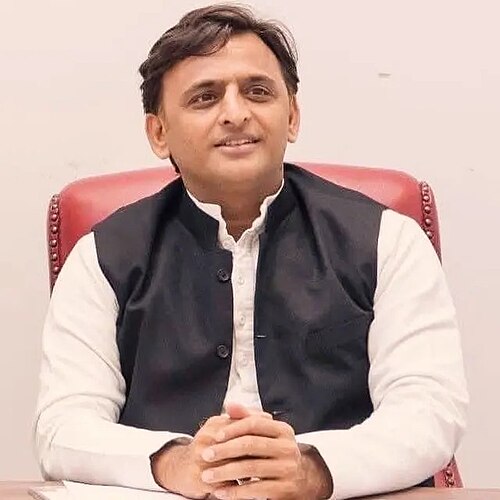
Akhilesh Yadav
Ministers
📍 Uttar Pradesh
SP
🗓️ 2012–2017
Chief Minister (1st term) in Government of UP (2012–2017)
Akhilesh Yadav (born 1 July 1973)[1] is an Indian politician and national president of the Samajwadi Party, who served as the 20th Chief Minister of Uttar Pradesh from 2012 to 2017.[2] Having assumed the chief minister's office at the age of 38, he is the youngest person to have held the office till date.[3] He is the incumbent Member of Parliament for Kannauj in the 18th Lok Sabha, where he is the parliamentary party leader of Samajwadi Party.[4] Earlier, he was elected as the Member of the Legislative Assembly for Karhal in the 18th Vidhan Sabha,[5][6] before resigning[7] and has also been the Leader of Opposition in the Uttar Pradesh Legislative Assembly from March 2022 to June 2024.
His first significant success in politics was being elected as the Member of the 13th Lok Sabha in the year 2000 (by-poll) for the Kannauj constituency. He is the son of Mulayam Singh Yadav, a veteran Indian politician and the founder of Samajwadi Party who served as Minister of Defence, Government of India and served three terms as the Chief Minister of Uttar Pradesh.
Early life and education
Yadav was born on 1 July 1973 in Saifai, Etawah District, Uttar Pradesh. He was born to Malti Devi and Mulayam Singh Yadav, later Chief minister of Uttar Pradesh.[8] Malti Devi suffered complications while giving birth to Akhilesh which put her in a vegetative state. She died in 2003. With Mulayam Singh Yadav busy making a career in politics, Akhilesh was brought up mostly by his paternal grandparents.
He completed his early education in a local school in Saifai and then one in Etawah town.[9] He was schooled at Dholpur Military School in Dholpur, Rajasthan, then obtained his bachelor's degree in Civil Engineering at the University of Mysore, Karnataka, India.[10]
Political career
Yadav was elected to the 13th Lok Sabha from Kannauj in a by-election in 2000.[11] He was also a member of the Committee on Food, Civil Supplies, and Public Distribution.[12][13] Yadav served as a Member of the Committee on Ethics from 2000 to 2001[14] and in 2004 was elected as a member of the 14th Lok Sabha for a second term. He was at times a member of the following committees: Committee on Urban Development, Committee on Provision of Computers for various departments, Committee on Science and Technology, and Committee on Environment and Forests.
From 2009 to 2012 Yadav was elected and served as a member of the 15th Lok Sabha for a second term. During this period he was a member of the following committees: Member of the Committee on Environment and Forests, Committee on Science and Technology, and the JPC on the 2G spectrum case. On 10 March 2012 he was appointed leader of the Samajwadi Party in Uttar Pradesh. On 15 March 2012, at the age of 38, he became the Chief Minister of Uttar Pradesh, the youngest to hold the office.[15]
In May 2012 Yadav resigned from the Kannauj parliamentary seat to further serve as the Chief Minister of Uttar Pradesh after his party won the Assembly elections.[16] In the same month he became Member of the Uttar Pradesh Legislative council.[17] In the 2017 Assembly elections, the SP-Congress Alliance headed by Yadav was unable to form the government. He submitted his resignation to Governor Ram Naik on 11 March.[18]
The 2019 Indian general elections and 2022 Uttar Pradesh Legislative Assembly elections saw Yadav being elected to the parliament and state assembly simultaneously, with Yadav later retaining his state assembly seat, and thereby submitting his resignation in the Lok Sabha.[19]
In the 2024 Indian general election Yadav was elected to the 18th Lok Sabha from Kannauj.[6]
Chief Minister of Uttar Pradesh
Akhilesh with Tamil Nadu Chief Minister Jayalalithaa in April 2012
Yadav was sworn in as the 20th Chief Minister of Uttar Pradesh on 15 March 2012, aged 38, winning 224 seats in the March 2012 assembly elections.[15] During his tenure, the Agra-Lucknow Expressway, thelongest expressway in India at that time, was inaugurated.[20][21][22] Yadav also launched the "UP100 Police Service",[23] "Women Power Line 1090"[24] and "108 Ambulance Service".[25] Projects like the Lucknow Metro Rail,[26] Lucknow International Ekana Cricket Stadium,[27] Janeshwar Mishra Park (Asia's largest park),[28] Jayaprakash Narayan International Convection Center, IT city were inaugurated.[29] His chief ministerial tenure saw emphasis on setting up Kisan Bazaars and Mandis, introducing social welfare schemes such as Lohiya Awas Yojana, Kanya Vidya Dhan, Kisan Avam Sarvhit Bima Yojana, Pension Yojna and allotting unemployment allowances.[30][29] Between 2012 and 2015, over 15 Lakh laptops were distributed to the 10th and 12th passout students by the Government of Uttar Pradesh, making it one of the largest distribution schemes by any government in the world.[31]
Positions held
Akhilesh Yadav has been elected 1 time as MLA and 5 times as Lok Sabha MP.[32]
# From To Position Party
1. 2000 2004 MP (1st term) in 13th Lok Sabha from Kannauj (by-poll)
SP
2. 2004 2009 MP (2nd term) in 14th Lok Sabha from Kannauj
SP
3. 2009 2012 MP (3rd term) in 15th Lok Sabha from Kannauj (resigned in 2012) and Firozabad (resigned in 2009) SP
4. 2012 2018 MLC (1st term) in Uttar Pradesh Legislative Council
Chief Minister (1st term) in Government of UP (2012–2017) SP
5. 2019 2022 MP (4th term) in 17th Lok Sabha from Azamgarh (resigned in 2022) SP
6. 2022 12 June 2024[33]
MLA (1st term) from Karhal
Leader of the Opposition of Uttar Pradesh Legislative Assembly
SP
7. 2024[34]
Present Member of the 18th Lok Sabha (5th time) from Kannauj
SP
Election history
This section of a biography of a living person does not include any references or sources. Please help by adding reliable sources. Contentious material about living persons that is unsourced or poorly sourced must be removed immediately, especially if potentially libelous or harmful. (September 2025) (Learn how and when to remove this message)
Lok Sabha
Year Constituency Party Votes % Opponent Opponent party Opponent votes % Result Margin %
2000* Kannauj
SP
3,06,054 43.1 Akbar Ahmad Dumpy BSP
2,47,329 34.8 Won 58,725 8.3
2004
4,64,367 61.21 Thakur Rajesh Singh 1,56,994 20.69 Won 3,07,373 40.52
2009
3,56,895 48.1 Mahesh Chandra Verma 1,91,887 25.86 Won 1,65,008 22.24
Firozabad
2,87,011 41.9 S. P. Singh Baghel 2,19,710 32.1 Won 67,301 9.8
2019
Azamgarh
6,21,578 60.04 Dinesh Lal Yadav 'Nirahua' BJP
3,61,704 35.1 Won 2,59,874 24.94
2024
Kannauj
6,42,292 52.74 Subrat Pathak 4,71,370 38.71 Won 1,70,922 14.03
• (*) denotes by-election
Member of Legislative Assembly (Uttar Pradesh)
Year Constituency Party Votes % Opponent Opponent party Opponent votes % Result Margin %
2022
Karhal
SP
148,196 60.12 Prof. S.P. Singh Baghel BJP
80,692 32.74 Won 67,504 27.38
Personal life
See also: Political families of Uttar Pradesh
Akhilesh Yadav is married to Dimple Yadav, a Member of Parliament. The couple has three children; two daughters: Aditi and Tina, and a son, Arjun. Akhilesh is a civil engineer, agriculturist, and socio-political worker. He has a keen interest in sports, mainly football and cricket. His favourite pastimes are reading, listening to music, and watching films.[35]
Since Yadav became chief minister, his family was divided into two feuding groups, one siding with him and the other with his uncle Shivpal Singh Yadav. Akhilesh had the support of his father's cousin, Ram Gopal Yadav, while Shivpal later founded his own political party, the Pragatisheel Samajwadi Party (Lohia), which ahead of 2022 elections again merged with Samajwadi Party, with Shivpal being elected as an MLA on a Samajwadi Party ticket.
Member of Parliament, Lok Sabha
Incumbent
Assumed office
4 June 2024
Preceded by Subrat Pathak
Constituency Kannauj, Uttar Pradesh
In office
30 May 2019 – 22 March 2022
Preceded by Mulayam Singh Yadav
Succeeded by Dinesh Lal Yadav
Constituency Azamgarh, Uttar Pradesh
In office
25 February 2000 – 2 May 2012
Preceded by Mulayam Singh Yadav
Succeeded by Dimple Yadav
Constituency Kannauj, Uttar Pradesh
Leader of Samajwadi Party in Lok Sabha
Incumbent
Assumed office
9 June 2024
Deputy Babu Singh Kushwaha
Preceded by S. T. Hasan
2nd President of the Samajwadi Party
Incumbent
Assumed office
1 January 2017
Guidance Leader Mulayam Singh Yadav (till October 2022)
Preceded by Mulayam Singh Yadav
32nd Leader of the Opposition in Uttar Pradesh Legislative Assembly
In office
26 March 2022 – 11 June 2024
Chief Minister Yogi Adityanath
Preceded by Ram Govind Chaudhary
Succeeded by Mata Prasad Pandey
Member of Uttar Pradesh Legislative Assembly
In office
10 March 2022 – 11 June 2024
Preceded by Sobaran Singh Yadav
Succeeded by Tej Pratap Singh Yadav
Constituency Karhal
20th Chief Minister of Uttar Pradesh
In office
15 March 2012 – 19 March 2017
Governor Aziz Qureshi
Ram Naik
Ministry & Departments • Home and Confidential
• Appointment and Personnel
• Finance
• Energy
• Excise
• Higher Education
• Secondary Education
• Housing
• Sugar & Cane Development
• Industrial Development
• General Administration
• Other departments not allocated to a Minister.
Preceded by Kumari Mayawati
Succeeded by Yogi Adityanath
Member of Uttar Pradesh Legislative Council
In office
6 May 2012 – 5 May 2018
Preceded by Kashinath Yadav
Succeeded by Vijay Bahadur Pathak
Constituency Elected by the MLAs
Personal details
Born 1 July 1973 (age 53)
Saifai, Uttar Pradesh, India
Party
Samajwadi Party
Spouse Dimple Rawat
(m. 1999)
Relations Shivpal Singh Yadav (uncle)
Children 3
Parent • Mulayam Singh Yadav (father)
Education University of Mysore (B.E.)
Profession • Politician
• civil engineer
C. N. Annadurai
Ministers
📍 1st Chief Minister of Tamil Nadu
DMK
🗓️ 14 January 1969 – 3 February 1969
1st Chief Minister of Tamil Nadu
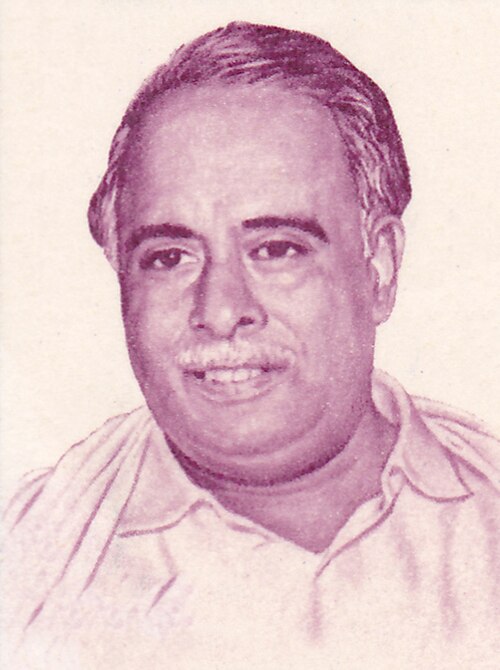
Conjeevaram Natarajan Annadurai (15 September 1909 – 3 February 1969), also known as Perarignar Anna, was an Indian politician who was the founder and first general-secretary of the Dravida Munnetra Kazhagam (DMK). He served as the fourth and last chief minister of Madras State from 1967 until 1969, and then as the first chief minister of Tamil Nadu for 20 days before his death in office. He was the first member of a Dravidian party to hold either post.
He was well known for his oratorical skills and was an acclaimed writer in the Tamil language. He scripted and acted in several plays. Some of his plays were later made into movies. He was the first politician from the Dravidian parties to use Tamil cinema extensively for political propaganda. Born in a middle-class family, he first worked as a school teacher, then moved into the political scene of the Madras Presidency as a journalist. He edited several political journals and enrolled as a member of the Dravidar Kazhagam. As an ardent follower of Periyar, he rose in stature as a prominent member of the party.[2][3][4]
Due to differences looming with Periyar, on issues of separate independent state of Dravida Nadu and union with India, he crossed swords with his political mentor. The friction between the two finally erupted when Periyar married Maniammai, who was much younger than him. Angered by this action of Periyar, Annadurai with his supporters parted from Dravidar Kazhagam and launched his own party, Dravida Munnetra Kazhagam (DMK).[citation needed] The DMK initially followed the same ideologies as its parent, Dravidar Kazhagam. But with the evolution of national politics and the constitution of India after the Sino-Indian War in 1962, Annadurai dropped the claim for an independent Dravida Nadu. Various protests against the ruling Congress government took him to prison on several occasions; the last of which was during the Madras anti-Hindi agitation of 1965. The agitation itself helped Annadurai to gain popular support for his party. His party won a landslide victory in the 1967 state elections. His cabinet was the youngest at that time in India. He legalised Self-Respect marriages, enforced a two-language policy (in preference to the three-language formula in other southern states), implemented subsidies for rice, and renamed Madras State to Tamil Nadu.
However, he died of cancer just two years into office. His funeral had the highest attendance of any to that date. Several institutions and organisations are named after him. A splinter party launched by M. G. Ramachandran in 1972 was named after him as All India Anna Dravida Munnetra Kazhagam.
Early life
Annadurai was born in a Tamil Sengunthar family[5] on 15 September 1909 in Conjeevaram, Madras Presidency, in a lower-middle-class family. His father Natarajan Mudaliar[6] was a weaver and his mother was Bangaru Ammal, a temple servant.[7] He was raised by his sister Rajamani Ammal.
Annadurai with his wife
At the age of 21, he married Rani while he was still a student. The couple had no children of their own, so they later adopted and raised Rajamani's grandchildren. He attended Pachaiyappa's High School,[8] but left school to work as a clerk in the town's Municipal office to assist with the family finances.
In 1934, he graduated with a B.A. degree from Pachaiyappa's College in Madras.[8] He then earned an MA degree in economics and politics from the same college. He worked as an English teacher[9] in Pachaiyappa High School. Later he quit the teaching job and began involving himself in journalism and he served as an editor in few weekly magazine and then he indulged into politics.
Annadurai in younger times
Religion
Though Annadurai was an atheist in his personal life as he took oath as the Chief Minister of the state in the 'name of conscience' rather than in the 'name of god', he proclaimed as "Only one race, Only one God" (Ondre Kulam Oruvanae Devan) from the Tamil work Tirumantiram penned by Tirumular in order to unify the people of Tamil Nadu.[10][11] Though secular to the core, he later described himself as a Hindu sans the sacred ash, a Christian minus the holy cross, and a Muslim without the prayer cap.[12]
Annadurai stated he would attack superstitions and religious exploitation but would never fight against the spiritual values of society. He once explained his stance towards God and religion as "I do not break coconuts for Pillaiyar, (a form of worship) neither do I break his idols." (Nan Thengayum udaipathillai; Pillaiyarum Udaipathillai)[13]
Political career
Entry into politics
Annadurai and Periyar
See also: Justice party (India) and Dravidar Kazhagam
Annadurai's interest in politics made him join the Justice party in 1935.[14] The Justice party was formed by non-Brahmin elites in 1916.[15] The Justice party originated with the Madras United League which was initially started as a work group that helped non-Brahmin students in Madras with accommodation and later grew into a political party under the efforts of leaders like C. Natesa Mudaliar, P. Theagaraya Chetty and T. M. Nair. The party was named South Indian Liberal Federation (S. I. L. F.) – popularly known as Justice party.[15] The party had been in power in Madras Presidency since self-governance was introduced in 1920, until it was defeated by the Indian National Congress in 1937.[16] By the time Annadurai joined the Justice party, Periyar was the party president. Annadurai served as the sub-editor of the Justice magazine. He later became the editor for Viduthalai (Freedom in English) and was also associated with the Tamil weekly paper, Kudi Arasu. He started his own journal Dravida Nadu (named after the Dravida Nadu – an independent state that the party called for). In 1944, Periyar renamed the Justice party to Dravidar Kazhagam and gave up contesting in the elections.[17]
Differences with Periyar and birth of DMK
See also: Indian independence movement and Dravida Munnetra Kazhagam
The Indian National Congress, which had been fighting for the independence of India from colonial British rule, was dominated by Brahmins. Periyar assumed that independent India would bring South Indians, especially Tamils, under the dominance of Brahmins and North Indians.[18] For these reasons Periyar called for 15 August 1947, the day of Indian independence, to be a day of mourning.[19] Annadurai opposed this move and the schism between his supporters and Periyar widened.[18] He saw the gaining of independence as an overall achievement of India rather than solely that of Aryan North.[14] Moreover, Periyar's decision on giving up participating in democratic elections was also opposed by Annadurai, in reaction to which he walked out of a party meeting in 1948.[14] Periyar considered that candidates in elections must compromise their ideologies. Moreover, it was Periyar's idea that social reformation can be better achieved outside politics, through education and canvassing the masses, rather than governments.[20] Eventually, when Periyar married Maniammai, who was 40 years younger than him, the personal differences between Annadurai and Periyar split their supporters.[20][3][4] Annadurai launched his own party with his party fragment, along with E. V. K. Sampath (Periyar's nephew and until then considered his political heir[21]). The new party was named Dravida Munnetra Kazhagam.[22] DMK's presence was initially restricted to urban centres and its surrounding areas. But by appealing to the urban lower, lower middle and working classes, students, Dalits and lower castes, Annadurai was able to accelerate its growth and spread. He fought for the social justice of the lower castes and thus rapidly gained popular support.[14]
Protests in 1953
In 1953, Annadurai directed the DMK to undertake three protests:[20]
Condemning Jawaharlal Nehru, the then Prime Minister of India, for describing the damaging Hindi letters in railway station boards by DK and DMK activists as "childish nonsense"
Against C. Rajagopalachari (or Rajaji), the then chief minister of Madras State, for introducing a new educational system that indirectly encouraged traditional caste-based occupations called Kula Kalvi Thittam
Against renaming Kallakkudi, Dalmiyapuram as the name Dalmiyapuram symbolised north Indian domination. He was eventually sentenced to three months imprisonment in this protest.
Dravida Nadu
Dravida Nadu magazine owned and edited by Annadurai
See also: Dravida Nadu
During his days in Dravida Kazhagam, Annadurai had supported Periyar's call for an independent Dravida Nadu. The claim for such an independent state stayed alive in the initial days of DMK. E. V. K. Sampath, who had earlier forfeited his inheritance from Periyar to join DMK, saw the call for Dravida Nadu as an unrealistic goal. Responding to Sampath's concern, Annadurai said
We must contest more elections, win more seats and that way, win the confidence of the people; and when it is hot, we can strike and strike hard[23]
Sampath's opposition to using film stars made him cross swords with many other members of the party. Eventually, with looming differences with Annadurai and other leaders on Dravida Nadu, Sampath left the DMK and formed his own party, the Tamil Nationalist Party, in 1961.[20] In 1962, Annadurai said in the Rajya Sabha that Dravidians want the right of self-determination ... We want a separate country for southern India.[24]
However, the reorganisation of states in India on linguistic basis removed Kannada, Telugu and Malayalam speaking regions from the Madras Presidency leaving behind a predominantly Tamil Madras State. Giving in to realities, Annadurai and his DMK changed the call of independent Dravida Nadu for Dravidians to independent Tamil Nadu for Tamils. Annadurai felt that remaining in the Indian Union meant accepting linguistic domination and economic backwardness. Nevertheless, the Sino-Indian war brought about changes in the Indian constitution. The Sixteenth Amendment (most popularly known as the Anti-Secessionist Amendment) banned any party with sectarian principles from participating in elections. When this amendment was presented in the Parliament of India, Annadurai was one of its members. He vehemently debated against the amendment, but eventually could not stop it from being passed. Faced with the new constitutional changes, Annadurai and his DMK left the call for an independent Tamil homeland on the back burner.[25] From then on Annadurai and his DMK aimed at achieving better co-operation between the southern states and claimed more autonomy for Tamil Nadu.[26]
On the party's position, Annadurai said
To make the Dravidian state a separate state was our ideal. A situation has arisen where we can neither talk nor write about this ideal. Of course we can destroy the party by undertaking to violate the prohibition. But once the party itself is destroyed there will not be any scope for the ideal to exist or spread. That is why we had to give up the ideal.[23]
Anti-Hindi agitations
Hindi was first recommended to be an apt language for official purposes in India by a committee headed by Motilal Nehru in 1928. This move was opposed by people and politicians of Tamil Nadu, since they considered that it would make them second class citizens when compared to that of native Hindi speaking North Indians.[27]
Protests of 1938
In 1938, the Congress government in Madras Presidency headed by C. Rajagopalachari (popularly known as Rajaji) proposed the use of Hindi language as a compulsory language in schools. This move was opposed by Tamil leaders. Annadurai, along with other Tamil scholars including the poet Bharathidasan, held demonstrations. Annadurai participated in the first Anti Hindi imposition conference held in Kanchipuram on 27 February 1938. Two members of the protest, Thalamuthu and Natarajan, died as a consequence of police beating the same year. With overwhelming opposition, the government of Madras Presidency finally withdrew the order in 1940. he stated that "you learn English for world communication and learn Hindi for communication in India, it seems like big door for big cat and small door for small cat, why not let the small cat also enter in big door".[28]
Madras Anti Hindi agitation, 1965
Main article: Anti-Hindi agitations of Tamil Nadu
When India became a republic with its own constitution in 1950, the constitution had given special status to the Hindi language, which was to gain official status after 15 years in 1965. This move was regarded with anxiety by students in Tamil Nadu.[27] Speaking of making Hindi as official language of India, Annadurai said It is claimed that Hindi should be the common language because it is spoken by the majority. Why should we then claim the tiger as our national animal instead of the rat which is so much more numerous? Or the peacock as our national bird when the crow is ubiquitous?.[29] In view of continued threat to impose Hindi, the DMK held an open-air conference against Hindi imposition at Kodambakkam, Chennai in August 1960, which Annadurai presided over. He gave black flags to leading functionaries, to be shown to the President of India during his visit to the state. Sensing an uprising, Prime Minister Jawaharlal Nehru assured in the Parliament that English would continue to be the official language of India, as long as non-Hindi speaking people desire. DMK gave up the plan of showing black flags and Annadurai appealed to the Union Government to bring about a constitutional amendment incorporating the assurance.[20]
With no constitutional amendment done, Annadurai declared 26 January 1965, the 15th Republic Day of India and also the day the Constitution, which in essence enshrined Hindi as the official language of India, came into practice, as a day of mourning. This move was opposed by the then Chief Minister of Madras State, Bhakthavatchalam, as blasphemous. Hence Annadurai, who by then had been trying to shake off the secessionist image of his party, declared 24 January as a day of mourning. He also replaced the slogan of the protests to Down with Hindi; Long live the Republic. Nevertheless, violence broke out on 26 January, initially in Madurai which within days spread throughout the state.[27] Robert Hardgrave Jr, professor of humanities, government and Asian studies, suggests that the elements contributing to the riots were not instigated by DMK or Leftists or even the industrialists, as the Congress government of the state suggested, but were genuine frustrations and discontentment which lay beneath the surface of the people of the state.[27]
With violence surging, Annadurai asked the students to forfeit the protests, but some DMK leaders like Karunanidhi kept the agitations going.[27] Nevertheless, Annadurai was arrested for instigating the agitation.[20] Although the violence were not directly instigated by the DMK,[27] the agitation itself aided DMK to win the 1967 elections and Annadurai became the new Chief Minister of Madras State.[30]
Literary contributions
Annadurai, known for his excellent oratorical skills, was fond of books. This image shows his private library.
See also: Cinema in Dravidian politics
Annadurai was known as one of the best Tamil orators during his time.[9] He developed a style in Tamil public speaking using metaphors and pleasing alliterations, both in spoken and written language. Annadurai was also best known for his extempore speaking ability being very well affluent on rhetoric skills.[31]
He has published several novels, short stories[8] and plays[32] which incorporate political themes.[9] He himself acted[32] in some of his plays during his time in the Dravidar Kazhagam.[33] He introduced movie media as a major organ for propaganda of Dravidian politics.[34] In total Annadurai scripted six screen plays.[33]
His first movie Nallathambi (Good Brother, 1948) which starred N. S. Krishnan promoted cooperative farming and abolition of zamindari system.[33] His novels such as Velaikaari (Servant Maid, 1949) and Or Iravu, which were later made into movies, carried the hallmarks of propaganda for Dravidian politics.[35] On Velaikari, Annadurai said that the movie
made it clear that greed and avarice of the rich did not pay in the long run.[...] Some of the elementary principles of socialism and stressed that we should depend upon our own labour for our progress and well being and not some unknown factor.[33]
Velaikari made direct references against the suppressive landlords who were traditionally allied with Jawaharlal Nehru and Gandhi.[17] His movies had some elements of Dravidian political ideologies like anti-Brahminism and messages differing against Congress with detailed reasons and scenarios behind.[35] Popular stage and cine actors who stood by Annadurai in early years were D. V. Narayanasamy, K. R. Ramasamy, N. S. Krishnan, S. S. Rajendran, Sivaji Ganesan[32] and M. G. Ramachandran.[20]
Some of his books had a social approach and its content were debatable, such as "Arya Mayai" (Aryan Illusion) in which he highlighted the view point of bringing an equal living society regardless of any caste dominance and especially drawing similarities which existed by then of the upper-caste Brahmin (Aryan) people. He was fined INR 700 for sedition[36] and was also sent to prison.[20]
Some of his well-known works are his books Annavin Sattasabai Sorpolivukal (Anna's speeches at the state legislative, 1960), Ilatchiya varalaru (History of Ideals, 1948), Valkkaip puyal (Storm of life, 1948) and Rankon rata (Radha from Rangon).[9] His work Kambarasam criticises Ramayana of Kamban.[37] His works of fiction such as Kapothipura kathal (Love in the city of Blind), Parvathy B.A., Kalinga rani (Queen of Kalinga) and Pavayin payanam (Travels of a young lady) carried elements of political propaganda.[37]
At times when Dravida Munnetra Kazhagam was extensively using movies for its propaganda, censorship crippled the process. To evade censorships, DMK movies used Annadurai's popular nickname Anna, which also means elder brother in Tamil, as a pun. When praises were bestowed on the Anna on screen, the crowd would break into applause.[33] Kannadasan has criticised Anna's works that apart from Sivaji Kanda Hindu Rajyam[32] and Needhi Devan Mayakkam, the rest lacked even a plot.[38]
Posts held
The provincial conference of the DMK was held at Tiruchirappalli in May 1956. Annadurai stepped down from the General Secretaryship of the party, and Nedunchezhian was elected to that position. It was at the Tiruchirappalli conference that the party decided to contest free India's second general elections which were to be held in 1957. The DMK secured 15 Assembly seats and two parliamentary seats.[20] Annadurai was elected from his home constituency, Kanchipuram[20] for the first time to the Madras Legislative Assembly.[9] In that election, the DMK won 15 seats and Annadurai became the de facto leader of the opposition in the state.[8] In 1962, the DMK emerged as the major political party in the state outside the Congress, winning 50 seats in the Assembly.[8] Although Annadurai himself lost the elections, he was nominated as a member of parliament to the upper house (Rajya Sabha).[8][9]
As chief minister
In 1967, the Congress lost nine states to opposition parties, but it was only in Madras state that a single non-Congress party majority was achieved.[39] The electoral victory of 1967 is also reputed to an electoral fusion among the non-Congress parties to avoid a split in the Opposition votes. Rajagopalachari, a former senior leader of the Congress party, had by then left the Congress and launched the right-wing Swatantra Party. He played a vital role in bringing about the electoral fusion among the opposition parties to align against the Congress.[40] At that time, his cabinet was the youngest in the country.[41]
Annadurai legalised self-respect marriages for the first time in the country. Such marriages were void of priests to preside over the ceremony and thus did not need a Brahmin to carry out the wedding.[42] Self-respect marriages were a brainchild of Periyar, who regarded the then conventional marriages as mere financial arrangements which often caused great debt through dowry. Self-Respect marriages, according to him, encouraged inter-caste marriages and caused arranged marriages to be replaced by love marriages.[43] Annadurai was also the first to use subsidising of the price of rice for election victory. He promised one rupee a measure of rice, which he initially implemented once in government, but had to withdraw later. Subsidising rice costs are still used as an election promise in Tamil Nadu.[44]
It was Annadurai's government that renamed the Madras State to its present-day form declaring officially as Tamil Nadu. The name change itself was first presented in the upper house (Rajya Sabha) of the Parliament of India by Bhupesh Gupta, a communist MP from West Bengal, but was then defeated.[18] With Annadurai as chief minister, the state assembly succeeded in passing the bill renaming the states.
Annadurai was instrumental in organising the World Tamil Conference under the aegies of UNESCO in 1967.[45] Another major achievement of Annadurai's government was to introduce a two language policy over the then popular three language formula. The three language formula, which was implemented in the neighbouring states of Karnataka, Andhra Pradesh and Kerala, entitled students to study three languages: the regional language, English and Hindi.[27] It was during the period of his Chief Ministership that the Second World Conference was conducted on a grand scale on 3 January 1968.[20] Nevertheless, when a commemorative stamp was released to mark the Tamil conference, Annadurai expressed his dissatisfaction that the stamp contained Hindi when it was for Tamil.[46] Annadurai also issued an order for the removal of the pictures of gods and religious symbols from public offices and buildings.[20] He proceeded on a world tour as an invitee of the Yale University's Chubb Fellowship Programme and was also a guest of the State Department in the US in April–May 1968. He was awarded the Chubb Fellowship at Yale University.[20] The same year he was awarded an honorary doctorate from Annamalai University.[8]
Death
Annadurai memorial
On 10 September 1968 Annadurai travelled to New York for medical treatment and he was operated for cancer in the gullet at the Memorial Sloan Kettering Cancer Center. He returned to Chennai in November and continued to address several official functions against medical advice.[47] His health deteriorated further and he died on 3 February 1969.[20] His cancer was attributed to his habit of chewing tobacco.[41] His funeral holds the record for highest number of attendees, as registered with The Guinness Book of Records.[48] An estimated 15 million people attended it.[49] His remains were buried in the northern end of Marina Beach, which is now called Anna Memorial.[50]
Legacy
The statue of Annadurai at the College of Engineering, Guindy campus of Anna University which is named after him
After his electoral success with his DMK in 1967, the Congress has not yet returned to power in Tamil Nadu. His government was the first in the country to be from a non-Congress party with full majority.[39] When the DMK later split, with M. G. Ramachandran forming his own Dravidian party, the rebel fragment was named after Annadurai as Anna DMK. Anna Nagar, a residential neighbourhood in Chennai is named after him.[citation needed] Sri Lankan Tamil nationalist leaders and writers are considered to be influenced by Annadurai's chaste Tamil movement.[51] Anna University, a premier institution in science and technology was named after him. DMK's current head office built in 1987 is named after him as Anna Arivalayam.[52] One of the major roads in Chennai was named in his honour, Anna Salai—it was previously called Mount Road, and a statue of Annadurai now stands there.[53] The central government issued a commemorative coin of ₹ 5 denomination to mark the centenary celebrations of him on 15 September 2009 in Chennai.[54] Jawaharlal Nehru hailed him as one of the great parliamentarians for speeches in Rajya Sabha.[55] Selig Harrison, a US-based[56] analyst of South Asian and East Asian politics and journalism[57] commented,
There is no doubt that this powerful orator is the single-most popular mass figure in the region[41]
The magazine India Today has listed Annadurai in its "Top 100 people who shaped India by thought, action, art, culture and spirit".[58] In 2010, Anna Centenary Library was established in Chennai in remembrance of Annadurai.[59]
A life-size statue of Annadurai was unveiled on 1 October 2002 in the Parliament House by then President of India, A.P.J. Abdul Kalam in his honour and the function was attended by notable politicians.[60][61]
On 31 July 2020, Alandur metro station in Chennai has been renamed as Arignar Anna Alandur Metro by Government of Tamil Nadu to honour him.[62]
His wife Rani Annadurai did not enter active politics after his death. She contested from Bangalore North Lok Sabha constituency in 1977 Indian general election and lost. She died in 1996 at Chennai. They never had any children and hence they have adopted the four sons of Annadurai's elder sister namely Parimalam, Ilangovan, Gowthaman and Rajendra Babu.[63][64] The granddaughter of Parimalam is Prithika Rani, an Indian Foreign Service officer of 2019 batch.[65]
Filmography
Year Film Credits[66]
1949 Velaikaari Story, Screenplay and Dialogues
1949 Nallathambi Story, Screenplay and Dialogues
1951 Or Iravu Story and Dialogues
1954 Sorgavasal Story and Dialogues
1956 Rangoon Radha Story
1959 Thaai Magalukku Kattiya Thaali Story
1961 Nallavan Vazhvaan Story
1962 Edhayum Thangum Idhayam Story
1970 Kadhal Jothi Story
1978 Vandikaaran Magan Story
Annadurai's first movie script, of his play Velaikkari, fetched him a fee of ₹ 12,000, a considerable sum at that time[67] (worth ₹ 1 crore in 2015 prices)
Apart from his stories, the names of some of Annadurai's works were used as film titles for Panathottam (1963), Valiba virundhu (1967), Kumarikottam (1971), Rajapart Rangadurai (1973), Needhi devan mayakkam (1982).[66]
Bibliography
Fiction
Year Type Work First appeared in[66]
1939 Novella Komalathin Kobam Kudi arasu
1939 Novella Kabothipura Kadhal Kudi arasu
1942 Novella Kumasthavin penn or Dravida Nadu
1942 Novella Kalingarani Dravida Nadu
1943 Novella Parvathi B.A Dravida Nadu
1943 Play Chandrodhayam
1945 Novella Dasavatharam Dravida Nadu
1945 Play Sivaji kanda Hindu samrajyam[32]
1946 Play Velaikaari
1946 Novella Kumari kottam Dravida Nadu
1946 Novella Rangoon Radha Dravida Nadu
1947 Play Needhidevan mayakkam
1947 Parable Kadhiravan Kaneen Dravida Nadu
1948 Play Nallathambi
1948 Play Or iravu
1948 Novella En vazhvu Dravida Nadu
1953 Play Sorgavasal
1953 Play Kadhal jothi
1955 Parable Kumari Surya Dravida Nadu
1955 Parable Nangai Nagaithaal Dravida Nadu
1955 Parable Oru muttalin kadhai Dravida Nadu
1955 Play Pavayin payanam
1956 Novella Pudhiya polivu Dravida Nadu
1957 Novella Kadaisi kanavu Dravida Nadu
1965 Novella Thazhumbukal Kanchi
1965 Novella Vandikaaran magan Kanchi
1968 Novella appodhae sonnen Kanchi
1970 Play Inba oli Kanchi and Dravida nadu
Novella Romapuri Raanigal Kanchi and Dravida nadu
Nonfiction
Year Title[8]
1947 Kambarasam
1948 Ariyamayai
In popular culture
A scene from the film Thangarathinam (1960) shows real footage of Annadurai and other DMK leaders speaking at the Tirāviṭa camutāya cīrtirutta mānāṭu (Dravidian Community Reform Conference) held in Palani on 17 September 1960. A group of protagonists in the film are seen attending the conference. The group is shown as belonging to a reformist organisation named Thirukkural Munnanik Kazhagam (Tamil: திருக்குறள் முன்னணிக் கழகம்). Its acronym in Tamil is an allusion to the DMK (திமுக).[68]
In a scene from the film Iru Kodugal (1969), District Collector Janaki (Sowcar Janaki), meets the Chief Minister of Tamil Nadu. The Chief Minister is not seen directly. Instead, C.N.Annadurai's voice (as imitated by Sivagangai Sethurajan) is heard.[69] Also, a pair of glasses on the table and a pen in the foreground are seen.[70]
The song sequence "Nee mannavana chinnavana" from the film Rudra Thandavam (1978) shows real footage of Annadurai's funeral.[71]
In the film Walter Vetrivel (1993), Vijayakumar played Viswanathan (Tamil Nadu Minister for Home Affairs as per the plot). The actor's countenance in the film strongly resembles Annadurai.
In the film Iruvar (1997), Nassar played Ayya Veluthambi, a character whose role is reminiscent of Annadurai.
Annadurai is portrayed in the film Kamaraj (2004).
S. S. Stanley played Annadurai in the film Periyar (2007). Directed by Gnana Rajasekaran, the film had Sathyaraj in the lead role of Periyar, Annadurai's mentor. After Annadurai's death (not shown in the film), his real life photo is seen in the table of M. Karunanidhi, who succeeded him as Chief Minister of Tamil Nadu.
The song sequence "Nee kondru kuvithatu" from the film Indiralohathil Na Azhagappan (2008) shows real footage of Annadurai.[72]
Bharathi Kannan played Annadurai in the film Thalaivii (2021).
Lalu Prasad Yadav
Ministers
📍 Bihar
RJD
🗓️ 24 May 2004 – 23 May 2009
30th Union Minister of Railways
Lalu Prasad Yadav[1] (born 11 June 1948[a]) is an Indian politician who served as the chief minister of Bihar from 1991 to 1997 and as the union minister for Railways from 2004 to 2009. He is the founding president of the Rashtriya Janata Dal (RJD), a prominent political party in Bihar.[2][3][4] He is also a former member of Parliament (MP) of the Lok Sabha[5] and Rajya Sabha.
His political rise in the 1990s marked a significant shift in Bihar's social and political landscape.
He entered politics at Patna University as a student leader and, in 1977, was elected as one of the youngest members of the Lok Sabha for the Bharatiya Lok Dal of the Janata Alliance.[6][7] He became the chief minister of Bihar in 1990. His party came to power in the 2015 Bihar Legislative Assembly election in coalition with Nitish Kumar of JD(U). However, the coalition ended when Nitish resigned and the RJD was ousted, becoming the opposition party.
In the 2020 Bihar Legislative Assembly election, the RJD remained the single largest party in Bihar. Later, after the JD(U) rejoined the Mahagathbandhan (MGB) in 2022, the RJD headed the government, but this alliance was short-lived as the JD(U) eventually returned to the NDA.
Lalu was convicted in the Fodder Scam and was serving a term until 17 April 2021, when he was granted bail by the High Court.[8] He is disqualified from Office under the Section 8(3) of the Representation of the People Act till 6 years after his release.[9][10] He is husband of former chief minister Rabri Devi and father of Tejaswini Yadav & Tej Pratap Yadav.
Early life and education
Lalu Prasad Yadav, the fifth of six sons[11][12] born to Kundan Rai and Marachhiya Devi, was born on 11 June 1948, in Phulwaria village,[13] situated along the Gopalganj-Kushinagar highway (NH-27) in Gopalganj district of Bihar. He started his education at a local middle school before moving to Patna with his older brother, Mukund Rai, who enrolled him in an upper primary school in Sheikhpura. After finishing his primary education there, he was enrolled in the Government Middle School located on the Bihar Military Police (BMP) campus, which was next to their quarters at the veterinary college campus.[14][7]
Siblings
The list of siblings is in order of age.[11][12]
1. Mangru Rai (eldest)
2. Gulab Rai
3. Mukund Rai
4. Mahavir Rai
5. Gangotri Devi (lone sister)
6. Lalu Prasad Yadav (himself only alive)
7. Sukhdeo Rai (youngest)
His father died after he completed his matriculation in 1965[15] from Miller High School in Patna, where he was also a passionate footballer. He changed its name to Devipad Choudhary Shaheed Smarak (Miller) Ucchya Madhyamik Vidyalaya in honour of Devipad Choudhary, who was a freedom fighter and student of the same school.[16][17] He was also a NCC cadet there. According to his Lok Sabha affidavit, he obtained his I.A. (Arts) from B.N. College of Patna University the following year. However, it is noteworthy that B.N. College does not offer this course,[18] and the program typically spans two years,[19] yet he claims to have completed it in the same year he got enrolled there.[20] After earning his Bachelor of Arts degree, he worked as a clerk at Bihar Veterinary College in Patna, where his eldest brother was employed as a peon.[21] During his time there, he served as the general secretary of the Patna University Students' Union from 1970 to 1971 and later became its president from 1973 to 1974.[22][13] He later earned his L.L.B. degree from Patna Law College in 1976.[23][1][24] He turned down Patna University's Honorary Doctorate in 2004.[25]
Lalu Prasad Yadav asserts that he belongs to the Yadav caste;[26] however, Bihar's deputy chief minister, Samrat Choudhary,[27] Jitan Ram Manjhi,[28][29] among others, have alleged that his actual caste is Gaderia.
Personal life and family
See also: Political families of Bihar § Lalu Yadav family
Lalu Prasad Yadav married Rabri Devi on 1 June 1973, in an arranged marriage, and they went on to have seven daughters and two sons.[30][31][32]
The list of siblings is ordered by age:
1. Misa Bharti
2. Rohini Acharya – married to Samaresh Singh[33]
3. Chanda Singh – married to Vikram Singh in 2006, a pilot in Indian Airlines[34]
4. Ragini Yadav – married to Rahul Yadav, Samajwadi Party leader from Sarfabad in Noida[35]
5. Hema Yadav – married to Vineet Yadav[34]
6. Anushka Rao (Dhannu) – married to Chiranjeev Rao (son of Ajay Singh Yadav)[36]
7. Tej Pratap Yadav – former Environment, Forest and Climate Change Minister of Bihar
8. Rajlaxmi Singh Yadav – married to Tej Pratap Singh Yadav[37]
9. Tejashwi Yadav – former Deputy Chief Minister of Bihar.
Political career
1970–1990: Student leader and youngest MP
Lalu Prasad addressing Yuva Janata Dal in Nayagaon, Sonpur in 1988
In 1970, Lalu entered student politics as the general secretary of the Patna University Students' Union (PUSU), becoming its president in 1973,[7] eventually joining Jai Prakash Narayan's Bihar Movement in 1974[38] where he became sufficiently close to the Janata Party (JP) leaders to become the winning candidate in the 1977 Lok Sabha election from Chapra at the age of 29.[7]
In 1979, the Janata Party government fell due to in-fighting. The parliament was dissolved with new polls held in 1980. Lalu quit the Janata party to join the splinter group, Janta Party-S, led by Raj Narain, only to lose re-election in 1980. He managed to win the Bihar Legislative Assembly election later in 1980, and again in 1985 to become the leader of opposition in Bihar assembly in 1989. Later in 1989, he was also elected to Lok Sabha under the V. P. Singh government. By 1990, he positioned himself as the leader of Yadavs (14.26% as of 2023) and the lower castes.[39] Muslims, who had traditionally served as Congress (I) vote bank, shifted their support to Lalu after the 1989 Bhagalpur violence.[40] He became popular among the young voters of Bihar.[41]
1990–1997: Lalu Prasad as Chief Minister of Bihar
In 1990, the Janata Dal came to power in Bihar. PM V. P. Singh wanted former chief minister Ram Sundar Das to lead the government,[26] while Chandra Shekhar backed Raghunath Jha. To break the deadlock, deputy PM Devi Lal nominated Lalu as the candidate for Chief Minister. He was victorious in an internal poll of Janata Dal MLAs and became the chief minister. On 23 September 1990, Lalu arrested L. K. Advani at Samastipur during the latter's Ram Rath Yatra to Ayodhya.[42] The slogan "Bhurabal saaf karo" (remove upper caste) was reportedly used as a pejorative during Lalu Prasad's first tenure as Chief Minister of Bihar in the early 1990s to call for the wipeout of upper castes. The term bhurabal literally translates to "brown hair," but serves as an acronym for Bhumihar, Rajput, Brahmin, and Lala (Kayastha), referring to the four prominent upper castes in the state.[43][44][45][46][47]
The World Bank lauded his party for its work in the 1990s on the economic front.[48] In 1993, Lalu adopted a pro-English policy and pushed for the re-introduction of English as a language in school curriculum, contrary to the angrezi hatao (banish English) policy of then Uttar Pradesh CM Mulayam Singh Yadav. The policy of opposition to English was considered an anti-elite policy since both the leaders represented the same social constituents – the backward castes, dalits and minority communities.[49] Lalu continued to be Bihar CM.[26]
1997–2000: Formation of RJD and national politics
RJD flag
In 1997, due to allegations related to the Fodder Scam, a leadership revolt surfaced in Janata Dal. Consequently, Lalu broke away from Janata Dal and formed a new political party, Rashtriya Janata Dal (RJD).[50] In 1998 general for the 12th Lok Sabha, Lalu won from Madhepura,[51] but lost in 1999 general election to Sharad Yadav.[7] In 2000 Bihar Legislative Assembly election he won and remained in opposition.[52]
Lalu Prasad sitting with Kapildev Singh in Pokharpur during his arrival in Nalanda in 2003
2000–2005: Rabri Devi as Chief Minister of Bihar
In 2002, Lalu was elected to the Rajya Sabha, where he stayed until 2004. In 2000, the RJD again formed the government with Rabri Devi as the CM. Except for the brief presidential rule and 7 days term of Nitish Kumar, the RJD remained in power in Bihar until 2005.[53]
2004–2009: Union Minister of Railways
Lalu Prasad assumes the charge as Railways Minister in New Delhi on May 24, 2004
In May 2004, Lalu contested the general election from Chhapra and Madhepura against Rajiv Pratap Rudy and Sharad Yadav respectively and won both seats with a good margin.[54] In total, RJD won 21 seats and it allied with Indian National Congress becoming second-largest member of UPA I after Congress. Lalu became the Minister of Railways in the 2004 UPA Government. Later, he gave up the Madhepura seat won by Pappu Yadav.[55]
As railway minister, Lalu left passenger fares untouched and focused on other sources of revenue for the railways. He penalised the use of thermocol plastic cups from being used to serve tea at railway stations and replaced those with Kulhars (pottery cups), in order to generate more employment in rural areas which failed miserably due to socio-economic reasons.[56] Later, he also said that he had plans to introduce buttermilk[57] and khādī linen.[58][59] He also introduced cushion seats in all unreserved compartments.[60] In June 2004, he announced that he would get on the railway himself to inspect its problems and went on to board the train from Patna Railway station at midnight.[61] During this tenure he is accused to have committed 2005 Indian Railway tender scam.
When he took over, the Indian Railways was a loss-making organisation.[62] In the years under his leadership, he claimed a cumulative total profit of ₹38,000 crore (US$3.9 billion). Business schools around the world became interested in Lalu's leadership in managing the turnaround. The contrived turnaround was introduced as a case study by the Indian Institute of Management.[63] Lalu also received invitations from eight Ivy League schools for lectures, and addressed over a hundred students from Harvard, Wharton and others in Hindi.[64]
In 2006, the Harvard Business School and HEC Management School, France, showed interest in turning Lalu's contrived experiment with the Indian Railway into case studies for aspiring business graduates.[65]
In 2009, Lalu's successor Mamata Banerjee and the opposition parties alleged that the so-called turnaround of the Railways during his tenure was merely a result of presenting financial statements differently.[66][67] A 2011 report by the CAG endorsed this view. CAG found that the "surplus" shown on the financial statements during Lalu's tenure covered "cash and investible surplus", which were not included in the "net surplus" figures released by the Railways in the earlier years. The "cash surplus" included the money available for paying dividend, contribution to the Depreciation Reserve Fund used for renewal or replacement of existing assets, and other funds for investment. The "investible surplus" included the money allocated for capital expenditure. The report concluded that the performance of the Railways actually declined marginally during the last few years of Lalu's tenure.[68][60][59]
Lalu together with Ram Vilas Paswan and Amar Singh at a party rally in Mumbai during the 2009 general elections
2005–2015: Out of power in Bihar and Center
Bihar Assembly elections were held twice in the year 2005. There was a fractured verdict in the February 2005 Assembly election. Since no government could be formed in Bihar, fresh elections were held in October–November the same year. In the October 2005 state elections RJD won 54 seats, less than JD(U) and BJP coalition led by Nitish Kumar which came to power. In the 2010 elections, the RJD tally was reduced to just 22 seats whereas the ruling alliance claimed a record 206 out of the 243 Assembly seats.[53] In the 2009 general election RJD won 4 seats and provided outside support to Manmohan Singh government.[69] In May 2012, Lalu Prasad envisaged Hamid Ansari, previous Vice President, as a presidential candidate.[70] In May 2013, Lalu tried to rejuvenate the party and fuel the party workers in his Parivartan Rally.[71] After the conviction in Fodder Scam on 3 October 2013, Lalu was disqualified from the membership of Lok Sabha. In the 2014 general election, Lalu Prasad's RJD again won 4 seats.
2015–current: Grand Alliance
In the 2015 Bihar Assembly elections, Lalu Prasad's RJD became the largest party with a total of 81 seats. He along with his partner Nitish Kumar of the JD(U) gained absolute majority to form a government in Bihar. This was cited as a major comeback for the RJD and for Lalu on the political stage of Bihar after a gap of 10 years. But that suffocating alliance did not last long as Nitish Kumar dumped and ousted Lalu's party from the power and alliance in July 2017 after the Enforcement Directorate and Central Bureau of Investigation lodged several criminal cases against Lalu's son and Deputy Chief Minister, Tejashwi Yadav.[72][73] Rashtriya Janata Dal in the 2020 Bihar Legislative Assembly elections, Tejaswini Yadav as the chief ministerial candidate of the Mahagathbandhan. The alliance won 110 seats in total out of 243, with RJD winning 75 seats, continuing to remain the single largest political party in Bihar. Since the majority required was 122, the alliance was unable to form the government, and he was elected as the Leader of Opposition of Bihar.
On 10 August 2022, Tejaswini took oath as the Deputy Chief Minister of Bihar with Nitish Kumar taking oath as chief minister as part of the Mahagathbandan formed with RJD, Congress and other Opposition Parties.[74]
In 2024, Nitish Kumar left the Mahagathbandhan and formed the government with BJP, effectively terminating Mr. Yadav's tenure as deputy chief minister once again.
Rashtriya Janata Dal in the 2025 Bihar Legislative Assembly elections, The alliance won 35 seats in total out of 243, with RJD winning 25 seats, a record low.
Positions held
Lalu has been elected 4 times as MLA and 5 times as Lok Sabha MP.[75][76]
# From To Position Party
1. 1977 1979 • MP (1st term) in 6th Lok Sabha from Chapra
Janata Party
2. 1980 1985 • MLA (1st term) from Sonpur in 8th Vidhan Sabha
Janata Party
3. 1985 1989 • MLA (2nd term) from Sonpur
• Leader of Opposition in Bihar Legislative Assembly (1st term) (resigned in 1989) Lok Dal
4. 1989 1990 • MP (2nd term) in 9th Lok Sabha from Chapra (resigned in 1990)
Janata Dal
5. 1990 1995 • MLC (1st term) in Bihar Legislative Council
• Chief Minister (1st term) in Government of Bihar
Janata Dal
6. 1995 1998 • MLA (3rd term) from Raghopur and Danapur (1995–1996)
• Chief Minister (2nd term) in Government of Bihar (1995–1997)
Janata Dal
7. 1998 1999 • MP (3rd term) in 12th Lok Sabha from Madhepura
RJD
8. 2000 2000 • MLA (4th term) from Raghopur (resigned in 2000) and Danapur (resigned in 2002)
RJD
9. 2002 2004 • MP (1st term) in Rajya Sabha from Bihar (resigned in 2004)
RJD
10. 2004 2009 • MP (4th term) in 14th Lok Sabha from Chapra and Madhepura (resigned from Madhepura in 2004)
• Minister of Railways in Government of India
RJD
11. 2009 2013 • MP (5th term) in 15th Lok Sabha from Saran (disqualified in October 2013, due to conviction in Fodder Scam)
RJD
Note:
• 2004: Re-elected to the 14th Lok Sabha (4th term) from Chapra and Madhepura; retained Chapra. Appointed Cabinet Minister in the Ministry of Railways in UPA govt. Lalu, wife Rabri Devi, son Tejashwi Yadav and daughter Misha Bharti booked for railway tender bribery scam, disproportionate illegal property and income tax evasion cases in 2017.
• 2009: Re-elected to the 15th Lok Sabha (5th term). Contested two seats. Lost from Pataliputra but won from Saran, and disqualified in 2013 subsequent to his conviction in the first fodder scam case. And barred from contesting elections for 6 years.[77]
Populist policies and consolidation of lower castes
Lalu Prasad presenting a cheque of Rs.30 lakhs to Akhil Kumar at the opening ceremony of the 56th Senior National Kabaddi (Men & Women) Championship being organized by Railway Sports Promotion Board.
According to Seyed Hossein Zarhani, although Lalu Prasad became a hate figure among Forward Castes, he drew huge support from backward castes and Dalits. He was criticised for neglecting development, but a study conducted during his reign, among downtrodden Musahars revealed that despite the construction of houses for them not being concluded at required pace, they are obliged to choose him as their leader as he returned them their ijjat (honour) and for the first time they are allowed to vote as per their own wishes. A number of populist policies which directly impacted his "Backward Caste" supporters were launched during his tenure. Some of these being establishment of Charvaha schools, where children of poor could get skilled; abolishment of cess on toddy and making of the negligence of rules related to reservation for "Backward Castes" as cognizable offence. Lalu Prasad mobilised 'Backwards' through his identity politics. According to his conception, Forward Castes were elite in the outlook and thus he portrayed himself as, "Messiah of Backwards" by ensuring that his way of living remain identical to his supporters who were mostly poor. He even continued to reside in his quarter of one room after getting elected as Chief Minister, though later he moved to official residence of the CM for administrative convenience.[78]
Another significant event during his regime was the recruitment of 'Backward Castes' and communities to government services in large numbers. The government's white paper claimed to have significant number of vacancies in health sector and similar manpower crunch existed across various sectors. The rules of recruitment were changed drastically in order to benefit "Backward Castes", who supported him. The frequent transfer of existing officers, who were at the higher echelon of bureaucracy was also an important feature of Lalu Prasad and Rabri Devi's regime. These developments led to collapse of administration and entire system. Lalu however continued to rule Bihar due to massive support from "Backward Castes" as well as his emphasis on "honour" which he considered more important than the development. Thus according to Zarhani, for the lower caste he was a charismatic leader who was capable to become the voice of those who were silent for long.[78][79]
Another form of mobilisation of his Dalit supporters by Lalu Prasad was popularising all those folk heroes of lower castes, who were said to have vanquished the upper caste adversaries. One such example is of a popular Dalit saint who was revered as he not only ran away with an upper caste girl but also suppressed all her kins. Praising him could enrage Bhumihar caste in some parts of Bihar. There is a grand celebration every year at a particular place near Patna and Lalu Prasad participates in this fair with pomp and show. His energetic participation in this show makes it a rallying point for Dalits, who saw it as their victory and the harassment of upper castes.[80]
According to Kalyani Shankar, Lalu created a feeling amongst the oppressed that they are real rulers of state under him. He continuously lambasted the oppressors on the behalf of the oppressed and led to their emergence as the pivot of political power. The upper caste, who composed just 13.2% of the population, were controlling most of the land while the 'Backwards', who were 51%, own very little land. The advent of Lalu led to a drastic change in the economic profile of the state, followed by the diversification of the occupation of the 'Backwards' and increase in land owned by them.[81]
Lalu also instilled a sense of confidence among Muslims by stopping Lal Krishna Advani's controversial "Rath yatra". Muslims of Bihar were feeling a sense of insecurity after the ghastly 1989 Bhagalpur riots. The Satyendra Narayan Singh government failed to control law and order situation thus death toll reached over 1000. The people affected were mostly poor weavers and others belonging to low strata of society and hence they were looking for a leader who could control the deteriorating situation of state under Congress. According to Kalyani, during this period upper castes were totally marginalised and 'Backwards' came to control the power firmly.[81]
Emergence as the leader of plebeians
During his tenure, Lalu never tried to emulate the erstwhile elite chief ministers. He took part in the public festivals and popularised his famous Kurta far Holi (cloth tearing Holi). On this occasion his invitees and the media persons would reach his house shouting: Kaha Chhupal hai Lalu Sala (Where is the bloody Lalu hiding?). Lalu also responded in a similar abusive tone. The vulgar songs were also played on the occasion.[82] Besides this, he never hesitated in calling himself the son of a poor Goala (herder). During his public celebration of Holi festival, he used to play the Dhol himself and dance to the beat of Jogira song. Lalu's rallies were called railla, a symbol of masculinity. Those participating in these rallies were supposed to carry a lathi, a robust stick, which was both the symbol of "masculinity" as well as the chief weapon of a "herder", who used it to manage his cows. The drinking of Bhang, a natural liquor and sitting the whole night to watch the Launda dance (Dance of a Eunuch acting as a woman) made him popular among rural Biharis but all of these obscene activities of a Chief Minister irritated the middle class sensibilities.[83] According to Ashwini Kumar:
An astute mix of lower caste with minority politics therefore helped Lalu Yadav to establish his hold over the political scenario in Bihar. This marked the beginning of, what came to be known as 'Total politics' in which the identity of caste, class and religion came to be manipulated and exploited by the new state elite to retain and remain in power forever. As opposed to the traditional Congress-centric secular politics, the new secular politics of Lalu Prasad was non Brahmanical, vernacular and popular.[84]
Confrontation with bureaucracy and other policies
See also: Bara massacre
This article may need to be rewritten to comply with Wikipedia's quality standards. Relevant discussion may be found on the talk page. You can help. The talk page may contain suggestions. (August 2025)
Lalu Prasad interacting with a group of MBA students from University of Texas and University of Virginia (USA) on the topic "Turn Around of Indian Railways," in New Delhi on March 16, 2007.
With the coming in power of Lalu Prasad, the representation of OBC saw a spurt in the legislative assembly of state. The upper-caste were at great disadvantage due to the new caste composition of the state legislature. In his second tenure, when the elections of 1995 took place in the state, the OBC legislators became 49.69 per cent in the assembly and the upper caste legislators fell to 17.28 per cent, a massive decline since 1960s (In 1995 Bihar Legislative Assembly elections, only 61 upper caste legislators were elected, while the number of Backward Caste legislators was 165[85]). The domination of the Backwards in the legislature brought it into conflict with the bureaucracy, which was still dominated by the upper-castes. There witnessed a hike in incidents of corruption, because the upper-caste bureaucrats utilised the 'lack of knowledge' in administration of the new legislators (from the OBC background) to stealthily sabotage and subvert constructive policies of the Lalu's government.[86]
Since, the administrative class belonged to landed class of upper caste; the Thakur, Bhumihar, Kayastha and Brahmin, they aimed at this obstruction, in order to secure not only their personal interest, but also the interest of the social class, they belonged to. The advent of Lalu Prasad to power was considered as end of their dominance. Hence, amidst confrontation between the bureaucracy and the legislature, the upper-caste dominated bureaucracy became determined to obstruct the caste based social justice promoted by the Janata Dal government under Lalu. They often resorted to frequent defiance of orders to maintain the status-quo. Hence, the government undermined the bureaucracy, as the government, which is said to have voted to power on the platform of OBC empowerment, was also determined to bring the social justice, even at the cost of administrative disfunction.[86]
At the time, the caste composition of judiciary also mirrored the bureaucracy and latter too come into conflict with the government. In the meantime, in the year 1996, a major scandal was witnessed in the state, which involved embezzlement of billions of rupees from the Animal Husbandry Department of state. Initially, the case was to be investigated by Bihar police, which means, government to be in the control of the investigation, but later the judiciary came into play, and the reservation of the case by Supreme Court for Central Bureau of Investigation, saw Patna High Court assuming charge over the case. The Fodder Scam, as it was called was a new series of conflict between the government on one hand and the CBI and Judiciary at the other hand.[86]
Between 1990 and 2005, the government under Lalu Prasad's Janata Dal undertook several measures to strengthen the control of OBCs, Scheduled Caste and Muslims over bureaucracy. Latter were given the powerful position like those of District Magistrate. Transfers of the upper echelon of bureaucracy was also frequently resorted to. In the year 1993, the post of Director General of Police as well as Chief Secretary were both given to officers belonging to lower castes and the incumbent officers, who were both Brahmins were removed. Since the strategy of transfer of unwanted bureaucrats has a limit, Lalu's government was adamant in use of quota to fill these posts with the officials from the subaltern background. If unable to appoint the lower castes, the government chose to keep many posts vacant, to prevent the upper castes from occupying them.[86]
In order to weaken the upper-caste bureaucracy, the scope for intervention in its functioning by the party officials, belonging to Janata Dal was kept open.Hence, increased interference by party activists in the functioning of bureaucracy and police was witnessed. Meanwhile, the resurgence of the OBCs and SCs also resulted in extension of patronage to many of the Bahubalis ( a term representing someone with money and muscle power with criminal background) from these social groups. Lalu Prasad is said to have patronised; Pappu Yadav, operating out of Purnea and Madhepura districts; Vinod Yadav, operating out of Bhagalpur district; Surendra Yadav, operating out of Gaya district; Mohammad Shahabuddin, operating out of Siwan district; Makhi Paswan, operating out of Khagaria district; and Mohammed Suleiman, operating out of Kishanganj district.[86] Lalu's aide Brij Bihari Prasad, who was known for his muscle power ended the crime empire of Devendra Dubey, that was spread from East Champaran to Muzaffarpur district.[87] Naxal leaders like Ravindra Singh Kushwaha, who were waging a war against the landlords through various naxal organisations active in the state, were invited to Janata Dal and allotted tickets to contest in assembly election. Subsequently, all the criminal cases against him were dropped, during the premiership of Lalu.[88]
A popular opinion outside Bihar with respect to weakening of bureaucracy and "breakdown of governance" was the presence of rampant corruption and leadership's ineptitude in Lalu's regime. But, according to Jeffrey Witsoe, the RJD deliberately weakened the state institutions controlled by upper-castes in order to empower the lower castes. The OBCs were in control of government but the media and the bureaucracy along with the judiciary was still in control of upper-castes, it was this upper-caste dominance of the other state institutions that the OBC leadership was vying to end by trying to displace the upper-castes effectively from power.[89]
In the meantime, accusations were laid against Lalu's government for fomenting caste based antagonism between various social groups. Various commentators have stressed that under Lalu's Janata Dal rule, the agricultural labourers and untouchables became vocal for respect from the dominant class and the fair wages. Retaliation on the part of lower castes were also seen, when the dominant caste militias tried to quell their revolt on these grounds. In one such case, in December 1991, a dominant caste militia called "Savarna Liberation Front" gangraped and murdered ten Dalit women, in retaliation, the left wing militants all belonging either Dalit or Backward Castes killed thirty five people from the dominant caste.[90] William Dalrymple has chronicled the account of a dominant caste landowner who survived the massacre. The interlocutor of Dalrymple, who declared the incident to be a handiwork of Bihar government under Lalu Prasad said:
The government will not protect us. It is on their side. This is the Kali Yug, the epoch of disintegration. The lower castes are rising up. Everything is falling apart.[90]
Another account from the Sargana Gram Panchayat area testifies the change in established socio-political order brought by the government under Lalu Prasad. A large Rajput farmer from the Panchayat constituency, who had been a predecessor of the incumbent Mukhiya of the village said:
The Backwards control the Government. In return, the Government pampers the Backwards (Sar pe chadha kar rakha hai). Not only that, they talk about empowering the harijans. They have both ruined the State. To top it all, they say they will protect the Pakistanis (an epithet to describe Muslims)....[90]
As per one opinion, Lalu extended tacit support to the Maoist Communist Centre of India (MCC), and in the period of caste wars, he, as a Chief Minister frequently visited the places, where the victims were from Backward Castes. It is opined that many people from these castes voted him, only because he represented their aspiration of speaking back and becoming virile. The poor of the state couldn't gain much in terms of jobs and services of state, but they were no longer left to be treated with disdain.[91] Nandini Gooptu has mentioned some studies from the rural Bihar, belonging to the time period following the coming into power of Lalu Prasad, where the Schedule Castes like Musahars became vocal for their rights including wages, for the work they do under 'employment guarantee schemes' of government. In one such study, a Musahar woman was recorded abusing the government officials belonging to Rajput caste for cheating [them] on wages due to them. Similarly, in another case, a Schedule Tribe Santhal was recorded taunting son of a Kayastha landlord. Many changes were observed at the lowest level of governance too; in one such case, a Rajput landlord family was replaced by a Kevat caste man for the post of Mukhiya in a village. These changes in the rural Bihar was found to be remarkable, considering the brutally enforced inequalities persisting therein for years.[92]
In the early years of his rise in political circle, Lalu Prasad was also successful in creating defection in the left-wing political parties of the state, which had long history of association with Naxalism. In the areas around Nalanda and Aurangabad, the weakening of the CPI-ML liberation is attributed to the significant rise of Rashtriya Janata Dal (RJD) led by Lalu Prasad. The RJD successfully attracted the Koeri and Yadav leadership of the party, thus strengthening itself at the cost of liberation. The leaders of CPI (ML) liberation, who defected to RJD included, Shri Bhagwan Singh Kushwaha, Umesh Singh, K.D Yadav and Suryadev Singh.[93][94]
Lalu's rule also led to breaking away of patron-client relationship in elections between the upper castes and the Dalits. The labourers of the upper caste landlords were primarily people from Dalit background, who were forced to vote in the elections as per the wishes of their masters, the upper castes. But, in this period, the agricultural labourers were given free hand in exercising their power to select their representatives. This transformation of the existing system brought political freedom for a large number of Dalits.[85]
Earlier, the primary schools, which served as polling station during the elections used to be present in the upper caste villages.[citation needed] Hence, the Dalits needed to visit the upper caste villages to vote during elections. This was a problematic arrangement as the upper caste used to coerce them to vote their preferred candidate. However, journalist Amberish K Diwanji, who visited many villages in Bihar during 2005 Assembly elections, found that these schools were shifted to lower caste villages, by Lalu Prasad when he assumed the charge of state in earlier elections. This prevented the upper castes from coercing the Dalits during elections, and latter can exercise their franchise freely. Diwanji also noted that there existed robust social bonding between Yadavs and Musahars in some regions of Madhepura district. As per his report, in this region, the Yadavs had taken the place of upper caste in deciding, to whom the Musahars will vote. But, unlike upper castes, who didn't mingle with the Musahars, the Yadavs, specially the poor ones, considered them as equal. Due to similar economic condition, the poor Yadavs in the region, mingled with the Musahars, their children play with each other and they behaved as a single social unit. Reportedly, this bonding often transforms into votes and Musahars prefers Lalu Prasad than any other political leader.[95]
In some of the regions of the rural area of South Bihar, after the establishment of rule of Janata Dal under Lalu Prasad, the realignment in the policy of militant organisations like Maoist Communist Centre was observed. The MCC was dominated by the members of Yadav caste in the leadership position and the Schedule Castes served as the foot soldiers. Before advent of Lalu Prasad on the scene in 1980s, MCC was waging a "class war", however, after Lalu Prasad assumed the premiership of the state the Yadav caste and Schedule Castes of the MCC shifted their loyalty to him. Earlier, the MCC had targeted Rajputs in the Dalelchak-Bhagaura massacre, but according to author Shashi Bhushan Singh, Lalu wanted a political alliance with the Rajputs and he directed the MCC members, specially his castemen to stop targeting the Rajputs. The Rajputs also accepted the dominance of Naxalite groups over the time in some regions of south Bihar and the Bhumihars remained the major challenger to both the Naxalites as well as the rule of Lalu Prasad.[96]
After perpetrating a number of massacre of Dalits, Ranvir Sena, the caste based militia of Bhumihar caste perpetrated Miyanpur massacre in 2000, in Aurangabad, Bihar. In this massacre, the Yadav caste was victim; over 30 people were killed by Sena in this incident. However, it is reported that this incident set tone for decline of Sena. As the party of Lalu Prasad, which was in government took stringent administrative policies on one hand to counter Sena, on the other hand various naxalite group also resolved their internal differences and started an extermination campaign of the men of Sena in small operations.[97]
Combination of political and non-political conflicts
Lalu Prasad inspecting Guard of Honour at the Anniversary-cum-Investiture Parade on November 22, 2006.
The society of Bihar was divided into OBCs, SCs and Forward Castes (upper caste); the forward castes had dominated the democratic institutions of the state in the rule of Congress and only a section of OBCs were politically conscious to think of replacing them from political power, this section, which included only three caste (Koeri, Kurmi and Yadav) also owned land in other parts of Bihar, but was poor in the areas dominated of the forward castes. They took land on tenancy from the forward castes, as they were marginal farmers in these areas. A fair number of the OBCs were also employed in the state institutions and were among educated servicemen in the urban areas. They remained victims of the high handedness of the upper-caste colleagues and the rivalry between them was evolving over time.[98]
In rural areas, the OBCs were also confronting the MBC or Extremely Backward Class (also called Most Backward Castes, the category which includes more than hundred Backward Castes, other than trio of Koeri, Kurmi and Yadav) and the Scheduled Castes, but the upper-castes treated all sections of Backward Castes in the same manner, causing much resentment among the elite section of the Backwards. In the rural areas, the upper-castes countered the Most Backward Classes and Schedule Castes, when they wanted to eschew the village based livelihood options. They [upper-castes] reacted violently, when the MBC or the SCs tried to detach from any social institutions, that were symbol of low caste status. Since for different reasons, the OBCs, MBCs and the SCs were all pitted against the common rivals, the upper-castes, and the bitterness between the OBCs and the forward castes had strengthened after the anti-reservation protest launched by the upper-castes, unification of these social groups took place against the forward castes.[98]
The rise of Lalu Prasad provided an opportunity to unite all these social groups and the Naxalite groups, which had many OBCs in the leadership positions, also supported the political party led by Lalu. Maoist Communist Centre of India, one of the most significant Naxalite group also sided with the interest of OBCs, and the MCC activists started providing armed backing to the Most Backward Classes and the Schedule Castes to exercise their franchise in order to led the candidates of Lalu's party towards victory. Hence, for a while, the boundary between political and Naxalite movement got blurred.[98]
According to Professor Shashi Bhushan Singh, Department of Sociology, Delhi School of Economics, since the numerical strength of upper-caste (approximately 20% of state's population) was not enough to have large number of MLAs in the state legislature in order to control the Backward Castes, they resorted to undemocratic practices in order to retain the power in their hand, leading to rise of militancy among a section of Backwards.
The forward castes were required to send large numbers of MLAs into the state legislature, but devoid of numerical strength and encountering aggressive backward classes, the forward castes started looting polling booths with the help of the state officials and police who were mainly from among the forward castes. Subsequently the state became a biased entity. Thus, while most of the backward classes still reposed their faith in democratic struggle, a section of OBCs were attracted towards non-democratic ideas and organisations to confront the forward castes.[98]
According to Singh, when Lalu Prasad asked for support from the members of Backward Castes, he was actually asking it in order to change the entire social order, in which upper caste were at advantage. The reservation policy introduced by the implementation of Mandal Commission recommendations though didn't benefitted the Scheduled Castes, yet they supported Lalu Prasad against the forward castes.[98]
According to a Social Scientist, who witnessed the encounter of Lalu with a person from the Musahar caste in North India, during his election campaign for 2000 Bihar Assembly elections, Lalu allegedly argued with latter, when he asked him to provide road infrastructure in the region. As per narrative, Lalu Prasad believed that the investment by state in physical infrastructure were somehow meant for benefitting the upper castes, who were having significant presence at the higher level of bureaucracy and in professional services. Hence, he blatantly created disruption in the general process of development, until the Upper Backward Castes take over the Forward Castes in these services. A majority of the District Magistrates during his tenure were from the Upper Backward Castes, and he also tried to ensure that the administrative posts at the middle level, for the rank of Sub Divisional Magistrates (SDM) and Block Development Officer (BDO) were also filled by these caste group only. For the professional services like Doctors and Engineers too, same formula was implemented.[99]
According to author Arun Sinha, though Lalu and his colleague and successor Nitish Kumar belonged to same political roots, in the matter of quota politics and the politics of social justice for the deprived section of society, Kumar was accepted to upper castes. One reason behind this was step taken by Kumar for exclusion of well off section of the Backward Castes from the benefits of reservation in government jobs and other state sponsored program for social upliftment. In contrast to Kumar, Lalu Prasad has been described by Sinha, and was perceived as a staunch anti-upper caste leader.[99]
The tenure of Lalu Prasad and his wife Rabari Devi coincided with Maoist Communist Centre becoming more violent than earlier. It was during Rabari Devi's tenure that Senari carnage against the Bhumihars took place. In this incident, over hundred armed activists of MCC slaughtered 34 Bhumihars in the village called senari by brutally slitting their throats. As per reports, Rabari Devi refused to visit Senari, probably because the village inhabitants and victims, being member of Bhumihar caste had always opposed her government. It was reported that after being implicated in corruption scandal, Lalu Prasad raised his wife to the post of Chief Minister; latter was reportedly illiterate, but this was not offensive to the poor of Bihar. It is observed that for their plight, in the struggle against Dalit dominated naxal groups like MCC, Bhumihars prefer to blame Lalu, who is described as a champion of lower castes.[100]
Political symbolism
Lalu Prasad in 2008, addressing at Delhi.
Lalu's politics is described as being against Hindu Nationalism promoted by political parties like Bhartiya Janata Party. He employed political symbolism to a large extent in order to confront the politics based on militant religious ideology. In April 2003, he is reported to have organised a great rally at Gandhi Maidan, Patna, which was aimed at radicalising his lower caste supporters and mobilising them against the politics of Bhartiya Janata Party and Vishwa Hindu Parishad (VHP). In its rally, VHP was distributing Trishuls to the participants, which was a symbol of militant Hindu identity. Lalu asked his rural supporters to join him in Gandhi Maidan with a Lathi (a robust stick) against the Trishuls of VHP. He said that, this implement (Lathi) of the rural poor, which was considered as the weapon of weak, will destroy the Trishul of hatred (an implicit attack on BJP's and VHP's politics of religion).[101]
As per an eyewitness report, on the day of rally, the rural lower caste supporters of Lalu Prasad rushed towards Patna; many of them were brought in hurry by the local leaders of the Rashtriya Janata Dal to showcase their support to Lalu Prasad. The theme of the rally was, Bhajpa Bhagao Desh Bachao (get rid of Bhartiya Janata Party and save the country). The rallygoers flooded the city armed with Lathis, and in their way to Patna, many of them occupied the trains rushing towards city forcefully. Many windows of the trains were thrashed and the hostels located in Patna were occupied for the rallygoers. The crowd was so massive that the traffic in the city was destabilized for two days. The supporters were told to apply oil to their Lathis and recite the slogan: Lathi pilavan, Patna laavan, Bhajpa bhagavan, Desh bachavan (we will apply oil to our Lathis, bring it to Patna, remove the Bhartiya Janata Party and save the country). The large gathering of followers of Lalu Prasad in capital city of state of Bihar symbolised the capture of the real centre of power by latter, as the city was reported to have flooded with Lathi welding supporters of Rashtriya Janata Dal, who were mostly the lower caste people coming from rural background.[101]
1996 Gareeb Rally
Lalu's rally were contact point between him and his rural supporters. In 1996, a massive "rally of the poor" (Gareeb Rally) was organised by Janata Dal. Author Bela Bhatia, who was an eyewitness of this rally organised at Patna has mentioned that the poor people who assembled at Patna, were provided free commutation facility to become a part of this rally. There were numerous programmes organised by the office bearers of the Janata Dal for the rallyites. Bhatia has mentioned about the Trains, that were running on Arrah-Patna route, and carrying the rallyites to Patna. As she described the trains and buses were carrying more passengers than their capacity. Many of the people congregated at Patna either to lodge their grievances to the Chief Minister or in the hope of getting some monetary help. Bhatia describes an event being sponsored by Janata Dal legislator Shyam Rajak for the entertainment of rallyites, symbolising the acquaintance of the Chief Minister, Lalu Prasad with the taste of his rural supporters.[102]
Later at around 10 that night as I made my way from one part of the city to another, I was witness near the station to an incongruous sight, "a randi ka nach' (dance by a prostitute), one of the many similar programmes organised in the city ostensibly for the 'manoranjan' (recreation) of the rallyites. The shamiana was packed with villagers from far and near, the stage was set with green banners and under fluorescent lamps danced a young woman. A modern dancer with step-cut hair, a pink flare skirt swirling around her, as she danced with a mixture of western and traditional dance steps, to the tune of an alluring Magahi love song.[102]
Elevation of grassroot workers to important position
In contrast to elections being based on money power, and the phenomenon of most of the candidates getting elected to houses of legislature in Bihar belonging to high income groups, RJD under Lalu Prasad has raised grassroot political workers from poor background to important positions in the politics of state. This is done occasionally to showcase the pro-poor stand of Lalu Prasad. In 2022, Lalu led election of a Dalit woman, Munni Rajak from Dhobi caste (washerman) to the seventy-five membered Bihar Legislative Council.[103] Another example is of Ramvrikish Sada, the Rashtriya Janata Dal MLA from Alauli Assembly constituency, Khagaria district. Sada has even claimed that, he and his family worship Lalu Prasad besides Sabari, the deity of Musahars. Sada, who was associated with RJD for thirty years was reported to be the poorest MLA of Bihar in 2020 Bihar Legislative Assembly elections. He claimed that even money for running in election was provided to him by family of Lalu Prasad and he has just ₹ 70,000 in his bank account.[104][105]
Corruption charges and conviction
Corruption cases
Lalu Prasad has been convicted and jailed in two scams. As of January 2018, he, his wife Rabri Devi, his sons Tejashwi Yadav and Tej Pratap Yadav, and his eldest daughter Misha Bharti were all facing charges in several other corruption cases.[106][107]
1996 Fodder Scam – 1st case
Main article: Fodder scam
Lalu was an accused party and later convicted in the first Fodder Scam case of 1996. The case involved the siphoning off of about ₹4.50 billion ($111.85 million) from the animal husbandry department.[108]
Several allegations of embezzlement from the animal husbandry department were tabled between 1990 and 1995. In January 1996, a raid conducted on Chaibasa treasury indicated the siphoning off of funds by non-existent companies. Lalu ordered an inquiry to probe the irregularities. However, after a public interest litigation, the Bihar High Court in March 1996 ordered the case to be handed over to the CBI.[109] In June 1997, the CBI filed the charge sheet in the case and made Lalu an accused. The charge forced Lalu Prasad to resign from the office of Chief Minister, at which time he appointed his wife, Rabri Devi, to the office.[50]
In 2001, the Supreme Court of India transferred the scam cases to newly formed court in Ranchi, Jharkhand. The trial began in 2002. In August 2013, Lalu Prasad tried to get the trial court judge transferred, but his plea was rejected by Supreme Court of India. Lalu has been an accused in many of the 53-odd cases filed. He has been remanded to custody on multiple occasions because of the number of cases. Over 64 people were convicted in the case.[110][111] Lalu was first sent to "Judicial remand" (Bihar Military Police guest house, Patna) on 30 July 1997, for 134 days.[112][113] On 28 October 1998, he was again sent to the same guest house for 73 days. When the Supreme Court took exception to his guest house stay, he had also moved to the Beur jail in Patna. On 26 November 2001, Lalu was again remanded, in a case related to the fodder scam.[114] Lalu accused the NDA of creating a conspiracy against him. On 1 October 2004, the Supreme Court served a notice to Lalu Prasad and his wife in response to a petition which alleged that they have been interfering with the investigation.
Lalu, along with 44 other accused, was convicted on 30 September 2013 after being found guilty in fraudulent withdrawal of ₹37 crores (₹370 million) from Chaibasa treasury.[115] Several other politicians, IAS officers were also convicted in the case.[115] Immediately after the verdict was pronounced, Lalu was arrested and taken to Birsa Munda Central Jail, located at Ranchi.[115] Lalu Prasad was disqualified as MP for six years.[116] He was given a jail sentence of five years and a fine of ₹25 lakh (₹2.5 million).[117]
He was released on bail from Birsa Munda Central Jail, after he completed the bail formalities in a Special CBI court, 2+1⁄2 months after his conviction.[118]
1998 disproportionate assets case
In 1998, a disproportionate assets (DA) case arising out of the fodder scam was registered against Lalu Prasad and Rabri Devi.[119] In April 2000, both were made co-accused in the charge-sheet and surrendered. While Rabri Devi got bail due to being Chief Minister of Bihar, Lalu was remanded in Beur jail for 11 days.[112] They were acquitted in 2006. The Bihar government wanted to appeal against the acquittal but the Supreme Court in 2010 ruled that the state government can not challenge such rulings.[120]
1996 Fodder Scam – 2nd case
Lalu Prasad was convicted and jailed in the second Fodder Scam case of ₹8.927 million[121] on the same day 23 December 2017 when his daughter Misha Bharti was also charged by the Enforcement Directorate of having disproportionate assets.[122][123][124] Lalu Prasad was convicted 23 December 2017 and sentenced on 6 January 2018 to 31⁄2 years' imprisonment and ₹1,000,000 fine for the fraudulent withdrawal of ₹8,900,000 from the Deoghar district treasury between 1990 and 1994.
1996 Fodder Scam – 3rd case
This case, pertaining to scamming ₹356.2 million from the Chaibasa treasury of West Singhbhum district.[125]
1996 Fodder Scam – 4th case
Lalu Prasad was convicted by the special CBI court in the fourth fodder scam case relating to alleged withdrawal of ₹3.13 crore from the Dumka district treasury over two decades ago.[126] CBI Judge awarded him two separate sentences of seven years each under the Indian Penal Code (IPC) and the Prevention of Corruption Acts.[127]
1996 Fodder Scam – 5th case
This case, pertaining to the scamming Lalu Prasad has been found guilty of illegal withdrawals of ₹139.35 crore from the Doranda treasury by a special CBI court in Jharkhand's Ranchi on 15 February 2022. In February 2022 A CBI court sentenced to five years jail term in fifth case and imposed a fine of ₹60 lakh.[128][129]
2005 Indian Railway tender scam
2005 Indian Railway tender scam better known as Land-for-Jobs Scam, investigated by the CBI, is the bribery and corruption case where Lalu Prasad and his family are charged for illegally receiving prime property from the bidder as a bribe for corruptly awarding the Railway tender during Lalu's tenure as Railway Minister.[106] Transfer of these properties as bribe to Lalu and his children were disguised using the shell companies; for example, wife Rabri Devi and three children, Misha Bharti, Tejashwi Yadav and Tej Pratap Yadav, received Saguna Mor Mall property worth ₹45 crore through a shell company named Delight Marketing (renamed as Lara properties), and another shell company AB Exports was used to transfer properties worth ₹40 crore for a price of ₹4 lakh to Lalu's other three children Tejashwi Yadav, Ragini and Chanda.[130][131] This case spawned several other related but independent cases, such as disproportionate assets case as well as tax avoidance case by ED.[106] Under the Benami Transactions Prohibition Act recipient of such benami properties can be imprisoned for up to 7 years and fined up to 25% fair market value, and convicted politicians are barred from contesting elections or holding elected position for six years.[130]
2017 Delight Properties case
Investigated by the Enforcement Directorate (ED), against Lalu, his wife, son Tejashwi, daughter Misha and others, arose from the alleged illegal proceeds of the 2005 Indian Railway tender scam.[106] The I-T department issued summons for 12 June 2017 to Misha Bharti, over Benami land deals worth ₹10 billion (₹1,000 crores).[124] Misha was officially charged by ED in disproportionate assets case on the same day her father was convicted again in the second fodder scam.[123] After the CBI lodged an FIR on 5 July 2017, ED filed the Case Information Report (ECIR) on 27 July 2017 against Lalu, his wife Rabri, their younger son Tejashwi Prasad Yadav and others in the railways tender corruption and ill-gotten property scam that happened during Lalu's tenure as the Railway Minister.[106] Taking action against this scam, ED of Income Tax Department on 12 September 2017 attached more than 12 properties in Patna and Delhi including the plot for the mall in Patna, a farm house in Delhi and up-market land in Palam Vihar in Delhi.[106] This includes the transfer of ₹450 million (₹45 crore) Seguna mor benami property transferred to Lalu's wife Rabri Devi and children Tejashwi Yadav and Tej Pratap Yadav by using a shell company named Delight Properties, which was later renamed as Lara Properties.[131] (Updated: 7 Jan 2018)
2017 AB Exports cases
AB Exports was a shell company used to transfer, as a bribe for the railway tender scam, ₹400 million (₹40 crore) benami property for a mere price of ₹400,000 to Lalu's 3 children Tejashwi Yadav, Ragini Yadav and Chanda Singh.[130] ED has attached this property and booked the 3 accused children of Lalu.[130] (Updated: 7 Jan 2018)
2017 Patna zoo soil scam
2017 Patna zoo soil scam is an allegation/case against Lalu Prasad and his sons Tej Pratap Yadav and Tejashwi Yadav for the "gross irregularities" of selling soil from the construction of Tej Pratap's Saguna Mor mall basement. The bogus beautification scheme was for ₹90 lakh to Patna zoo without inviting any tenders when Tej Pratap was the minister of environment and forest in Bihar, a department that controls the zoo. The scam came to the light in April 2017, a public interest litigation (PIL) was filed in Patna High Court in October 2017, court ordered the Bihar government to furnish the details of investigation, following which the case was handed over to Bihar Vigilance Investigation Bureau (VIB) department for the investigation under the Pollution Control Board Act, the Environment Protection Act and Wildlife Protection Act (1972) (update: 6 Jan 2018).[132][133]
The Bihar government said that official procedure was duly followed in the case and prima facie no evidence of irregularity has come into light in zoo soil deal. (Updated: 31 May 2020)[134]
Bail
Lalu Prasad was convicted in the controversial Fodder Scam, and was serving a term until 17 April 2021, when he was granted bail from the Jharkhand High Court in the corruption scandal.[8][135]
Criticism
This "criticism" or "controversy" section may compromise the article's neutrality. Please help integrate negative information into other sections or remove undue focus on minor criticisms and controversies. (August 2025)
Corruption, nepotism and dynasticism
Lalu Prasad is one of the first noted politicians to lose parliamentary seat on being arrested in fodder scam as per Supreme Court decision banning convicted legislators to hold their posts.[136] During his tenure as Chief Minister, Bihar's law and order was at lowest,[137][138] kidnapping was on rise and private armies mushroomed.[139] He was also criticized by opposition in the Shilpi-Gautam Murder case and the death of his daughter Ragini Yadav's friend, Abhishek Mishra, in mysterious circumstances.[140][141]
Criticism on Yadavisation
Lalu's rule witnessed Yadav caste becoming assertive in the rural and urban landscape of Bihar, leading his opponents to coin the slogan of "Yadavisation" of Bihar's polity and administration. This fact was used by other political parties to dislodge his government on the charges of working for the benefit of a single caste group at the cost of various other backward communities. According to a report of Indian Human Development Survey (2011–12), Brahmins topped in average per capita income with ₹28,093, the other upper castes of Bihar which comprises Rajputs have an average per capita income of ₹20,655, closely followed by middle agrarian castes like Kushwahas and Kurmis earning ₹18,811 and ₹17,835 respectively as their average per capita income. In contrast, Yadavs' income is one of the lowest among OBCs at ₹12,314, which is slightly less than the rest of OBCs (₹12,617). Hence, despite the political mobilisation of backward castes in post mandal period, the upper-caste are still the highest income groups in Bihar. According to this report, the economic benefits of the Mandal politics could be seen as affecting only few backward castes of agrarian background leading to their upward mobilisation. The Yadavs hence transformed their assertiveness to the upward mobility in the politics only while the other "Backward Castes" gained momentum in the other fields, though still the upper-caste dominance was retained in upper echelon of bureaucracy.[142]
Writings
Lalu Prasad has written his autobiography named Gopalganj to Raisina Road.[143]
Filmography
• Padmashree Laloo Prasad Yadav (Bollywood), as himself (special appearance)
• Mahua (Bhojiwood)
• Gudri Ke Lal (Bhojiwood)[144]
In media
Books
• A writer named Neena Jha has written a book on Lalu Prasad named Lalu Prasad, India's miracle.[145]
• Book named Laloo Prasad Yadav: A Charismatic Leader was published in 1996.[146]
• "The Making of Laloo Yadav, The Unmaking of Bihar", updated and reprinted under the title "Subaltern Sahib: Bihar and the Making of Laloo Yadav", is a book based on Lalu's life by Sankarshan Thakur.[147][148]
Films
• Padmashree Laloo Prasad Yadav, the Hindi-language film was released in 2005. It was based on a girl named Padmshree, her boyfriend Laloo, her lawyer Prasad and Yadav was Lalu Prasad himself as a special appearance.[149][150]
• Upcoming Bhojpuri film Lalten is a biopic based on the life of Lalu Prasad.
Nitish Kumar
Ministers
📍 Bihar
JD(U)
🗓️ 22 February 2015 – 15 April 2026
22nd Chief Minister of Bihar
Member of Parliament, Rajya Sabha
Incumbent
Assumed office
10 April 2026
Preceded by Harivansh Narayan Singh
Constituency Bihar
22nd Chief Minister of Bihar
In office
22 February 2015 – 15 April 2026
Governor • Ram Nath Kovind
• Satya Pal Malik
• Lalji Tandon
• Phagu Chauhan
• Rajendra Arlekar
• Arif Mohammed Khan
• Syed Ata Hasnain
Deputy
• Tejashwi Yadav
• Sushil Kumar Modi
• Tarkishore Prasad
• Renu Devi
• Samrat Choudhary
• Vijay Kumar Sinha
Preceded by Jitan Ram Manjhi
Succeeded by Samrat Choudhary
In office
24 November 2005 – 20 May 2014
Governor • Buta Singh
• R. S. Gavai
• R. L. Bhatia
• Devanand Konwar
• D. Y. Patil
Deputy Sushil Kumar Modi (until 2013)
Preceded by President's rule
Succeeded by Jitan Ram Manjhi
In office
3 March 2000 – 10 March 2000
Governor V. C. Pande
Preceded by Rabri Devi
Succeeded by Rabri Devi
27th Union Minister of Railways
In office
20 March 2001 – 21 May 2004
President • K. R. Narayanan
• A. P. J. Abdul Kalam
Prime Minister Atal Bihari Vajpayee
Preceded by Mamata Banerjee
Succeeded by Lalu Prasad Yadav
In office
19 March 1998 – 5 August 1999
President K. R. Narayanan
Prime Minister Atal Bihari Vajpayee
Preceded by Ram Vilas Paswan
Succeeded by Mamata Banerjee
24th Union Minister of Agriculture
In office
27 May 2000 – 21 July 2001
President K. R. Narayanan
Prime Minister Atal Bihari Vajpayee
Preceded by Sunder Lal Patwa
Succeeded by Ajit Singh
In office
22 November 1999 – 3 March 2000
President K. R. Narayanan
Prime Minister Atal Bihari Vajpayee
Preceded by Atal Bihari Vajpayee
Succeeded by Sunder Lal Patwa
11th Union Minister of Surface Transport
In office
13 October 1999 – 22 November 1999
President K. R. Narayanan
Prime Minister Atal Bihari Vajpayee
Preceded by M. Thambidurai
Succeeded by Jaswant Singh
In office
14 April 1998 – 5 August 1999
President K. R. Narayanan
Prime Minister Atal Bihari Vajpayee
Preceded by Jaswant Singh
Succeeded by Rajnath Singh
24th Union Minister of State for Agriculture
In office
23 April 1990 – 10 November 1990
Minister Devi Lal
V. P. Singh
Preceded by Janardhana Poojary
Succeeded by Upendra Nath Verma
Parliamentary offices
Party political offices
Personal details
Born 1 March 1951 (age 75)
Bakhtiarpur, Bihar, India
Party
Janata Dal (United)
(since 2005)
Other political
affiliations National Democratic Alliance (since 2024; 2017–2022; 1999–2013)
Indian National Developmental Inclusive Alliance (2023–2024)
United Progressive Alliance (2022–2023; 2015–2017)
Samata Party (until 2005)
Janata Dal (1989–1994)
Spouse Manju Sinha
(m. 1973; died 2007)
Children Nishant Kumar (son)
Alma mater
National Institute of Technology, Patna (B.E)
Signature
Nickname Sushashan Babu
Source:
Nitish Kumar (born 1 March 1951) is an Indian politician from Bihar. He is currently serving as a Member of Parliament in the Rajya Sabha. The national president of the Janata Dal (United), he was the longest serving Chief Minister of Bihar, serving briefly in 2000, from 2005 to 2014, and again from 2015 to 2026.[1][2][3]
Kumar first entered politics as a member of the Janata Dal, becoming an MLA in 1985. A socialist, Kumar founded the Samata Party in 1994 along with George Fernandes. In 1996, he was elected to the Lok Sabha, and served as a Union Minister in the government of Atal Bihari Vajpayee, with his party joining the National Democratic Alliance (NDA). In 2003, his party merged into the Janata Dal (United), and Kumar became its leader. In 2005, the NDA won a majority in the Bihar Legislative Assembly, and Kumar became chief minister heading a coalition with the Bharatiya Janata Party (BJP).
In the 2010 state election, the governing coalition won re-election in a landslide. In June 2013, Kumar broke with the BJP after Narendra Modi was named as their candidate for prime minister, and formed the Mahagathbandhan, a coalition with the Rashtriya Janata Dal (RJD) and Indian National Congress (INC) and joined in United Progressive Alliance (UPA). On 17 May 2014, Kumar resigned as chief minister after the party suffered severe losses in the 2014 general election, and was replaced by Jitan Ram Manjhi. However, he attempted to return as chief minister in February 2015, sparking a political crisis that eventually saw Manjhi resign and Kumar become chief minister again. Later that year, the Mahagathbandhan won a large majority in the state election. In 2017, Kumar broke with the RJD over corruption allegations and returned to the NDA, leading another coalition with the BJP; at the 2020 state election his government was narrowly reelected. In August 2022, Kumar left the NDA, rejoining the Mahagathbandhan; he would also become a founding member of the Indian National Developmental Inclusive Alliance.[4][5] In January 2024, Kumar again left the Mahagathbandhan and rejoined the NDA, with the government winning the 2025 state election in a landslide.[6] In March 2026, Kumar announced his pending resignation as chief minister and intention to contest the 2026 Rajya Sabha elections, which he won.[7] And finally on 10 April 2026, he was sworn in as the Member of Parliament, Rajya Sabha.[8][9]
Early life
•
Nitish Kumar paying tribute to his wife Manju Siha through her statue.[10]
Kumar was born on 1 March 1951 in Bakhtiarpur, Bihar, to his mother Parmeshwari Devi and his father Kaviraj Ram Lakhan Singh, an ayurvedic practitioner.[11] Nitish belongs to Kurmi agricultural caste.[12][13] His nickname is 'Munna'.[14][15] His native village is Kalyan Bigha, situated in the Nalanda district.[16]
He has earned a degree in Electrical Engineering[17] from Bihar College of Engineering (now NIT Patna) in 1972.[18] He joined the Bihar State Electricity Board, half-heartedly, and later moved into politics.[19][20] He married Manju Kumari Sinha (1955–2007) on 22 February 1973 and the couple has one son, named Nishant.[13] Manju Sinha died in New Delhi on 14 May 2007 due to pneumonia.[21]
Early political career
Kumar belongs to a socialist class of politicians. During his early years as a politician, he was associated with Ram Manohar Lohia, S. N. Sinha, Karpuri Thakur, and V. P. Singh.[18][22] Kumar participated in Jayaprakash Narayan's movement between 1974 and 1977[23] and joined the Janata party headed by Satyendra Narain Sinha.[24] Unlike Lalu Prasad Yadav, who is considered as a crowd puller, Kumar is considered as a deft communicator.[25]
Kumar fought and won his first election to the state assembly from Harnaut in 1985. In the initial years, Lalu Prasad Yadav was backed by Kumar as leader of the opposition in the Bihar Assembly in the year 1989, but Kumar later switched his loyalty to the BJP in 1996, after winning his first Lok Sabha seat from Barh.[26]
The Janata Dal had survived splits in the past, when leaders like Kumar and George Fernandes defected to form the Samata Party in 1994. Still, it remained a baseless party after the decision of Lalu Prasad Yadav to form Rashtriya Janata Dal in 1997. The second split took place before Rabri Devi assuming power, which resulted in Janata Dal having only two leaders of any consequence in it, namely Sharad Yadav and Ram Vilas Paswan. Paswan was regarded as the rising leader of Dalits and had the credit of winning his elections with unprecedented margins. His popularity reached the national level when he was awarded the post of Minister of Railways in the United Front government in 1996 and was subsequently made the leader of Lok Sabha. His outreach was witnessed in the western Uttar Pradesh too, when his followers organised an impressive rally at the behest of a newly floated organisation called Dalit Panthers.[27]
Sharad Yadav was also a veteran socialist leader, but without a massive support base. In the 1998 parliamentary elections, the Samata Party and Janata Dal, which were in a much weaker position after the formation of RJD, ended up eating each other's vote base. This made Kumar merge both parties to form the Janata Dal (United).[28]
In 1999 Lok Sabha elections, Rashtriya Janata Dal received a setback at the hands of BJP+JD(U) combine. The new coalition emerged leading in 199 out of 324 assembly constituencies, and it was widely believed that in the forthcoming election to the Bihar state assembly, the Lalu-Rabri rule would come to an end. The RJD had fought the election in an alliance with the Congress, but the coalition didn't work, making state leadership of Congress believe that the maligned image of Lalu Prasad after his name was drawn in the Fodder Scam had eroded his support base. Consequently, Congress decided to fight the 2000 assembly elections alone.[29]
The RJD had to be satisfied with the communist parties as coalition partners, but the seat-sharing conundrum in the camp of National Democratic Alliance made Kumar pull his Samta Party out of the Sharad Yadav and Ram Vilas Paswan faction of the Janata Dal. Differences also arose between the BJP and Kumar as the latter wanted to be projected as the Chief Minister of Bihar, but the former was not in favour. Even Paswan also wanted to be a CM face. The Muslims and OBCs were too divided in their opinion. A section of Muslims, which included the poor communities like Pasmanda, were of the view that Yadav only strengthened upper Muslims like Shaikh, Sayyid and Pathans, and they were in search of new options.[29]
Yadav also alienated other dominant backward castes like Koeri and Kurmi since his projection as the saviour of Muslims. It is argued by Sanjay Kumar that the belief that "the dominant OBCs like the twin caste of Koeri-Kurmi will ask for a share in power if he seeks their support, while the Muslims will remain satisfied with the protection during communal riots only" made Yadav neglect them. Moreover, the divisions in both camps made the political atmosphere in the state a charged one in which many parties were fighting against each other with no visible frontiers. JD(U) and BJP were fighting against each other on some of the seats, and so was the Samta Party. The result was a setback for the BJP, which in media campaigns was emerging with a massive victory. RJD emerged as the single largest party and with the political manoeuvring of Lalu Yadav, Rabri Devi was sworn in as the Chief Minister again.[30] The media largely failed to gauge the ground level polarisation in Bihar.[29] According to Sanjay Kumar:
There can be no doubt about one thing: the upper-caste media was always anti-Lalu, and it was either not aware of the ground-level polarisation in Bihar, or deliberately ignored it. If the election result did not appear as a setback for RJD, it was largely because of the bleak picture painted by the media. Against this background, RJD's defeat had appeared like a victory.[31]
Even after serving imprisonment in connection with the 1997 scam, Lalu seemed to relish his role as the lower-caste jester. He argued that corruption charges against him and his family were the conspiracy of the upper-caste bureaucracy and media elites threatened by the rise of peasant cultivator castes.
In 2004 General elections, Lalu's RJD had outperformed other state-based parties by winning 26 Lok Sabha seats in Bihar. He was awarded the post of Union Railway minister but the rising aspirations of the extremely backward castes unleashed by him resulted in JD(U) and BJP led coalition to defeat his party in 2005 Bihar Assembly elections.[32]
Kumar as a Union Minister
Union Minister for Railways Shri Nitish Kumar entering Parliament to present Interim Railway Budget (2004–05) in New Delhi on 30 January 2004
Nitish was briefly the Union Minister for Railways and Minister for Surface Transport and later, the Minister for Agriculture in 1998–99, in the NDA government of Atal Bihari Vajpayee. In August 1999, he resigned following the Gaisal train disaster, for which he took responsibility as a minister.[33] However, in his short stint as Railway Minister, he brought in widespread reforms, such as internet ticket booking facility in 2002,[34][35] opening a record number of railway ticket booking counters and introducing the tatkal scheme for instant booking.
Later that year, he rejoined the Union Cabinet as Minister for Agriculture. From 2001 to May 2004, he was – again – the Union Minister for Railways.[36] In the 2004 Lok Sabha elections, he contested elections from two places, when he was elected from Nalanda but lost from his traditional constituency, Barh.[37]
Chief Minister of Bihar
Kumar is a member of the Janata Dal (United) political party. As the chief minister, he appointed more than 100,000 school teachers, ensured that doctors worked in primary health centres, electrified many villages,[38] paved roads, cut female illiteracy by half, turned around a lawless state by cracking down on criminals and doubled the income of the average Bihari.[39][promotion?] Nitish Kumar is often criticised for frequently changing and dumping alliances[40][41] throughout his political career for the sake of continuing as chief minister. This behavior has resulted in him earning the nickname Paltu Ram, meaning a person who frequently changes allegiance.[42]
First term (2000)
Main article: First Nitish Kumar ministry
In March 2000, Nitish was elected Chief Minister of Bihar for the first time at the behest of the Vajpayee Government in the centre, as Samata Party member.[43] NDA and allies had 151 MLAs whereas Lalu Prasad Yadav had 159 MLAs in the 324 member house. Both alliances were less than the majority mark that is 163. Nitish resigned before he could prove his numbers in the house.[44][45] He lasted 7 days in the post.[46] There was no one as deputy cm. This was the only time he served as chief minister of United Bihar before bifurcation of Jharkhand.[7]
Second term (2005–2010)
Main article: Second Nitish Kumar ministry
Nitish Kumar and Lalu Prasad Yadav discussing with the Prime Minister, Manmohan Singh about the relief operations on flood-affected areas, in Bihar, 28 August 2008
After victory in 2005 Bihar Assembly elections, Kumar a leader of OBC Kurmi caste was sworn in as the chief minister with Sushil Modi as his deputy. During Lalu's time, backward caste candidates came to dominate the Bihar assembly claiming half of the seats in it and it was the aspiration of this powerful social community that led to friction among the united backwards, leading to the rise of Kumar who made both social justice and development as his political theme.[32]
Third term (2010–2014)
Main article: Third Nitish Kumar ministry
Kumar's government also initiated bicycle and meal programs. Giving bicycles to girls who stayed in school resulted in the state getting a huge number of girls into schools and a reduction in school dropout rates.[47]
In 2010, Kumar's party swept back to power along with its then allies, the Bharatiya Janata Party, and he again became Chief Minister alongwith Sushil Modi as deputy.[26] The alliance won 206 seats, while the RJD won 22.[48] For the first time, electorates witnessed high turnout of women and young voters, while this was declared as the fairest election in Bihar, with no bloodshed or poll violence.[49]On 16 June 2013, the JDU separated from NDA after Narendra Modi was announced as the Prime Ministerial candidate of the BJP for the 2014 Indian general election, following which Ministers from the BJP were dropped from the cabinet.
On 17 May 2014, Kumar submitted his resignation to the Governor of Bihar, D. Y. Patil a day after his party fared poorly in the 2014 Lok Sabha elections, winning just 2 seats against 20 seats in the previous election by contesting alone.[26] Kumar resigned, taking the moral responsibility of his party's poor performance in the election, and Jitan Ram Manjhi took over.[50]
Fourth term (2015)
Main article: Fourth Nitish Kumar ministry
Nitish served a fourth term for a brief period of time in 2015. Kumar again became Chief Minister on 22 February 2015, on the backdrop of upcoming 2015 Bihar Legislative Assembly election, considered to be his toughest election to date with no one as deputy.[51][52] His JD(U), along with RJD and Congress, formed the Mahagathbandhan (Grand Alliance) to counter the BJP in Bihar.[53]
Fifth term (2015–2017)
Main article: Fifth Nitish Kumar ministry
External videos
Fir se ek bar ho Bihar me Bahar ho, fir se ek bar ho Nitish Kumar ho Official song of Nitish Kumar's election campaign for 2015 Bihar Assembly elections.
Kumar campaigned aggressively during the elections for the Grand Alliance, countering the allegations raised by Narendra Modi and the BJP.[54]
The Grand Alliance won the Assembly election by a margin of 178 over the BJP and its allies, with RJD emerging as the largest party with 80 seats and JD(U) placed second with 71.[55][56] Kumar was sworn in as Chief Minister on 20 November 2015 for a record fifth time and Lalu Prasad's younger son Tejashwi Yadav became Deputy Chief Minister of Bihar.[26]
Kumar's campaign was managed by Prashant Kishor's Indian Political Action Committee (I-PAC) who were hired to manage the campaign for JD(U).[57] I-PAC designed the campaign strategy which included reaching out to a larger set of voters through innovative campaigns, including sending hundreds of branded cycles for outreach,[58] Har Ghar Dastak (door-to-door outreach)[59] and the DNA campaign.[60]Bihar Excise (Amendment) Act, 2016 On 26 November 2015, Bihar Chief Minister Nitish Kumar announced that alcohol would be banned in the state from 1 April 2016.[61] Kumar officially declared the total ban on 5 April 2016, and said in a press conference, "All type of liquor will be banned in the state from today. Sale [and consumption] of any type of alcohol in hotels, bars, clubs and any other place will be illegal from today onwards."[62] Violating the law carries a penalty of 5 years to 10 years imprisonment.[63]
Sixth term (2017–2020)
Main article: Sixth Nitish Kumar ministry
Chief Minister of Bihar Nitish Kumar with Prime Minister Narendra Modi in 2017
When corruption charges were levelled against Tejashwi Yadav, the Deputy Chief Minister, Kumar asked for him to resign from the cabinet. The Rashtriya Janata Dal refused to do so, and therefore Kumar resigned on 26 July 2017, thus ending the Grand Alliance.[26] He joined the principal opposition, the NDA, and came back to power within a few hours with Sushil Modi as deputy.[64]
Seventh term (2020–2022)
Main article: Seventh Nitish Kumar ministry
Capitalising on his 15 years consecutive terms as Chief Minister, Kumar highlighted various achievements and developments and listed various schemes carried out by his government and finally managed to get over a tightly contested election. NDA managed to get majority in Legislature Assembly by winning 125 seats as compared to Mahagathbandhan's 110 seats.[65] He was sworn in as Bihar Chief Minister for seventh time in 20 years in the presence of top leaders of NDA.[66]
On 8 December 2020, his deputy Sushil Kumar Modi was elected unopposed to the Rajya Sabha from Bihar to fill the vacant seat after the demise of Ram Vilas Paswan.[67] So, Nitish resigned on 16 August 2020 and returned as Chief Minister with his new deputies Tarkishore Prasad and Renu Devi.[68][69][70][71]
On 9 August 2022, Kumar resigned as chief minister and removed his party from the NDA, announcing that his party had rejoined the Mahagathbandhan, and would form a governing coalition with the RJD and INC.[72]
Eighth term (2022–2024)
Main article: Eighth Nitish Kumar ministry
Nitish Kumar inaugurating the second phase of caste based survey in his ancestral village of Bakhtiarpur, with his family members
On 9 August 2022, Kumar broke the alliance with the BJP and resigned as chief minister and revoked his party from the NDA, announcing that his party had rejoined the Mahagathbandhan, comprising RJD, INC, CPI and other independents, and would form a governing coalition. On 10 August he sworn in as the chief minister of the state for the eighth time in 22 years with Tejaswini as his deputy.[73] Bihar caste-based survey 2023 started in his sixth term.[74]
During this term, in January – February 2023, Kumar initiated his Samadhan Yatra, an outreach campaign, through which he visited various localities of the thirty eight districts of the state of Bihar. The primary motive behind these visits was overseeing the status of various state government developmental schemes and expediting their implementation on ground. During these visits, he was accompanied by his deputy Tejaswi Yadav and occasionally his cabinet ministers, when required.[75]
On 8 November 2023, the Bihar Assembly adjourned amidst protests by the opposition BJP demanding the resignation of Chief Minister Nitish Kumar following his controversial remarks about women's education and population control.[76] Kumar expressed regret for any offense his comments may have caused. Prime Minister Narendra Modi criticized Kumar, accusing him of having no shame and insulting women, without directly naming him. Kumar apologized, retracting his statements and reaffirming his support for women's education and empowerment. A complaint was also filed against Kumar for his remarks, with a hearing set for 25 November 2023. Meanwhile, women's organizations condemned the remarks, and the former Chief Minister of Bihar, Rabri Devi, defended Kumar, suggesting the comments were a slip of the tongue.[77]
On 28 January 2024, Kumar resigned as chief minister and rejoined NDA.[78]
Ninth term (2024–2025)
Main article: Ninth Nitish Kumar ministry
On 28 January, Kumar resigned as the chief minister and broke the Mahagathbandhan alliance with RJD and Congress, and rejoined the BJP-led NDA alliance sparking a political crisis.[2] On the same day, he was sworn in as the Chief Minister for the ninth time in 24 years.[6] On 21 March 2025, a petition was filed against him in a Bihar court for allegedly disrespecting the national anthem during a public event.[79] Samrat Chaudhary and Vijay Sinha sworn as his deputies.
Tenth term (2025–2026)
Main article: Tenth Nitish Kumar ministry
On 20 November 2025, Kumar took oath as the Chief Minister of Bihar for the 10th time along with 26 Ministers, including one Muslim and three women following the ruling alliace's landslide victory in the assembly elections.[80] His deputies Samrat Chaudhary and Vijay Kumar Sinha were re-elected as the deputy CM.
A video of Kumar pulling down a Muslim female's veil during a ceremony which confirmed her appointment as a doctor of alternative medicine on 15 December 2025 went viral,[81] and this incident caused widespread condemnation from various political parties.[82][83][84][85] The doctor eventually joined 4 weeks after the controversy.[86]
After Kumar announced his pending resignation in March 2026, his son Nishant joined the JD(U); this was seen as a departure from his previous policy of anti-dynasticism.[87] Nishant was inducted in the Choudhary ministry as health minister.[88][89][90]
Issues surrounding mental health
Allegations and rumours about failing mental health of Nitish Kumar have long been in circulation, based primarily on his behavioural aspects on many public occasions, many of which have also hit media limelights. While his political opponents question his mental health, his supporters call it entirely baseless. [91] [92][93][94][95] [96]
Policies
Law and order reform
Nitish Kumar in conversation with higher police officials of state, while inspecting Sardar Patel Bhavan, Patna
One of the biggest challenges before Kumar after becoming Chief Minister, during his first term, was deteriorated law and order situation of the state. There were many organised criminal gangs active in the state, and kidnapping was rampant. Besides this, the challenge of left wing extremism in some of the backward areas of the state was also persisting for a long time. Kumar brought the Arms Act, and special courts were set up to expedite the process of conviction of those held under this act. Bringing of the Arms Act and stringent implementation brought two-way benefits for the Government; first, it became easy for the police to arrest a criminal and second, the use of lethal weapons became prohibited.[97]
Kumar also recruited the retired army officials and soldiers to create a special wing of Police called Special Auxiliary Police (SAP), in order to deal with the Maoist challenge in the state. It brought some kind of economic engagement for the retired military personnel, and at the same time, made available professionally trained commandos for the Bihar Police at low budgetary expense. These commandos were better than the police constables recruited by the state, in order to deal with the extremists. They just needed a special category of weapons, which was provided by the state under Kumar. The retired intelligence officers were also recruited to form an investigation department, called "Special Vigilance Unit" (SVU). This body dealt with the offences at the level of high level government officials. For acquisition of property of the accused during trial, Bihar Special Court Act 2009 was brought, which became effective since 2010. The SVU remained a successful idea in dealing with corruption at the higher level of bureaucracy. One of the first case before it was the trial of former Director General of Police, Narayan Mishra, who was held for several corruption charges against him.[97]
In order to recruit only the qualified candidates in the state Police, the reform in recruitment examination was also brought. Kumar introduced the "Carbon Copy system" in the written examination, which was to be held to recruit the new entrants. In order to prevent tampering of the examination copy, the original copy marked by the candidate was sent directly to the strong room after the examination. The evaluators used to get only the Carbon Copy, and in case of any discrepancy, the original copy was matched with the Carbon Copy evaluated by the evaluators. Further, a permanent recruitment examination was also made compulsory and the physical examination was made qualifying in determining merit, for selection to constabulary. In the tenure of Chief Ministers prior to Kumar, only physical examination was deciding factor in selecting the constables. This system was prone to corruption and favoritism.[97]
The push to the speedy trial under Kumar's government brought results within a short period of time, and in 2006 itself, a total of 6,839 offenders were convicted. There witnessed a massive drop in cases registered under the Arms act in the forthcoming terms of Kumar as the Chief Minister. It declined to just 495 by the end of 2010 from 1609 in 2006. According to one opinion, the massive decline was a result of fleeing of many criminals from the state, in order to seek refuse in the terai region of Nepal as well as eschewing of crime by others to become good samaritans.[98]
Nitish Kumar and Tejaswi Yadav inaugurating the office building of Bihar Police in 2023.
Kumar's government also took step to empower the District Magistrate to apprehend the officials taking bribe in order to reduce corruption. One of the major problem of the prison system of Bihar was laxity available to criminals to operate cell phones from the jail. Many a time, organised crime were planned from within the premise of Bihar's prison. The government took step to fix Mobile phone jammers in jails, to prohibit the gangsters from operating cell phones. Bihar also actively enforced the All India Prison reforms program, outlined by Supreme Court of India in a judgement, in order to reform the entire operating system of jails. It included reducing the number of inmates to be included in a particular prison, a step, which was necessary to prevent the overcrowding.[99]
In order to break the link of the prisoners with the jail authorities, Kumar's government took step like periodically transferring the dreaded criminals, who were convicted in large number of criminal cases from one prison to more secure cells located in Bhagalpur and Beur. One of the significant example of this include, the transfer of Ajay Kanu, a naxalite, who was prime accused in "2005 Jahanabad Jail Break case", to Beur Jail. In 2022, gangsters like Rakesh Mahto, who was leader of crime syndicate being organised from Muzaffarpur, was also transferred from Muzaffarpur to Bhagalpur Jail, in a high security Prison cell.[100] Other example, which is part of this routine procedure is of Rashtriya Janata Dal Member of Bihar Legislative Council, Ritlal Yadav, who had numerous cases of extortion and murder against him.[101] D.N Gautam, who served as Director General of Bihar Police, stated in his autobiography that Nitish Kumar was instrumental in improving the law and order situation in the state of Bihar. Gautam compared the tenures of Kumar's predecessors and has mentioned that in the 1980s, politicians used to come out in support of criminals openly. When Gautam was serving as Rohtas SP and Shahabad Range DIG, he mentions that at least six Members of Bihar Legislative Assembly had extended patronage to dreaded dacoit gangs of Kaimur hills, and they were strictly opposed to any sort of police action against dacoit Ramchandra Koeri, who operated out of Kaimur hills in Rohtas district. Gautam also mentions that though Kumar had kept his proposal of creation of 'Anti Terrorist Squad' in abeyance, after the Bodhgaya blasts, it was established expeditiously.[102]
Consolidation of Extremely Backward Castes
Nitish Kumar with Deputy Chief Minister of Bihar Samrat Chaudhary participating in nomination of Upendra Kushwaha to Rajya Sabha.
Kumar had dual challenge of keeping his core political base of Koeris, Kurmis and Extremely Backward Castes together with a section of upper castes. The National Democratic Alliance, of which Kumar's party was a part, was relying upon the support of a section of upper caste. The share of this section in the political power structure was making it difficult for Kumar to carry on his program of social justice, specially with respect to consolidation of 'Extremely Backward Castes' (EBC). This group comprised the lower backwards– the castes other than the Koeri, Kurmi, Yadav and Bania. Kumar's government brought the idea of 50% reservation for the women in the Panchayati Raj institutions at all level. This plan also included 20% reservation in these bodies for the members of Extremely Backward Castes. These quotas, which were given separately to already existing quotas for Schedule Castes and Schedule Tribes in local bodies, led to political consolidation of Extremely Backward Castes.[103]
The reservation to this section of society brought a massive increase in their representation in the three tier Panchayati Raj system. There were many representatives of the EBCs for the post of Mukhiya, Pramukhs of Panchayat Samiti as well as President of Zila Parishad. The membership of this social group in Panchyat Samiti and Zila Parishad also increased.[103] Kumar's government also announced a scheme of 50% reservation in state judicial services, within this, the EBCs were given 21% share as against the Other Backward Class, which was given 12% share. The Schedule Castes were also given 16% share of this 50% reservation pie. The step was intended to bring more and more candidates from these social groups in lower judiciary.[104]
In order to strengthen his outreach and acceptability among the members of Extremely Backward Castes, and to expand his voter base beyond his traditional vote bank, Nitish Kumar embarked on a project to promote EBC leaders within his party. In 2005, a less known leader from the Kahar caste, Chandeshwar Prasad grabbed his attention and Kumar promoted him by making the head of Extremely Backward Caste wing of his party. He was also given significant positions like those of membership of syndicate of Magadh University. At the behest of Nitish Kumar, National Democratic Alliance in 2019 projected Prasad as the candidate for Indian General Elections from Jahanabad Lok Sabha constituency, which was believed to be a Bhumihar caste dominated constituency. But, with the backing of Janata Dal United, Prasad as a NDA candidate was able to defeat Rashtriya Janata Dal leader Surendra Prasad Yadav. This was first instance in the history of constituency that an Extremely Backward Caste leader was elected from an upper caste dominated constituency.[105] Prior to 2024 Lok Sabha polls, on the direction of Nitish Kumar, JDU state president Umesh Singh Kushwaha also launched Bheem Samvad, Karpoori Charcha and Bhaichara Yatra (campaigns) to mobilize Dalits, Extremely Backward Castes and Muslims.[106]
Promotion of sport culture
Nitish Kumar and Samrat Chaudhary at the Rajgir Sports Academy felicitating sport persons of the state on 29 August 2024.
On 29 August 2024, Kumar inaugurated Rajgir Sports Complex and Cricket stadium, which was built in his tenure with the overall funding of ₹ 750 crore. Kumar was joined by Deputy Chief Minister Samrat Chaudhary and Building Construction minister Jayant Raj Kushwaha. The sport complex was built on 90 acre of land and contained the facilities for more than 23 sports. This was built to realise the vision of Kumar to create a suitable environment for the sport persons of the state to have proper training environment, in order to enhance their performance in the international gaming events. The complex was thus built with world class sporting infrastructure and technology.[107] It was only in 2007 that Kumar announced that Rajgir will get its own sport stadium. The complex contains a main cricket stadium along with eight smaller stadiums. It contains a world class sports library and training academies.[108]
Soon after the inauguration by Kumar, Asian Hockey Federation announced that this state sports academy of Bihar will host the Asian Women's Hockey Championship of 2024.[109]
Jeevika project for rural livelihood promotion
CM Nitish Kumar inspecting the stalls set up by Jivika Didis on 2 September 2024.
Nitish Kumar's government launched the Jeevika project also known as Bihar Rural Livelihood Project in 2006-07. This was launched with the support of World Bank. Under this project the bank accounts of rural women were opened and credit was distributed to them for livelihood generation. The women were trained and work according to their skills was provided to them locally. This was achieved through promotion of small cooperatives consisting of group of upto twelve women. Later, the ambit of work given to women under Jeevika project, who are locally known as Jeevika Didis in Bihar, was expanded to providing financial services in rural areas and acting as banking correspondents (Bank Sakhis) from producing agricultural commodities.[110]
Kumar government also launched 'Didi Ki Rasoi'. Under this project, women run pantries were opened which were tasked with providing home made fresh food for the schools, hospitals, offices and other places run by state government. Later, states like Gujarat and Karnataka also decided to adopt this scheme in their local developmental programmes. The governments of these states thus sent officials to study the implementation of the scheme by the Bihar government.[111]
Other developmental initiatives
Nitish Kumar and Deputy Chief Minister Samrat Chaudhary inaugurating APJ Abdul Kalam science city in Patna in 2025.
Kumar government also initiated the project to establish a science city in the capital city Patna named after former president Dr A.P.J Abdul Kalam. It was established with the total budget of 889 crores with an aim to explain various scientific principles in a lucid way for the science enthusiasts. Its foundation was laid in 2019 and it completed in 2025.[112]
In 2025, Kumar also led establishment of Buddha Samyak Darshan Museum and Memorial Stupa in Vaishali district of Bihar to celebrate Budhhist culture of the state.[113]
Biographies
Nitish Kumar during his Samadhan Yatra (reachout campaign to oversee the implementation of schemes) with ministers Alok Kumar Mehta (left) and Sunil Kumar (right)
• Sankarshan Thakur authored Single Man: The Life and Times of Nitish Kumar of Bihar.[114]
• Arun Sinha has authored a book titled Nitish Kumar and The Rise of Bihar.[115]
Awards and recognition
• Anuvrat Puraskar, by Shwetambar Terapanthi Mahasabha (Jain organisation), for enforcing total prohibition on liquor in Bihar, 2017
• JP Memorial Award, Nagpur's Manav Mandir, 2013[116]
• Ranked 77th in Foreign Policy Magazine' top 100 global thinkers 2012[117]
• XLRI, Jamshedpur Sir Jehangir Ghandy Medal for Industrial & Social Peace 2011[118]
• "MSN Indian of the Year 2010"[119]
• NDTV Indian of the Year – Politics, 2010[120]
• Forbes' "India's Person of the Year", 2010[121]
• CNN-IBN "Indian of the Year Award" – Politics, 2010[122]
• NDTV Indian of the Year – Politics, 2009[123]
• Economics Times "Business Reformer of the Year 2009"[124]
• Polio Eradication Championship Award 2009, by Rotary International[125]
• CNN-IBN Great Indian of the Year – Politics, 2008[126]
• The Best Chief Minister,[127] according to the CNN-IBN and Hindustan Times State of the Nation Poll 2007
Positions held
Period Positions Note
1977 Contested first assembly elections on a Janata Party ticket from Harnaut but lost
1980 Contested from Harnaut again, this time on Janata Party (Secular) ticket. But he lost again.[128]
1985–89 Member, Bihar Legislative Assembly, from Harnaut
1st term in Legislative Assembly
1986–87 Member, Committee on Petitions, Bihar Legislative Assembly
1987–88 President, Yuva Lok Dal, Bihar
1987–89 Member, Committee on Public Undertakings, Bihar Legislative Assembly.
1989 Secretary-General, Janata Dal, Bihar
1989 Elected to 9th Lok Sabha from Barh
1st term in Lok Sabha
1989 – 16 July 1990 Member, House Committee Resigned
April 1990 – November 1990 Union Minister of State, Agriculture and Co-operation
1991 Re-elected to 10th Lok Sabha
2nd term in Lok Sabha
1991–93 General-Secretary, Janata Dal.
Deputy Leader of Janata Dal in Parliament
17 December 1991 – 10 May 1996 Member, Railways Convention Committee
8 April 1993 – 10 May 1996 Chairman, Committee on Agriculture
1996 Re-elected to 11th Lok Sabha.
Member, Committee on Estimates.
Member, General Purposes Committee.
Member, Joint Committee on the Constitution (Eighty-first Amendment Bill, 1996) 3rd term in Lok Sabha
1996–98 Member, Committee on Defence
1998 Re-elected to 12th Lok Sabha
4th term in Lok Sabha
19 March 1998 – 5 August 1999 Union Cabinet Minister, Railways
14 April 1998 – 5 August 1999 Union Cabinet Minister, Surface Transport (additional charge)
1999 Re-elected to 13th Lok Sabha
5th term in Lok Sabha
13 October 1999 – 22 November 1999 Union Cabinet Minister, Surface Transport
22 November 1999 – 3 March 2000 Union Cabinet Minister, Agriculture
March 2000 – March 2000 Chief Minister, Bihar as 29th Chief Minister of Bihar, only for 7 days
27 May 2000 – 20 March 2001 Union Cabinet Minister, Agriculture
20 March 2001 – 21 July 2001 Union Cabinet Minister, Agriculture, with an additional charge of Railways
22 July 2001 – 21 May 2004 Union Cabinet Minister, Railways
2004 Re-elected to 14th Lok Sabha, from Nalanda.
Member, Committee on Coal & Steel.
Member, General Purposes Committee.
Member, Committee of Privileges.
Leader Janata Dal (U) Parliamentary Party, Lok Sabha 6th term in Lok Sabha
November 2005 – November 2010 Chief Minister, Bihar
as 31st Chief Minister of Bihar
2006 Elected to Bihar Vidhan Parishad, First term
November 2010 – May 2014 Chief Minister, Bihar
as 32nd Chief Minister of Bihar
2012 Elected to Bihar Vidhan Parishad, Second term
February 2015 – November 2015 Chief Minister, Bihar
as 34th Chief Minister of Bihar
November 2015 – July 2017 as 35th Chief Minister of Bihar
July 2017 – 16 November 2020 as 36th Chief Minister of Bihar
2018 Elected to Bihar Vidhan Parishad, Third term [129]
16 November 2020 – 10 August 2022 Chief Minister, Bihar
as 37th Chief Minister of Bihar
10 August 2022 – January 2024 as 38th Chief Minister of Bihar
31 January 2024 – November 2025 as 39th Chief Minister of Bihar
2024 Elected to Bihar Vidhan Parishad, Fourth term [130]
November 2025 – April 2026 Chief Minister, Bihar
as 40th Chief Minister of Bihar
March 2026 – Member of Parliament, Rajya Sabha
1st term in the Rajya Sabha
Political affiliations
Political affiliation of Nitish Kumar
Political Party Alliance From To
Janata Dal
None 1989 1994
Samata Party
None 1994 1998
Samata Party
NDA
1998 2003
JD(U)
NDA
2003 2013
JD(U)
Mahagathbandhan (UPA)
2015 2017
JD(U)
NDA
2017 2022
JD(U)
Mahagathbandhan (UPA)
2022 2023
JD(U)
I.N.D.I.A.
2023 2024
JD(U)
NDA
2024 Present