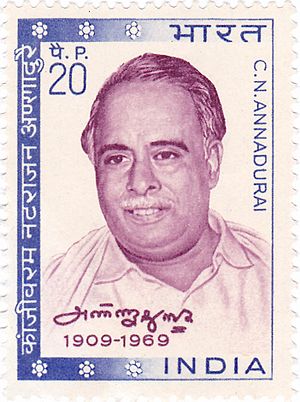
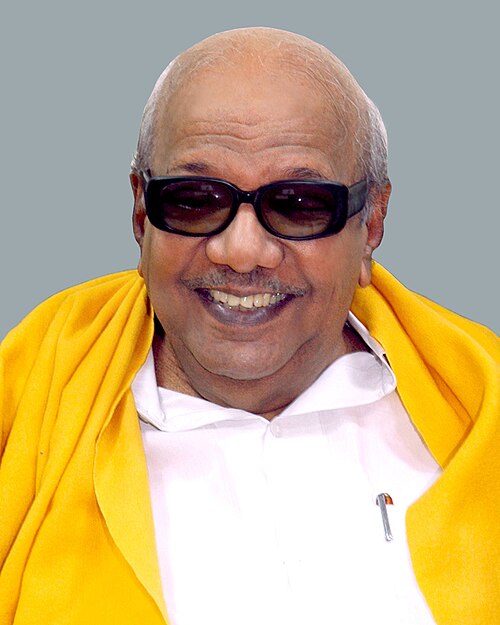
C. N. Annadurai
MLCs
📍 Tamilnadu
DMK
🗓️ 6 March 1967 – 14 January 1969
Conjeevaram Natarajan Annadurai (15 September 1909 – 3 February 1969), also known as Perarignar Anna, was an Indian politician who was the founder and first general-secretary of the Dravida Munnetra Kazhagam (DMK). He served as the fourth and last chief minister of Madras State from 1967 until 1969, and then as the first chief minister of Tamil Nadu for 20 days before his death in office. He was the first member of a Dravidian party to hold either post.
He was well known for his oratorical skills and was an acclaimed writer in the Tamil language. He scripted and acted in several plays. Some of his plays were later made into movies. He was the first politician from the Dravidian parties to use Tamil cinema extensively for political propaganda. Born in a middle-class family, he first worked as a school teacher, then moved into the political scene of the Madras Presidency as a journalist. He edited several political journals and enrolled as a member of the Dravidar Kazhagam. As an ardent follower of Periyar, he rose in stature as a prominent member of the party.[2][3][4]
Due to differences looming with Periyar, on issues of separate independent state of Dravida Nadu and union with India, he crossed swords with his political mentor. The friction between the two finally erupted when Periyar married Maniammai, who was much younger than him. Angered by this action of Periyar, Annadurai with his supporters parted from Dravidar Kazhagam and launched his own party, Dravida Munnetra Kazhagam (DMK).[citation needed] The DMK initially followed the same ideologies as its parent, Dravidar Kazhagam. But with the evolution of national politics and the constitution of India after the Sino-Indian War in 1962, Annadurai dropped the claim for an independent Dravida Nadu. Various protests against the ruling Congress government took him to prison on several occasions; the last of which was during the Madras anti-Hindi agitation of 1965. The agitation itself helped Annadurai to gain popular support for his party. His party won a landslide victory in the 1967 state elections. His cabinet was the youngest at that time in India. He legalised Self-Respect marriages, enforced a two-language policy (in preference to the three-language formula in other southern states), implemented subsidies for rice, and renamed Madras State to Tamil Nadu.
However, he died of cancer just two years into office. His funeral had the highest attendance of any to that date. Several institutions and organisations are named after him. A splinter party launched by M. G. Ramachandran in 1972 was named after him as All India Anna Dravida Munnetra Kazhagam.
Early life
Annadurai was born in a Tamil Sengunthar family[5] on 15 September 1909 in Conjeevaram, Madras Presidency, in a lower-middle-class family. His father Natarajan Mudaliar[6] was a weaver and his mother was Bangaru Ammal, a temple servant.[7] He was raised by his sister Rajamani Ammal.
Annadurai with his wife
At the age of 21, he married Rani while he was still a student. The couple had no children of their own, so they later adopted and raised Rajamani's grandchildren. He attended Pachaiyappa's High School,[8] but left school to work as a clerk in the town's Municipal office to assist with the family finances.
In 1934, he graduated with a B.A. degree from Pachaiyappa's College in Madras.[8] He then earned an MA degree in economics and politics from the same college. He worked as an English teacher[9] in Pachaiyappa High School. Later he quit the teaching job and began involving himself in journalism and he served as an editor in few weekly magazine and then he indulged into politics.
Annadurai in younger times
Religion
Though Annadurai was an atheist in his personal life as he took oath as the Chief Minister of the state in the 'name of conscience' rather than in the 'name of god', he proclaimed as "Only one race, Only one God" (Ondre Kulam Oruvanae Devan) from the Tamil work Tirumantiram penned by Tirumular in order to unify the people of Tamil Nadu.[10][11] Though secular to the core, he later described himself as a Hindu sans the sacred ash, a Christian minus the holy cross, and a Muslim without the prayer cap.[12]
Annadurai stated he would attack superstitions and religious exploitation but would never fight against the spiritual values of society. He once explained his stance towards God and religion as "I do not break coconuts for Pillaiyar, (a form of worship) neither do I break his idols." (Nan Thengayum udaipathillai; Pillaiyarum Udaipathillai)[13]
Political career
Entry into politics
Annadurai and Periyar
See also: Justice party (India) and Dravidar Kazhagam
Annadurai's interest in politics made him join the Justice party in 1935.[14] The Justice party was formed by non-Brahmin elites in 1916.[15] The Justice party originated with the Madras United League which was initially started as a work group that helped non-Brahmin students in Madras with accommodation and later grew into a political party under the efforts of leaders like C. Natesa Mudaliar, P. Theagaraya Chetty and T. M. Nair. The party was named South Indian Liberal Federation (S. I. L. F.) – popularly known as Justice party.[15] The party had been in power in Madras Presidency since self-governance was introduced in 1920, until it was defeated by the Indian National Congress in 1937.[16] By the time Annadurai joined the Justice party, Periyar was the party president. Annadurai served as the sub-editor of the Justice magazine. He later became the editor for Viduthalai (Freedom in English) and was also associated with the Tamil weekly paper, Kudi Arasu. He started his own journal Dravida Nadu (named after the Dravida Nadu – an independent state that the party called for). In 1944, Periyar renamed the Justice party to Dravidar Kazhagam and gave up contesting in the elections.[17]
Differences with Periyar and birth of DMK
See also: Indian independence movement and Dravida Munnetra Kazhagam
The Indian National Congress, which had been fighting for the independence of India from colonial British rule, was dominated by Brahmins. Periyar assumed that independent India would bring South Indians, especially Tamils, under the dominance of Brahmins and North Indians.[18] For these reasons Periyar called for 15 August 1947, the day of Indian independence, to be a day of mourning.[19] Annadurai opposed this move and the schism between his supporters and Periyar widened.[18] He saw the gaining of independence as an overall achievement of India rather than solely that of Aryan North.[14] Moreover, Periyar's decision on giving up participating in democratic elections was also opposed by Annadurai, in reaction to which he walked out of a party meeting in 1948.[14] Periyar considered that candidates in elections must compromise their ideologies. Moreover, it was Periyar's idea that social reformation can be better achieved outside politics, through education and canvassing the masses, rather than governments.[20] Eventually, when Periyar married Maniammai, who was 40 years younger than him, the personal differences between Annadurai and Periyar split their supporters.[20][3][4] Annadurai launched his own party with his party fragment, along with E. V. K. Sampath (Periyar's nephew and until then considered his political heir[21]). The new party was named Dravida Munnetra Kazhagam.[22] DMK's presence was initially restricted to urban centres and its surrounding areas. But by appealing to the urban lower, lower middle and working classes, students, Dalits and lower castes, Annadurai was able to accelerate its growth and spread. He fought for the social justice of the lower castes and thus rapidly gained popular support.[14]
Protests in 1953
In 1953, Annadurai directed the DMK to undertake three protests:[20]
Condemning Jawaharlal Nehru, the then Prime Minister of India, for describing the damaging Hindi letters in railway station boards by DK and DMK activists as "childish nonsense"
Against C. Rajagopalachari (or Rajaji), the then chief minister of Madras State, for introducing a new educational system that indirectly encouraged traditional caste-based occupations called Kula Kalvi Thittam
Against renaming Kallakkudi, Dalmiyapuram as the name Dalmiyapuram symbolised north Indian domination. He was eventually sentenced to three months imprisonment in this protest.
Dravida Nadu
Dravida Nadu magazine owned and edited by Annadurai
See also: Dravida Nadu
During his days in Dravida Kazhagam, Annadurai had supported Periyar's call for an independent Dravida Nadu. The claim for such an independent state stayed alive in the initial days of DMK. E. V. K. Sampath, who had earlier forfeited his inheritance from Periyar to join DMK, saw the call for Dravida Nadu as an unrealistic goal. Responding to Sampath's concern, Annadurai said
We must contest more elections, win more seats and that way, win the confidence of the people; and when it is hot, we can strike and strike hard[23]
Sampath's opposition to using film stars made him cross swords with many other members of the party. Eventually, with looming differences with Annadurai and other leaders on Dravida Nadu, Sampath left the DMK and formed his own party, the Tamil Nationalist Party, in 1961.[20] In 1962, Annadurai said in the Rajya Sabha that Dravidians want the right of self-determination ... We want a separate country for southern India.[24]
However, the reorganisation of states in India on linguistic basis removed Kannada, Telugu and Malayalam speaking regions from the Madras Presidency leaving behind a predominantly Tamil Madras State. Giving in to realities, Annadurai and his DMK changed the call of independent Dravida Nadu for Dravidians to independent Tamil Nadu for Tamils. Annadurai felt that remaining in the Indian Union meant accepting linguistic domination and economic backwardness. Nevertheless, the Sino-Indian war brought about changes in the Indian constitution. The Sixteenth Amendment (most popularly known as the Anti-Secessionist Amendment) banned any party with sectarian principles from participating in elections. When this amendment was presented in the Parliament of India, Annadurai was one of its members. He vehemently debated against the amendment, but eventually could not stop it from being passed. Faced with the new constitutional changes, Annadurai and his DMK left the call for an independent Tamil homeland on the back burner.[25] From then on Annadurai and his DMK aimed at achieving better co-operation between the southern states and claimed more autonomy for Tamil Nadu.[26]
On the party's position, Annadurai said
To make the Dravidian state a separate state was our ideal. A situation has arisen where we can neither talk nor write about this ideal. Of course we can destroy the party by undertaking to violate the prohibition. But once the party itself is destroyed there will not be any scope for the ideal to exist or spread. That is why we had to give up the ideal.[23]
Anti-Hindi agitations
Hindi was first recommended to be an apt language for official purposes in India by a committee headed by Motilal Nehru in 1928. This move was opposed by people and politicians of Tamil Nadu, since they considered that it would make them second class citizens when compared to that of native Hindi speaking North Indians.[27]
Protests of 1938
In 1938, the Congress government in Madras Presidency headed by C. Rajagopalachari (popularly known as Rajaji) proposed the use of Hindi language as a compulsory language in schools. This move was opposed by Tamil leaders. Annadurai, along with other Tamil scholars including the poet Bharathidasan, held demonstrations. Annadurai participated in the first Anti Hindi imposition conference held in Kanchipuram on 27 February 1938. Two members of the protest, Thalamuthu and Natarajan, died as a consequence of police beating the same year. With overwhelming opposition, the government of Madras Presidency finally withdrew the order in 1940. he stated that "you learn English for world communication and learn Hindi for communication in India, it seems like big door for big cat and small door for small cat, why not let the small cat also enter in big door".[28]
Madras Anti Hindi agitation, 1965
Main article: Anti-Hindi agitations of Tamil Nadu
When India became a republic with its own constitution in 1950, the constitution had given special status to the Hindi language, which was to gain official status after 15 years in 1965. This move was regarded with anxiety by students in Tamil Nadu.[27] Speaking of making Hindi as official language of India, Annadurai said It is claimed that Hindi should be the common language because it is spoken by the majority. Why should we then claim the tiger as our national animal instead of the rat which is so much more numerous? Or the peacock as our national bird when the crow is ubiquitous?.[29] In view of continued threat to impose Hindi, the DMK held an open-air conference against Hindi imposition at Kodambakkam, Chennai in August 1960, which Annadurai presided over. He gave black flags to leading functionaries, to be shown to the President of India during his visit to the state. Sensing an uprising, Prime Minister Jawaharlal Nehru assured in the Parliament that English would continue to be the official language of India, as long as non-Hindi speaking people desire. DMK gave up the plan of showing black flags and Annadurai appealed to the Union Government to bring about a constitutional amendment incorporating the assurance.[20]
With no constitutional amendment done, Annadurai declared 26 January 1965, the 15th Republic Day of India and also the day the Constitution, which in essence enshrined Hindi as the official language of India, came into practice, as a day of mourning. This move was opposed by the then Chief Minister of Madras State, Bhakthavatchalam, as blasphemous. Hence Annadurai, who by then had been trying to shake off the secessionist image of his party, declared 24 January as a day of mourning. He also replaced the slogan of the protests to Down with Hindi; Long live the Republic. Nevertheless, violence broke out on 26 January, initially in Madurai which within days spread throughout the state.[27] Robert Hardgrave Jr, professor of humanities, government and Asian studies, suggests that the elements contributing to the riots were not instigated by DMK or Leftists or even the industrialists, as the Congress government of the state suggested, but were genuine frustrations and discontentment which lay beneath the surface of the people of the state.[27]
With violence surging, Annadurai asked the students to forfeit the protests, but some DMK leaders like Karunanidhi kept the agitations going.[27] Nevertheless, Annadurai was arrested for instigating the agitation.[20] Although the violence were not directly instigated by the DMK,[27] the agitation itself aided DMK to win the 1967 elections and Annadurai became the new Chief Minister of Madras State.[30]
Literary contributions
Annadurai, known for his excellent oratorical skills, was fond of books. This image shows his private library.
See also: Cinema in Dravidian politics
Annadurai was known as one of the best Tamil orators during his time.[9] He developed a style in Tamil public speaking using metaphors and pleasing alliterations, both in spoken and written language. Annadurai was also best known for his extempore speaking ability being very well affluent on rhetoric skills.[31]
He has published several novels, short stories[8] and plays[32] which incorporate political themes.[9] He himself acted[32] in some of his plays during his time in the Dravidar Kazhagam.[33] He introduced movie media as a major organ for propaganda of Dravidian politics.[34] In total Annadurai scripted six screen plays.[33]
His first movie Nallathambi (Good Brother, 1948) which starred N. S. Krishnan promoted cooperative farming and abolition of zamindari system.[33] His novels such as Velaikaari (Servant Maid, 1949) and Or Iravu, which were later made into movies, carried the hallmarks of propaganda for Dravidian politics.[35] On Velaikari, Annadurai said that the movie
made it clear that greed and avarice of the rich did not pay in the long run.[...] Some of the elementary principles of socialism and stressed that we should depend upon our own labour for our progress and well being and not some unknown factor.[33]
Velaikari made direct references against the suppressive landlords who were traditionally allied with Jawaharlal Nehru and Gandhi.[17] His movies had some elements of Dravidian political ideologies like anti-Brahminism and messages differing against Congress with detailed reasons and scenarios behind.[35] Popular stage and cine actors who stood by Annadurai in early years were D. V. Narayanasamy, K. R. Ramasamy, N. S. Krishnan, S. S. Rajendran, Sivaji Ganesan[32] and M. G. Ramachandran.[20]
Some of his books had a social approach and its content were debatable, such as "Arya Mayai" (Aryan Illusion) in which he highlighted the view point of bringing an equal living society regardless of any caste dominance and especially drawing similarities which existed by then of the upper-caste Brahmin (Aryan) people. He was fined INR 700 for sedition[36] and was also sent to prison.[20]
Some of his well-known works are his books Annavin Sattasabai Sorpolivukal (Anna's speeches at the state legislative, 1960), Ilatchiya varalaru (History of Ideals, 1948), Valkkaip puyal (Storm of life, 1948) and Rankon rata (Radha from Rangon).[9] His work Kambarasam criticises Ramayana of Kamban.[37] His works of fiction such as Kapothipura kathal (Love in the city of Blind), Parvathy B.A., Kalinga rani (Queen of Kalinga) and Pavayin payanam (Travels of a young lady) carried elements of political propaganda.[37]
At times when Dravida Munnetra Kazhagam was extensively using movies for its propaganda, censorship crippled the process. To evade censorships, DMK movies used Annadurai's popular nickname Anna, which also means elder brother in Tamil, as a pun. When praises were bestowed on the Anna on screen, the crowd would break into applause.[33] Kannadasan has criticised Anna's works that apart from Sivaji Kanda Hindu Rajyam[32] and Needhi Devan Mayakkam, the rest lacked even a plot.[38]
Posts held
The provincial conference of the DMK was held at Tiruchirappalli in May 1956. Annadurai stepped down from the General Secretaryship of the party, and Nedunchezhian was elected to that position. It was at the Tiruchirappalli conference that the party decided to contest free India's second general elections which were to be held in 1957. The DMK secured 15 Assembly seats and two parliamentary seats.[20] Annadurai was elected from his home constituency, Kanchipuram[20] for the first time to the Madras Legislative Assembly.[9] In that election, the DMK won 15 seats and Annadurai became the de facto leader of the opposition in the state.[8] In 1962, the DMK emerged as the major political party in the state outside the Congress, winning 50 seats in the Assembly.[8] Although Annadurai himself lost the elections, he was nominated as a member of parliament to the upper house (Rajya Sabha).[8][9]
As chief minister
In 1967, the Congress lost nine states to opposition parties, but it was only in Madras state that a single non-Congress party majority was achieved.[39] The electoral victory of 1967 is also reputed to an electoral fusion among the non-Congress parties to avoid a split in the Opposition votes. Rajagopalachari, a former senior leader of the Congress party, had by then left the Congress and launched the right-wing Swatantra Party. He played a vital role in bringing about the electoral fusion among the opposition parties to align against the Congress.[40] At that time, his cabinet was the youngest in the country.[41]
Annadurai legalised self-respect marriages for the first time in the country. Such marriages were void of priests to preside over the ceremony and thus did not need a Brahmin to carry out the wedding.[42] Self-respect marriages were a brainchild of Periyar, who regarded the then conventional marriages as mere financial arrangements which often caused great debt through dowry. Self-Respect marriages, according to him, encouraged inter-caste marriages and caused arranged marriages to be replaced by love marriages.[43] Annadurai was also the first to use subsidising of the price of rice for election victory. He promised one rupee a measure of rice, which he initially implemented once in government, but had to withdraw later. Subsidising rice costs are still used as an election promise in Tamil Nadu.[44]
It was Annadurai's government that renamed the Madras State to its present-day form declaring officially as Tamil Nadu. The name change itself was first presented in the upper house (Rajya Sabha) of the Parliament of India by Bhupesh Gupta, a communist MP from West Bengal, but was then defeated.[18] With Annadurai as chief minister, the state assembly succeeded in passing the bill renaming the states.
Annadurai was instrumental in organising the World Tamil Conference under the aegies of UNESCO in 1967.[45] Another major achievement of Annadurai's government was to introduce a two language policy over the then popular three language formula. The three language formula, which was implemented in the neighbouring states of Karnataka, Andhra Pradesh and Kerala, entitled students to study three languages: the regional language, English and Hindi.[27] It was during the period of his Chief Ministership that the Second World Conference was conducted on a grand scale on 3 January 1968.[20] Nevertheless, when a commemorative stamp was released to mark the Tamil conference, Annadurai expressed his dissatisfaction that the stamp contained Hindi when it was for Tamil.[46] Annadurai also issued an order for the removal of the pictures of gods and religious symbols from public offices and buildings.[20] He proceeded on a world tour as an invitee of the Yale University's Chubb Fellowship Programme and was also a guest of the State Department in the US in April–May 1968. He was awarded the Chubb Fellowship at Yale University.[20] The same year he was awarded an honorary doctorate from Annamalai University.[8]
Death
Annadurai memorial
On 10 September 1968 Annadurai travelled to New York for medical treatment and he was operated for cancer in the gullet at the Memorial Sloan Kettering Cancer Center. He returned to Chennai in November and continued to address several official functions against medical advice.[47] His health deteriorated further and he died on 3 February 1969.[20] His cancer was attributed to his habit of chewing tobacco.[41] His funeral holds the record for highest number of attendees, as registered with The Guinness Book of Records.[48] An estimated 15 million people attended it.[49] His remains were buried in the northern end of Marina Beach, which is now called Anna Memorial.[50]
Legacy
The statue of Annadurai at the College of Engineering, Guindy campus of Anna University which is named after him
After his electoral success with his DMK in 1967, the Congress has not yet returned to power in Tamil Nadu. His government was the first in the country to be from a non-Congress party with full majority.[39] When the DMK later split, with M. G. Ramachandran forming his own Dravidian party, the rebel fragment was named after Annadurai as Anna DMK. Anna Nagar, a residential neighbourhood in Chennai is named after him.[citation needed] Sri Lankan Tamil nationalist leaders and writers are considered to be influenced by Annadurai's chaste Tamil movement.[51] Anna University, a premier institution in science and technology was named after him. DMK's current head office built in 1987 is named after him as Anna Arivalayam.[52] One of the major roads in Chennai was named in his honour, Anna Salai—it was previously called Mount Road, and a statue of Annadurai now stands there.[53] The central government issued a commemorative coin of ₹ 5 denomination to mark the centenary celebrations of him on 15 September 2009 in Chennai.[54] Jawaharlal Nehru hailed him as one of the great parliamentarians for speeches in Rajya Sabha.[55] Selig Harrison, a US-based[56] analyst of South Asian and East Asian politics and journalism[57] commented,
There is no doubt that this powerful orator is the single-most popular mass figure in the region[41]
The magazine India Today has listed Annadurai in its "Top 100 people who shaped India by thought, action, art, culture and spirit".[58] In 2010, Anna Centenary Library was established in Chennai in remembrance of Annadurai.[59]
A life-size statue of Annadurai was unveiled on 1 October 2002 in the Parliament House by then President of India, A.P.J. Abdul Kalam in his honour and the function was attended by notable politicians.[60][61]
On 31 July 2020, Alandur metro station in Chennai has been renamed as Arignar Anna Alandur Metro by Government of Tamil Nadu to honour him.[62]
His wife Rani Annadurai did not enter active politics after his death. She contested from Bangalore North Lok Sabha constituency in 1977 Indian general election and lost. She died in 1996 at Chennai. They never had any children and hence they have adopted the four sons of Annadurai's elder sister namely Parimalam, Ilangovan, Gowthaman and Rajendra Babu.[63][64] The granddaughter of Parimalam is Prithika Rani, an Indian Foreign Service officer of 2019 batch.[65]
Filmography
Year Film Credits[66]
1949 Velaikaari Story, Screenplay and Dialogues
1949 Nallathambi Story, Screenplay and Dialogues
1951 Or Iravu Story and Dialogues
1954 Sorgavasal Story and Dialogues
1956 Rangoon Radha Story
1959 Thaai Magalukku Kattiya Thaali Story
1961 Nallavan Vazhvaan Story
1962 Edhayum Thangum Idhayam Story
1970 Kadhal Jothi Story
1978 Vandikaaran Magan Story
Annadurai's first movie script, of his play Velaikkari, fetched him a fee of ₹ 12,000, a considerable sum at that time[67] (worth ₹ 1 crore in 2015 prices)
Apart from his stories, the names of some of Annadurai's works were used as film titles for Panathottam (1963), Valiba virundhu (1967), Kumarikottam (1971), Rajapart Rangadurai (1973), Needhi devan mayakkam (1982).[66]
Bibliography
Fiction
Year Type Work First appeared in[66]
1939 Novella Komalathin Kobam Kudi arasu
1939 Novella Kabothipura Kadhal Kudi arasu
1942 Novella Kumasthavin penn or Dravida Nadu
1942 Novella Kalingarani Dravida Nadu
1943 Novella Parvathi B.A Dravida Nadu
1943 Play Chandrodhayam
1945 Novella Dasavatharam Dravida Nadu
1945 Play Sivaji kanda Hindu samrajyam[32]
1946 Play Velaikaari
1946 Novella Kumari kottam Dravida Nadu
1946 Novella Rangoon Radha Dravida Nadu
1947 Play Needhidevan mayakkam
1947 Parable Kadhiravan Kaneen Dravida Nadu
1948 Play Nallathambi
1948 Play Or iravu
1948 Novella En vazhvu Dravida Nadu
1953 Play Sorgavasal
1953 Play Kadhal jothi
1955 Parable Kumari Surya Dravida Nadu
1955 Parable Nangai Nagaithaal Dravida Nadu
1955 Parable Oru muttalin kadhai Dravida Nadu
1955 Play Pavayin payanam
1956 Novella Pudhiya polivu Dravida Nadu
1957 Novella Kadaisi kanavu Dravida Nadu
1965 Novella Thazhumbukal Kanchi
1965 Novella Vandikaaran magan Kanchi
1968 Novella appodhae sonnen Kanchi
1970 Play Inba oli Kanchi and Dravida nadu
Novella Romapuri Raanigal Kanchi and Dravida nadu
Nonfiction
Year Title[8]
1947 Kambarasam
1948 Ariyamayai
In popular culture
A scene from the film Thangarathinam (1960) shows real footage of Annadurai and other DMK leaders speaking at the Tirāviṭa camutāya cīrtirutta mānāṭu (Dravidian Community Reform Conference) held in Palani on 17 September 1960. A group of protagonists in the film are seen attending the conference. The group is shown as belonging to a reformist organisation named Thirukkural Munnanik Kazhagam (Tamil: திருக்குறள் முன்னணிக் கழகம்). Its acronym in Tamil is an allusion to the DMK (திமுக).[68]
In a scene from the film Iru Kodugal (1969), District Collector Janaki (Sowcar Janaki), meets the Chief Minister of Tamil Nadu. The Chief Minister is not seen directly. Instead, C.N.Annadurai's voice (as imitated by Sivagangai Sethurajan) is heard.[69] Also, a pair of glasses on the table and a pen in the foreground are seen.[70]
The song sequence "Nee mannavana chinnavana" from the film Rudra Thandavam (1978) shows real footage of Annadurai's funeral.[71]
In the film Walter Vetrivel (1993), Vijayakumar played Viswanathan (Tamil Nadu Minister for Home Affairs as per the plot). The actor's countenance in the film strongly resembles Annadurai.
In the film Iruvar (1997), Nassar played Ayya Veluthambi, a character whose role is reminiscent of Annadurai.
Annadurai is portrayed in the film Kamaraj (2004).
S. S. Stanley played Annadurai in the film Periyar (2007). Directed by Gnana Rajasekaran, the film had Sathyaraj in the lead role of Periyar, Annadurai's mentor. After Annadurai's death (not shown in the film), his real life photo is seen in the table of M. Karunanidhi, who succeeded him as Chief Minister of Tamil Nadu.
The song sequence "Nee kondru kuvithatu" from the film Indiralohathil Na Azhagappan (2008) shows real footage of Annadurai.[72]
Bharathi Kannan played Annadurai in the film Thalaivii (2021).
M. Karunanidhi
MLCs
📍 Tamilnadu
DMK
🗓️ 30 March 1984 – 1 November 1986
2nd Chief Minister of Tamil Nadu
Muthuvel Karunanidhi (3 June 1924 – 7 August 2018), popularly known as Kalaignar was an Indian politician, writer and screenwriter who served as Chief Minister of Tamil Nadu for five terms between 1969 and 2011 and was the longest-serving chief minister in the state's history. He was the ten-time president of the Dravida Munnetra Kazhagam (DMK) for nearly five decades and a leading figure in the Dravidian movement.[4] He was noted for his contributions to Tamil literature, which include plays, novels, poems, and a multi-volume memoir.
Born in Thirukkuvalai in 1924, Karunanidhi was politically active from adolescence, participating in the Anti-Hindi agitation of 1937–40 and founding the Dravidian movement's first student wing. He pursued a parallel career in the Tamil film industry as a screenwriter, composing the dialogue for landmark films including M. G. Ramachandran's debut as a lead, Rajakumari, and Sivaji Ganesan's debut, Parasakthi. He used his writing to propagate the rationalist and egalitarian ideals of Periyar and DMK founder C. N. Annadurai, and was himself an avowed atheist and rationalist.
Karunanidhi entered the Madras state legislature in 1957 and succeeded Annadurai as DMK president and Chief Minister following the latter's death in 1969. Over the following four decades, his political career was characterised by shifting alliances with national parties — the Indian National Congress, the Bharatiya Janata Party, and the United Front — and by sustained rivalry with the AIADMK, particularly its leader J. Jayalalithaa. His government was dismissed in 1991 over alleged links with the Liberation Tigers of Tamil Eelam, and he was controversially arrested in 2001 on Jayalalithaa's orders. He returned to power in 1996 and again in 2006, completing his final term in 2011.
As Chief Minister, Karunanidhi championed increased state autonomy, caste-based affirmative action, and subsidies for the poor, policies that were widely adopted elsewhere in India and cemented his support among lower-caste communities. He was instrumental in securing classical language status for Tamil and in commissioning the 133-foot Thiruvalluvar Statue at Kanyakumari. He was also frequently accused of nepotism and of lending political support to the LTTE. Karunanidhi died on 7 August 2018 at Kauvery Hospital in Chennai after prolonged age-related illnesses.[3]
Early life and family
Karunanidhi was born on 3 June 1924, in the village of Thirukkuvalai in Tanjore district (currently Nagapattinam district), Madras Presidency in the erstwhile British Raj, to Ayyadurai Muthuvel and Anjugam. He had two elder sisters, Periyanayaki and Shanmugasundari.[5][6] There was some misconception that his birth name was Dakshinamurthy,[7] later changed to Karunanidhi as influenced by Dravidian and rationalist movements,[8][9] Karunanidhi himself stated that C.N. Annadurai asked him to keep his birthname "Karunanidhi", since it is already popular among the people.[10][additional citation(s) needed] In his own writings Karunanidhi said that his family were of the Isai Vellalar, a community who had traditionally played musical instruments at ceremonial occasions.[5][7][11] Karunanidhi started his education at a local school. Karunanidhi's father was eager to teach him music. His music teachers were from the Isai Vellalar group, and the lessons were conducted in temples where he was not allowed to cover his upper body, wear slippers, or wear a cotton cloth around his hips as a sign of respect for the upper caste people. He couldn't tolerate learning in an environment where he wasn't treated with respect, which made his father agree to stop his music classes. His father also asked the local headmaster to set up special tutoring courses for Karunanidhi and paid a tuition fee of milk every morning and evening.[12][13]
My music lessons were actually my first political studies. I learnt about the oppression of humans based on their caste. I saw the delight with which certain individuals could humiliate others, and the self-righteousness of others in carrying out their customs without realising that they were mistreating a large majority of the people.[13]
At the age of 12, he left to Thiruvarur to start his high school.[14] Karunanidhi started to organise school students for the anti-Hindi agitations.[15] The deaths of two anti-Hindi agitators by the police made a profound impact on him.[16] At the age of 13, he wrote his first Tamil historical novel titled Selvachandira.[6]
Entry into politics and early writing career
Karunanidhi entered politics at the age of 14, inspired by a speech by Pattukkottai Alagiri of the Justice Party, and participated in Anti-Hindi agitations.[17] As a teenager he was captivated by the political writings of Tamil leaders including Panagal Arasar, Periyar and Pattukkottai Alagiri (after whom Karunanidhi later named one of his sons). Karunanidhi joined the anti-Hindi protests sparked by the provincial government's legislation making Hindi-education mandatory in schools, and in 1938 organised a group of boys to hold demonstrations travelling around Tiruvarur on a cycle rickshaw. The law was rescinded in 1939. The taste for activism however stuck and in the ensuing years, after a brief flirtation with Communism, Karunanidhi started following the work and speeches of leaders of Justice Party, Self-Respect Movement and Dravidar Kazhagam.[5] According to Karunanidhi, he joined the Periyar's movement when he saw his father hurriedly rising and tied his towel to his waist from his head as a gesture of servitude when an upper caste landlord walked past him.[18]
At the age of fifteen, Karunanidhi started his own magazine Maanavanesan (transl. friends of students). He along with his friends would make fifty copies of the magazine and circulate it and also sometimes mailed them to the leaders of Self-respect movement.[19] A political activist after reading his magazine asked him to lead the forum for peace, liberty equality and justice, he accepted and became its elected secretary. Later, he dissolved the forum after there was a blatant attempt to convert the forum into as a front of the Congress party. He refunded the subscription money many refused to take the refund.[20] Using the rest of ₹75, he started the Tamil Nadu Tamil students association in 1941.[21] In 1942, the association held an annual function attended by Bharathidasan, K. Anbazhagan, and K. A. Mathiazhagan and student leaders from Annamalai University. He couldn't afford to pay for the invitees' and guest speakers' travels and expenditures, so he was forced to steal a gold necklace that his mother had made for him but which he rarely wore, pawned it for ₹50, and paid his invitees.[21]
As his writings were gaining popularity in Thiruvarur, he started Murasoli to widen his publishing platform. Its writer and chief editor was Karunanidhi, and its secretary was his friend Thennavan. It had a large print run, was mailed to many Tamil political organisations, and was in the forefront of the fight against caste, social isolation, sophistry, and supremacy.[21] He wrote a critical piece in Murasoli titled "Varnama, Maanama?" in 1944 when a conference was organised by conservatives in support of varna system.[22][21] He penned an article named 'Ilamaibali' (Youth Sacrifice) and sent it to C.N Annadurai's Dravida Nadu magazine. It appeared in the next issue. For a week, he wandered the streets of Thiruvarur with a print in hand, persuading many others to read it. He also penned an article that was never published. Within a week, Annadurai arrived in Thiruvarur for a public gathering and asked for Karunanidhi, he was stunned to find Karunanidhi as an 18-year-old school student. He instructed him to cease writing until he completed his education and asked him not to send any more articles.[23][24] Karunanidhi refused to go back as a school student.[23]
He failed three times in his final exams. During the result day, unable to face his family over his third consecutive failure, he left to Thopputhurai in search of his classmate Asan Abdul Kaathar who consoled him. He then started his passion of writing as a career.[25] In Thiruvarur, he started writing and staging plays. These plays served as a channel for the Dravidian movement's ideology to spread. In Thiruvarur, he presented a play named Palaniappan to raise cash for his student association. The total amount collected was only ₹80, despite the fact that the performance had cost him ₹200 to stage. He had no idea how he was going to repay the debt he owed to the individuals who were now harassing him for it. He travelled with his friend Thennavan for Nagapattinam, keen to take his chances somewhere else and met with R. V Gopal, a local leader of the Dravidar Kazhagam. Gopal sympathised with his situation but was hesitant to lend him the money but Instead bought the play for ₹100. The sale of his first play made his to write more ideological plays.[25][26][24]
His parents didn't approve of his writing career. They advised him to look for a job that would pay him at least ₹50 per month. He was determined on not taking a regular job. Karunanidhi then fell in love with a girl. He was certain that the girl was infatuated with him as well. When he and his family met the girl's parents, they demanded that if a wedding was to take place, it must be performed in the presence of Brahmin priests and vedic chanting. Karunanidhi rejected, citing his belief in the Self-Respect Movement as justification.[26][24]
After marriage, he worked as a playwright through the help of R.V Gopal who help his earlier with his play.[27] Their first camp for the troupe was at Villupuram where he was joined by his friends Thennavan and C.T Murthy. Their plays failed to bring people even after the attendance of Periyar and Annadurai. The failure was due to their comments against the caste prejudices, the troupe was named "Dravida Theatre group", the term "Dravida" was perceived to be a term for Dalits and hence non-Dalits boycotted it.[28] The troupe started to play in Pondicherry which was at the time a hub for social cultural and political change. His plays were an instant success and people started to call him as "Sivaguru", the name of his character.[28] During his stay in Pondicherry, Karunanidhi penned "That Pen!" a criticism of Gandhi and the Congress centred on a pen which was lost from the Sabarmati Ashram, which infuriated the congress workers. He followed up with a piece titled "What If Gandhi Became Viceroy?" Later, members of the congress attacked a public gathering in Pondicherry attended by Periyar, Annadurai, and Pattukottai Azhagirisamy. Karunanidhi was chased down and beaten until he fell unconscious. They dropped his unconscious body into the sewers and departed, thinking he was dead. He was nursed back by an old women and taken to Periyar who applied medicines to him and took him to Erode along with him where he worked as an assistant editor with Periyar's Kudi Arasu magazine in Erode for a year.[29][30][31][32]
Early political career
Karunanidhi along with a group of young band of Tamil enthusiasts led by Annadurai dissented from Dravidar Kazhagam and formed the Dravida Munnetra Kazhagam (DMK) on 17 September 1949.[33]
Kallakudi demonstration
Main article: Kallakudi demonstration
The first major protest that aided Karunanidhi in gaining ground in Tamil politics was his involvement in the Kallakudi demonstration in Kallakudi in 1953 when he was 29. The original name of this industrial town was Kallakudi. Kallakudi was renamed as "Dalmiapuram" by the state administration led by Rajagopalachari to commemorate the North Indian business magnate Ram Krishan Dalmia, who owned a cement factory there.[34] DMK wanted to change the name back to Kallakudi because Ram Krishna Dalmia depicted north Indian hegemonic power and predatory businesses. In the protest Karunanidhi and his companions erased the name Dalmiapuram from the railway station and lay down on the tracks blocking the course of trains. Six people died in the protest and Karunanidhi was arrested and was sent to jail for six months.[35][36]
MLA and deputy leader of opposition
At the age of 33, Karunanidhi entered the Tamil Nadu assembly by winning the Kulithalai seat in Tiruchirapalli during the 1957 election among the 15 DMK legislators elected and were elected as the Chief Whip.[37] During the 1959 elections of the Madras Municipal Corporation, he was managing the party campaigns, the party won 45 out of the 90 contested.[6] He was elected as DMK treasurer on 25 September 1960.[6] Karunanidhi was elected to the state assembly for the second time on 21 February 1962, from the Thanjavur constituency. He defeated Congress candidate A.Y.S. Parisutha Nadar.[6] In the same year, he became the deputy leader of opposition in the state assembly.[38]
During this time, Karunanidhi recognised the necessity for a regular engagement with party cadres. He began sending daily letters to his party members, whom he referred to as udan pirappukal (blood brothers), a practice he followed for fifty years.[39]
1965 Anti-Hindi Agitations and imprisonment
Main article: Anti-Hindi agitations of Tamil Nadu
Anti-Hindi agitations in Tamil Nadu started when the Union government announced that Hindi would become the single official language. The DMK, led by CN Annadurai, planned to organise a series of rallies against the action and declared 26 January to be a day of mourning. Chants of 'Hindi Ozhiga, Tamil Vaazhga' (Down with Hindi, long live Tamil) were heard everywhere. Violence continued across the state and several set themselves on fire.[40][6] Karunanidhi, the leader of the DMK's anti-Hindi agitation, was arrested on 16 February 1965, and was sentenced to six months imprisonment at the Central Prison in Palayamkottai.[6] He was later released at 15 April 1965.[41]
Cabinet Minister of state
Annadurai declared Karunnanidhi as a DMK candidate for the February 1967 Madras Legislative Assembly election, at the DMK's State-level meeting at Virugambakkam, Chennai. Karunanidhi, as DMK treasurer, raised ₹11 lakh for the party's election campaign.[6] For the first time, the DMK was elected with an absolute majority in February 1967 and Annadurai became the Chief minister.[6] After being elected to the Saidapet Assembly constituency in Chennai in March 1967, Karunanidhi was appointed as the Minister of Tamil Nadu Public Works Department.[42]
On 14 January 1969, under CN Annadurai's administration, Madras State was rechristened as Tamil Nadu.[43] Karunanidhi was in control of five ministries at the time: Transportation, Public Works, Highways, Ports, and Minor Irrigation.[6]
Later career as DMK President
First term as Chief minister,1969
See also: First Karunanidhi ministry
On 3 February 1969, the existing chief minister Annadurai died of cancer. On 9 February 1969, the DMK's MLAs chose Karunanidhi to lead the party with help of M. G. Ramachandran who his long-time friend. He was also chosen as the DMK's legislative assembly leader. Karunanidhi was appointed chief minister on 10 February 1969, the next day and was sworn in by Governor Sardar Ujjal Singh.[6] Members of the DMK selected him as the leader of the DMK on 27 July 1969, a position that had been kept vacant during Annadurai's tenure in honour of Periyar.[44]
The six Ministers of Annadurai's Cabinet were kept by Karunanidhi. In addition to his own ministries, Karunanidhi took on the ministries of late Annadurai and Nedunchezhiyan, who had refused to join his cabinet.[6]
He once found himself in a difficult situation in the state Assembly when members of the Congress party and Rajagopalachari's Swatantra Party hammered him and his amateur ministers with hard questions. Swatantra Party MP HV Hande described his new government as 'third rate.' Karunanidhi sprang up and exclaimed, 'Sorry, this is not third-rate government', This is a fourth-rate government." The house was startled for a few minutes. Some people believed Karunanidhi had admitted to the government's incompetence. Then Karunanidhi indicated that his government of Shudras, the lowest caste in the caste hierarchy which enraged the opposition.[34]
Karunanidhi started sending letters to his party members in Murasoli, opening with the words "Udan pirappe" (My blood brothers). These letters covered a wide range of themes, including the DMK's philosophy, his justifications for various party actions, and encouragements to party members to work very hard throughout electoral campaigns, among other things. Karunanidhi sent around 7,000 of these letters to party leaders between 1969 and his death in December 2016. They were later published in seven volumes.[6]
Karunanidhi sponsored and presided over a State Autonomy Conference in Madras on 12 September 1970, which included Periyar, West Bengal Chief Minister Ajoy Mukherjee, numerous Parliamentarians, and other dignitaries.[45]
During his tenure, he granted legal status to Self-Respect marriages and implemented a number of other programs aimed at protecting women and children.[46] Karunanidhi's administration established the Sattanathan commission for backward classes in 1969 to recognise underprivileged groups and give them with representation in government employment and educational institutions.[47] He implemented the "Manu Needhi Thittam", which mandated district officials to set aside a day every week to hear public grievances, and set up grievance redress procedures.[48] Karunanidhi founded the Tamil Nadu Slum Clearance Board in September 1970 to build permanent houses for those living in slums.[49] His government gave free eye surgeries for the blind from the 'Kannoli Thittam"[50] In 1970, he proposed the Tamil Nadu Land Reforms (Reduction of Ceiling on Land) Act, which cut the maximum amount of land a family could possess up to 15 standard acres, down from 30 acres under the previous Congress rule.[51]
Second term as Chief Minister ,1971
See also: Second Karunanidhi ministry
In March 1971, Karunanidhi formed an alliance with the Congress headed by Indira Gandhi, on the precondition that her party will not contest in any Assembly seats. In March 1971, the DMK contests for both the Assembly and the Lok Sabha. The DMK-Congress combination beat the Swatantra Party-Congress (Organisation) alliance led by Kamaraj and C. Rajagopalachari. The DMK won a landslide victory, with its candidates capturing 184 of the 234 seats on the ballot. Karunanidhi is re-elected as Chief Minister of Tamil Nadu for the second time. He was elected from Saidapet.[52][6]
Chief Minister M. Karunanidhi dismissed DMK's Treasurer M.G. Ramachandran from the party. He made this decision in response to a request from 26 of the executive council's 31 members. Karunanidhi later described the decision as "painful" at a public platform.[53] The DMK send him a requisition accusing him of breaking party rules. MGR said he was banned because he "demanded the party's finances, especially those connected to elections".[54] But the finances were submitted to the party executive committee. There had been conflict in the past, with MGR wanting to be Health Minister but Karunanidhi unwilling to satisfy him.[6] On 17 October 1972, MGR founded the ADMK.[53]
M Karunanidhi in 1970 issued an order that he said would "eliminate the thorn in the heart" of social reformer Periyar. The decree made it possible for people of all castes to become priests in public temples. However, the Supreme Court overturned this decision in 1972.[55]
Until 1973, Governors raised the national flag in state capitals on both Republic Day and Independence Day. Karunanidhi protested in February of that year that the Chief Ministers were "ignored" on Independence Day and Republic Day. In view of the Rajamannar Committee's report on Centre-State relations(1969–1971) being submitted at the time, he was reinforcing his call for State autonomy. In July, Prime Minister Indira Gandhi gave in to his demands, announcing that Chief Ministers would now hoist the flag on Independence Day, while Governors would do so on Republic Day. Karunanidhi became the first Chief Minister of Tamil Nadu to raise the national flag at Fort St. George on 15 August 1974.[56]
Karunanidhi launched the "Beggar rehabitation scheme" on his 48th birthday on 3 June 1971, and begged for funds for the scheme from shopkeepers near his residence, collecting ₹3,000 and said "Begging is not an insult to the person doing the begging. But it is an insult to the country and society that made him a beggar."[57] Karunanidhi established the Government Servants' Family Benefit Fund Scheme to give financial compensation to an employee's relatives in the event that he loses his job owing to permanent complete disability, medical incapacity, or death.[58] In 1971, his government increased reservation for BC from 25% to 31% and the reservation for Scheduled Castes (SC) and Scheduled Tribes (ST) from 16% to 18%. Karunanidhi established a separate Ministry for the Welfare of the backward class, the first such in the country.[59] During 1973, women were first inducted into the police force.[60]
The Emergency and government dismissal
Main article: The Emergency (India)
He resisted to let the Emergency's on Tamil Nadu for approximately seven months, until his administration was ousted on 31 January 1976. Karunanidhi was a supporter of Jayaparakash Narayan's anti-Emergency campaign and was the first one to ally with his Janata Party.[61] During an event at Don Bosco School, Karunanidhi stated, "Most likely, this would be my final public function as Chief Minister." He was dismissed before he even got home form the function. This occurred just 50 days before his tenure ended. The DMK suffered a great deal of damage once it was dismissed. 25,000 members of the party including Karunanidhi's close relatives and friends were imprisoned. His maternal uncle Murasoli Maran and his son M.K Stalin suffered health issues from torture and C. Chittibabu died trying to save M.K Stalin in prison.[62][63] He sent ₹200 a month to their families of jailed DMK members through the party office.[64]
A one-man Sarkaria Commission was established in February 1976 under Supreme Court judge Ranjit Singh Sarkaria, shortly after the Indira Gandhi government ousted the DMK administration after allegations of corruption were made by opposition leader MGR. DMK tried to make out that the investigation was an act of political vendetta. The Sarkaria commission described the evidence on the claims as "cogent, convincing, and reliable."[65][66] Although none of the corruption charges against him were proved.[67]
Opposition leader ,1977
AIADMK led alliance won 34 seats out of 39 seats in the 1977 Indian general election.[68] Top party figures such as general secretary V.R. Nedunchezhiyan, K. Rajaram and S. Madhavan quit accusing Karunanidhi for the DMK's failure in the general elections and demanded Karunanidhi to resign as the party's leader.[6] Later, DMK lost the 1977 Tamil Nadu Legislative Assembly election, Karunanidhi won from Anna Nagar consistency and became the leader of the opposition.[69][6]
On 29 October 1977, DMK supporters brandished black flags and yelled "Go back, Indira!" as she exited the Madras Airport for dissolving the DMK government in 1975. Indira Gandhi's vehicle was unable to pass through the black flag barrier in Madurai. Karunanidhi violated the police prohibition in Madras and led protests in Guindy. Karunanidhi and 28 other DMK leaders were detained the next day and were held in judicial custody.[70][6] Karunanidhi claimed in two separate interviews, in April 2009 and in May 2012, that Ramachandran was ready for the merger of his party, AIADMK, with the DMK in September 1979, with Biju Patnaik acting as the mediator. However, the plan failed to materialise as Panruti S. Ramachandran, a close confidante of Ramachandran, acted as a spoiler and Ramachandran later changed his mind.[71][72][73]
MGR offered a kind hand to the Morarji Desai government, while Karunanidhi renewed his alliance with Indira Gandhi. When Indira returned to power following the untimely end of Desai's government, she lost no time in dissolving MGR's cabinet. In the 1980 Indian general election and 1980 Tamil Nadu Legislative Assembly election, the state voted in favour of the AIADMK. MGR was re-elected as Chief Minister.[74] Karunanidhi was elected from Anna Nagar consistency again.[6] In February 1982, Karunanidhi embarked on a week-long padayatra from Madurai to Tiruchendur, spanning about 200 kilometres, in order to seek 'justice' for Subramania Pillai, a Hindu Religious and Charitable Endowments Department (HR & CE) officer who was found dead in November 1980. There were allegations that he was assassinated to cover financial misappropriation in the Tiruchendur temple. While Chief Minister MGR said the victim died by suicide, the DMK claimed it was an assassination. Karunanidhi walked over 30 kilometres during the day with a large crowd of cadres and leaders, stopping for lunch in small towns along the way. He gave public speeches in the evenings. The number of persons joining the padayatra grew by the day, and it became a topic of conversation in every family. The ruling government alarmed by the DMK's support, appointed a one-man committee chaired by retired judge C.J.R. Paul. The conclusions of the panel were never presented to the Assembly. Karunanidhi was able to obtain a copy of the study and disclosed it to the public in 1982 which revealed the panel's conclusion that Pillai had not committed suicide.[75]
Resignation, 1983
Karunanidhi in December 1988
Karunanidhi and DMK general secretary K. Anbazhagan resigned from the State Assembly soon after the 1983 anti-Tamil riots in Sri Lanka in protest of the union government and state's failure to defend Eelam Tamils. In May 1986, Karunanidhi established the Tamil Eelam Supporters Organisation (TESO) and held a major national conclave in Madurai to promote the Tamil aspiration for self-determination in Sri Lanka.[76][77]
Soon after AIADMK's election win in 1980, Congress abandoned its ally DMK and allied with AIADMK. The 1984 elections took place against the backdrop of Prime Minister Indira Gandhi's assassination. In December 1984, contested as allies in both Lok Sabha and the State Assembly which conducted together and were carried to victory by the sympathy generated for Indira Gandhi and MGR who was undergoing a Kidney transplant in New york. After being voted to the legislative council in April 1984, Karunanidhi decided to skip the elections.[78][79] In 1986, the MLC was however abolished by the Chief Minister, MG Ramachandran.[80]
Karunanidhi was instrumental in bringing the seven-party National Front together in Chennai in October 1988. With a plea for social justice, he backed Vishwanath Pratap Singh and his announcement of the Mandal Commission Report.[81] Earlier on 17 September 1988, he organised a large rally in Chennai with largely DMK members and a public meeting to commemorate the National Front's formation. It was the largest rally Chennai has ever seen.[6] Its inauguration was attended by 20 top national opposition leaders, including three non-Congress(I) chief ministers.[82]
Third term as Chief minister,1989
See also: Third Karunanidhi ministry
Karunanidhi in 1989
After a 13-year break, the DMK returned to power in 1989. Following MGR's death from a heart attack, the AIADMK split into two. The late Chief Minister MG Ramachandran's heroine J Jayalalithaa led one section, while his wife V N Janaki led another that helped the DMK. With about 33% of the vote, the DMK was able to secure a solid majority of 151 seats.[83] Karunandihi was elected Chief Minister for the third time from Chennai's Harbour constituency.[6]
Karunanidhi allowed the LTTE to use Tamil Nadu as a rear base for its battle for Eelam Between 1989 and 1991, even after Prabhakaran took up arms against the Indian Peace Keeping Force (IPKF). Karunanidhi accused the Indian soldiers of rape and massacre of Tamils in Sri Lanka and refused to receive the returning soldiers.[84] The Karunanidhi administration was then dismissed and placed under presidents rule by the Chandra Shekhar led union government after only two years of its five-year tenure due to its inability to act against Sri Lankan Tamil militants. Despite Governor S.S. Barnala's unwillingness to report to the Union Cabinet that Tamil Nadu's constitutional apparatus had broken down, the government was dismissed.[6]
He enacted legislations which provided financial assistance to widows and inter-caste weddings.[46] In 1989, Karunanidhi passed a law giving equal rights to women in family properties.[85] In 1989, Tamil Nadu became the first state to reserve 30% of government jobs for women.[86] After announcing on 17 November 1990, that his government would give free power connection, he followed it up with a Government Order giving power connection to 12.40 lakh farmers.[59] Women's self-help groups were first established in 1989 in Dharmapuri to integrate women and increase self-employment opportunities.[87] In 1990, Karunanidhi separated reservation for Scheduled Castes (SC) and Scheduled Tribes (ST) which gave 1% separate quota for STs.[88]
In opposition,1991
See also: Assassination of Rajiv Gandhi
The Assassination of Rajiv Gandhi by the LTTE took place during the electoral campaign for the 1991 Indian general elections. The DMK was accused in the incident and mobs vandalised the properties of DMK members and functionaries.[89] The allies AIADMK and the Congress campaigned together and spread propaganda claiming that the DMK was to responsible for Rajiv Gandhi's assassination and it worked. The AIADMK-Congress coalition won a decisive win in the Assembly elections on 24 June 1991, and Jayalalithaa was elected Chief Minister for the first time. Except for Karunanidhi, Parithi Ilamvazhuthi was the only DMK candidate who was elected in the elections, and Karunanidhi resigned from his seat immediately.[6]
Following the Demolition of the Babri Masjid in 1992, the DMK began holding rallies and public gatherings criticising the intentions of Kar sevaks. On 5 December 1992, Karunanidhi stated in Murasoli: "What does Kar Seva mean? God's service? Or The service of planting the seeds of unrest?".[90]
Fourth term as Chief minister ,1996
See also: Fourth Karunanidhi ministry
In 1996, he formed an alliance with the Tamil Maanila Congress, led by G.K. Moopanar, and was elected Chief Minister for the fourth time in the state. At the centre, he joined the Deve Gowda-led United Front government.[17] Karunanidhi's party, which had only two seats in the 1991 elections got 173 MPs, nine more than the AIADMK had the year before.[91]
Karunanidhi along with Governor Krishna Kanta receives President Shankar Dayal Sharma in 1997
In 1999, Karunanidhi made his most significant ideological concession. The DMK joined the BJP-led National Democratic Alliance to fight the elections, portraying Vajpayee as a softer ideological character than LK Advani. The National Democratic Alliance won the elections.[34] Following the DMK's support of the BJP, the TMC, CPI(M), and CPI withdrew.[92] The alliance with the BJP put him under increased pressure from both within and outside of the party. Following the 2002 Gujarat riots, Karunanidhi stated that both DMK and BJP were simply partners in the NDA and that the DMK had no intention of forming an alliance with the BJP. "We are not affiliated with the BJP." We are members of the NDA, and so is the BJP. That's it. So, where does the matter of forming an alliance with the BJP stand?".[93] Later, A Raja said that Karunanidhi told him that he regretted the alliance.[90]
He had to deal with caste animosity in numerous districts of Tamil Nadu throughout his tenure.[94]
The Anna Centenary Library built by the implementation of Karunanidhi
In 1996–97, Karunanidhi introduced the free bus pass system, which exempted government school and college students from paying for a ticket while giving private school and college students a 50% discount.[95] Karunanidhi devised the Uzhavar Sandhai plan in 1999, which aims to promote farmer-to-consumer communication and remove the middleman and helped farmers gain more remuneration.[58][96] He opened the Samathuvapuram (Equality Village) schemes in 145 places in Tamil Nadu in 1998 in order to forget and to eliminate caste-based segregation.[97][98] His administration was credited for accelerating the IT revolution, introducing mini-buses for connectivity. Karunanidhi renamed Madras to Chennai to reflect Tamil identity.[99] He introduced initiative which gives free education for the first graduate in a family up to their graduation. His decision to phase out hand-pulled rickshaws was enthusiastically applauded, and the rickshaw-pullers were given alternative work. He introduced the marriage assistance scheme for impoverished women.[100] His government introduced legislation establishing 33% reservation for women in local government.[46]
He was responsible for almost all of the state's major infrastructure projects which were implemented during this tenure including the TIDEL Park, the Coimbatore flyover, the Koyambedu bus terminal, Gemini flyover in Chennai, the rehabilitation of Poompuhar, the Anna Centenary Library, and the grade separators in Chennai and the new Secretariat complex.[100]
The 133 ft Thirvalluvar monument built by the implementation of Karunanidhi.
Thiruvalluvar statue
Main article: Thiruvalluvar Statue
On 31 December 1975, during a state cabinet meeting led by Karunanidhi, a plan was authorised to erect a statue for Thiruvalluvar at Kanyakumari. The DMK administration was dismissed a month later, and the state was placed under President's Rule. During his next term from 1989 to 1991, he resurrected the project. In March 1990, when presenting the Budget, he stated that a 133-foot-tall monument of Thiruvalluvar will be erected in Kanyakumari. He launched the project six months later. The project was restarted once he reclaimed power in May 1996. He unveiled the monument on New Year's Day, 2000.[101]
2001 state elections
Jayalalithaa, who was aligned with the Tamil Maanila Congress, the Congress, the Pattali Makkal Katchi, with both the communist parties, and other parties in 2001 Tamil Nadu legislative assembly elections received 49.89% of the vote, defeating the ruling DMK-led alliance by a large majority. Karunanidhi assumption that the DMK will be re-elected on the grounds of its government's good performance proved incorrect. His government's performance was praised by voters but it was not transferred into votes.[92] Karunanidhi was elected from Chepauk constituency.[102]
Leader of the DMK , 2001
He didn't want to serve as the leader of opposition.[103] K. Anbazhagan was made the leader of opposition.[104]
Controversy of arrests in Tamil Nadu about construction of flyovers
Main article: Controversy of arrests in Tamil Nadu about construction of flyovers
In the midnight 30 June 2001, he was arrested on the orders of J. Jayalalithaa as an act of vendetta[6] based on a First Information report over of alleged losses of ₹12 crore on construction of flyovers filed by Commissioner J. C. T. Acharyalu who Karunanidhi had earlier kept under suspension. He was arrested after a few hours after the complaint with no time for investigation. Sun TV broadcast these images live across the state, the cops stormed in, busted open his bedroom door, and hauled him out. The images of Karunanidhi falling, being dragged, being lifted up and pushed by the police created a sympathy wave for him.[105][106][107] T R Baalu and Murasoli Maran, two Union ministers, were also detained.[108] Karunanidhi told reporters "They didn't have a summons. They didn't have an arrest warrant. They claimed that these were unnecessary. They dragged me. They pushed me. They ripped my shirt. We treated her with respect when we arrested her."[109] Union Law Minister Arun Jaitley claimed it was a case of 'personal agenda'.[110] The Union ministers were freed and the allegations against them were dismissed. Karunanidhi was later released on bail on humanitarian grounds.[105] The police later dropped the case in 2006 citing it was a "mistake of facts".[111]
2004 general elections
Karunanidhi, on the other hand, left the BJP coalition in 2004 as the Union government refused to revoke the Prevention of Terrorism Act. He stood for the United Progressive Alliance led by the Congress party in the general elections, which won all 39 seats of the Parliament from Tamil Nadu.[34]
Fifth term as Chief minister, 2006
See also: Fifth Karunanidhi ministry
Karunanidhi meeting the Deputy Chairman of Planning Commission to finalise plan for the financial year, in New Delhi on 6 June 2006
On 8 May 2006, Karunanidhi's administration became the first minority administration in Tamil Nadu's history, and soon after declared a price cut for rice and the waiver of cooperative farmer loans, two of the DMK's main electoral promises.[112] The DMK won 96 of the 234 seats and emerged as the single-largest party in the Assembly with the alliance of CPI-M, Congress and CPI. Karunanidhi won from Chepauk constituency.[113][6]
Karunanidhi inaugurating the flyover at G N Chetty Road – Thirumalai Road Junction, in Chennai on 29 December 2008
Karunanidhi in January 2009 threatened to resign from the ruling alliance if India does not assist in securing a cease-fire in the Sri Lankan civil war.[114]
In 2006, the DMK administration formed 30 special welfare boards entrusted with lobbying for the rights of disadvantaged and marginalised people ranging from transgender people to construction workers who may not have political influence or form voting groups and endure many forms of oppression.[50] In 2006, Karunanidhi introduced the 'Anaithu Grama Anna Marumalarchi Thittam,' which aimed for the establishment of a library in each village panchayat.[115][58] In September 2006, he implemented the free land distribution scheme for the benefit of the landless poor.[116] Karunanidhi saw the value of the ramp as a wheelchair user. He mandated that all new government buildings, as well as existing ones, include a ramp and an elevator. He reserved 3% of government jobs for the physically challenged.[117] He launched the free gas connection distribution scheme in mid-January 2007.[118] In September 2008, he declared that 1 kg of rice will be offered at ₹1 at PDS stores, surpassing the campaign promise of ₹2.[119] In 2009, he introduced a special quota of 3 per cent reservations for the Arunthathiyar community. In 2019, the Arunthathiyars started building a temple "as a mark of thanksgiving to Kalaignar".[120] Karunanidhi launched the "Kalaignar Kapitu Thitam" in 2009 to give people from economically disadvantaged backgrounds receive quality medical treatments without discrimination.[121] At least 3 out of 5 people in the state have medical insurance due to this scheme.[122] In 2010, he introduced the "Kalaignar Veetu Vasathi Thittam" to convert thatched huts to concrete houses in the state.[123] During this tenure he implemented the construction of new Collectorates in nine districts, many universities were established, and highways and flyovers were built. The bus terminal in Koyambedu in Chennai, which is the largest in Asia, was built.[58] His health-care initiatives in the tenure, which included financial help for pregnant mothers, were well received by Jayalalithaa. Multiple medical camps were held around the state as part of the Varumun Kappom Thittam initiative, benefiting a huge portion of Tamil Nadu's population.[58] Schemes were implemented to provide free color TVs to every family with ration cards and to provide gas stoves with free gas connection to the poor women who use wood stove-kerosene stove.[124]
In opposition,2011
Karunanidhi meeting the then Prime Minister, Manmohan Singh, in Chennai, 2011
During the 2011 Tamil Nadu Legislative Assembly election, the AIADMK alliance won 203 seats and the DMK alliance won 31.[125] Karunanidi won by a huge margin of 50,249 votes Tiruvarur Assembly constituency.[126] Following the defeat, M. Karunanidhi said, "People have given me proper rest," before congratulating the people of the state.[127] (Made stalin as legislative leader)
On his 86th birthday, Karunanidhi donated his Gopalapuram home to the Annai Anjugam Trust, which would manage a free hospital for the underprivileged after his and his wife's demise.[128]
During the 2016 Tamil Nadu Assembly Elections, which the DMK lost only by 1.5 per cent votes.[129] Karunanidhi won from Tiruvarur constituency with margin of 68,366 votes thereby recording his 13th straight victory since 1957.[130]
In 2013, Karunanidhi announced his younger son M. K. Stalin was his successor, confirmed in 2016.[131][132]
Political positions
Sri Lankan Civil War
See also: Indian intervention in the Sri Lankan Civil War, Indian Peace Keeping Force, Protests against the Sri Lankan Civil War, K. Muthukumar, 2013 Anti-Sri Lanka protests, and Attacks on Sri Lankans in Tamil Nadu
Karunanidhi was known among his supporters as the "Tamil Inaththalaivar" (transl. leader of the Tamil race) He was close to numerous Sri Lankan Tamil politicians. In 1956, Karunanidhi issued a resolution at the DMK council in Chidambaram denouncing Sri Lanka's 'Sinhala Only policy'. He was acquainted with S.J.V. Chelvanayakam and was close with A. Amirthalingam, the head of the Tamil United Liberation Front. After 1977 anti-Tamil pogrom and 1983 anti-Tamil pogrom, his administration was at the forefront of organising protest demonstrations in Tamil Nadu. In protest at the 1983 riots, Karunanidhi and DMK general secretary K. Anbazhagan resigned from the State Assembly.[133]
The DMK was thought to support the Tamil Eelam Liberation Organization (TELO). After the LTTE started a war against its fellow Tamil militant group TELO in May 1986, Karunanidhi was sceptical of the LTTE's strategy.[134] Karunanidhi founded the Tamil Eelam Supporters Organisation (TESO) and held a large national conference in Madurai in May 1986 to emphasise the Tamil aspiration for sovereignty in Sri Lanka, during which he urged the LTTE to cease murdering TELO cadre. The LTTE then proceeded to kill the majority of the TELO cadres. The infighting was criticised by Karunanidhi as Sagodhara Yudham' (A Battle Between Brothers). Since the AIADMK and MGR were prepared to support the LTTE as the only representation of Sri Lankan Tamils, his constant attempts to convey the necessity for an unified front to the LTTE were ignored.[134] Karunanidhi was a vocal opponent of the decision to send Indian peace keeping forces (IPKF) to Sri Lanka as part of the Indo-Sri Lankan Accord, and he was accused of being anti-national for his outspoken criticism of the atrocities perpetrated by the IPKF.[133] He viewed the expulsion of Muslims from the North by the LTTE in 1990 as "ethnic cleansing."[135] His inaction against the LTTE in the state finally led to the Chandrasekhar government dismissing his cabinet in January 1991.[136] After the assassination of Rajiv Gandhi by LTTE he was not friendly with the overt LTTE sympathizers in the state.[133]
He ordered a special investigation of the conditions in the Tamil refugee camps in 2006, and subsequently provided funds to repair deteriorating dwellings.[133] In 2009, during the final stages of the war, Karunanidhi was unable to convince the UPA alliance to intervene.[136]
Tamil language
Karunanidhi on multiple occasions, expressed his admiration for Thiruvalluvar. The DMK administration built Valluvar Kottam, a memorial in Chennai dedicated to Valluvar in the mid-1970s. However, the government was removed from power in 1976, just weeks before the memorial was to be opened. Karunanidhi awaited 13 years to visit the memorial, and when the DMK regained power in January 1989, he held the swearing-in ceremony there. Karunanidhi built the Silappadikaram Art Gallery in Poompuhar and a special department for Tamil development as Chief Minister. His administration passed an order making Tamil obligatory in all schools until Class X a few weeks after he became Chief Minister in May 2006. Karunanidhi, a supporter of the two-language formula, had stressed the need of retaining English as the sole additional language in educational institutions.[137] After consulting with scholars, his government determined in 1972 that Thiruvalluvar was born in 31 BCE.[119] Karunanidhi and Congress leader Sonia Gandhi were vital in ensuring classical language status to Tamil in 2004.[138]
World Tamil Conference
Karunanidhi in Paavendhar Tamil Literature & Research library
He delivered the special address on the inaugural day of 3rd World Tamil Conference held in Paris in 1970, and also on the inaugural day of 6th World Tamil Conference held in Kuala Lumpur (Malaysia) in 1987. He penned the song "Semmozhiyaana Tamizh Mozhiyaam", the official theme song for the World Classical Tamil Conference 2010, that was set to tune by A. R. Rahman.[139]
In June 2010, his administration organised the World Classical Tamil Conference in Coimbatore.[137] 'Ulaga Tamizh Manadu' (World Tamil Conference), was the first coined word for the conference in 2010, however the IATR organisation that had right to conduct the conference was not happy hence change in name.[140] In the conference, Karunanidhi described Tamil as supreme among all classical languages. He reinforced the demand for Tamil to be recognised as a language of the Madras High Court.[141] Karunanidhi announced the foundation of the World Tholkappiyar Classical Tamil Sangam, that would include worldwide academics and will be based in Madurai, to hold World Classical Tamil Conferences at periodic intervals in the future. and to bring dispersed Tamil research centres and develop connections with Tamil organisations throughout the world.[142]
Screenwriting
Karunanidhi awarding Kalaimamani
See also: Parasakthi (1952 film) and Tamil cinema and Dravidian politics
Karunanidhi began his career as a screenwriter in the Tamil film industry.[143] His first movie as screenwriter was Rajakumari produced by Coimbatore-based Jupiter Pictures directed by A. S. A. Sami starring M. G. Ramachandran. During this period he and M. G. Ramachandran, then an upcoming actor and later day founder of AIADMK party started a long friendship eventually turning into rivals in later years politics. His stint with Jupiters Pictures then housed at Central Studios continued for another MGR starrer Abhimanyu, Marudhanaattu Ilavarasi (1950) starring M. G. Ramachandran and V. N. Janaki.
Around late 1949, T. R. Sundaram of Modern Theatres Studio in Salem engaged Karunanidhi as scriptwriter for the film Manthiri Kumari starring M. G. Ramachandran which would become be a blockbuster hit. Later T. R. Sundaram had Karunanidhi on permanent rolls at Modern Studio.
Karunanidhi chose to pen a script for a TV series based on the Vaishnavite philosopher-sage Ramanuja. He claimed that his party opposed Hindu fundamentalism, not Hindus.[34]
Parasakthi
His most notable movie was Parasakthi,[144] a turning point in Tamil cinema, as it espoused the ideologies of the Dravidian movement and also introduced two prominent actors of Tamil filmdom, Sivaji Ganesan and S. S. Rajendran.[145] The movie was initially marred with controversies and faced censorship troubles, but was eventually released in 1952.[145] becoming a huge box office hit. The movie was opposed by orthodox Hindus since it contained elements that criticised Hinduism.[146] The story contained condemnation of Tamil Nadu's severe social disparities, India's power difference between South and the North, and the moral corruption of the Hindu priestly caste. Upper caste Hindus sought to ban the movie.[147]
Two other movies that contained such messages were Panam (1952) directed by famous comedian and political activist N. S. Krishnan and Thangarathinam (1960) produced and acted by S. S. Rajendran another popular actor and DMK activist.[144] These movies contained themes such as widow remarriage, abolition of untouchability, self-respect marriages, abolition of zamindari and abolition of religious hypocrisy.[145] Another memorable hit movie was Manohara (1954) starring Sivaji Ganesan, S. S. Rajendran and P. Kannamba known for its crisp dialogues.
Writing and narration style
Through his wit and oratorical skills he rapidly rose as a popular politician. As his movies and plays with strong social messages became popular, they suffered from increased censorship; two of his plays in the 1950s were banned.[145] He was famous for writing historical and social (reformist) stories which propagated the socialist and rationalist ideals of the Dravidian movement to which he belonged. Alongside C. N. Annadurai he began using Tamil cinema to propagate his political ideals through his movies.[citation needed] His compositions, which often chastised upper castes while it making heroes out of the poor and advocating secularism, were seen as revolutionary.[148]
Filmography
At the age of 20, Karunanidhi went to work for Jupiter Pictures as a scriptwriter. His first film, Rajakumaari, gained him much popularity. It was here that his skills as a scriptwriter were honed, which extended to several films. He was active in screenwriting even during his later political career until 2011 when he last wrote for historic movie Ponnar Shankar.
As a scriptwriter
Rajakumaari (1947)
Abimanyu (1948)
Marudhanaattu Ilavarasi (1950)
Manthiri Kumari (1950)
Devaki (1951)
Manamagal (1951)
Parasakthi (1952)
Panam (1952)
Naam (1953)
Thirumbi Paar (1953)
Ammaiyappan (1954)
Manohara (1954)
Malaikkallan (1954)
Rangoon Radha (1956)
Raja Rani (1956)
Pudhaiyal (1957)
Pudhumai Pithan (1957)
Ellorum Innaattu Mannar (1960)
Kuravanji (1960)
Arasilangkumari (1961)
Thayilla Pillai (1961)
Iruvar Ullam (1963)
Kaanchi Thalaivan (1963)
Poompuhar (1964)
Poomalai (1965)
Avan Pithana? (1966)
Mani Magudam (1966)
Marakka Mudiyumaa (1966)
Valiba Virundhu (1967)
Thanga Thambi (1967)
Pillaiyo Pillai (1972)
Vandikaran Magan (1978)
Nenjukku Needhi (1979)
Aadu Paambe (1979)
Kaalam Pathil Sollum (1980)
Maadi Veettu Ezhai (1981)
Thooku Medai (1982)
Kaaval Kaithigal (1984)
Palaivana Rojakkal (1986)
Puyal Paadum Paattu (1987)
Sattam Oru Vilayaattu (1987)
Neethikku Thandanai (1987)
Veeran Veluthambi (1987)
Ore Raththam (1987)
Makkal Aanaiyittal (1988)
Paadatha Thenikkal (1988)
Paasa Paravaigal (1988)
Ithu Engal Neethi (1988)
Poruthadhu Pothum (1989)
Thendral Sudum (1989)
Nyaya Tharasu (1989)
Paasa Mazhai (1989)
Kavalukku Kettikaran (1990)
Madurai Meenakshi (1993)
Puthiya Parasakthi (1996)
Mannin Maindhan (2005)
Kannamma (2005)
Pasa Kiligal (2006)
Uliyin Osai (2008)
Pen Singam (2010)
Ilaignan (2011)
Ponnar Shankar (2011)
Television
Romapuri Pandian (Kalaignar TV)
Ramanujar (Kalaignar TV)
Lyrics
Year Film Song Composer
1980 Thooku Medai "Kodi Uyara", "Aayiram Piraigal", "Kurinji malar" Shankar Ganesh
1987 Ore Raththam "Ore Ratham", "Oru Poraliyin" Devendran
1987 Veeran Veluthambi "Surulu Meesai" S. A. Rajkumar
1988 Makkal Aanaiyittal "Aara Amara Konjam" S. A. Rajkumar
1993 Madurai Meenakshi "Neethi mandram" Deva
2005 Kannamma "Ilaignane", "Iru Vizhi" S. A. Rajkumar
2005 Mannin Maindhan "Kannin Manipola" Bharathwaj
2006 Pasa Kiligal "Thendral ennum" Vidyasagar
2010 Pen Singam "Aaha Veenaiyil" Deva
Literature
Karunanidhi (middle) with actor Sivaji Ganesan (left)
Karunanidhi is known for his contributions to Tamil literature. His contributions cover a wide range: poems, letters, screenplays, novels, biographies, historical novels, stage-plays, dialogues and movie songs. He has written Kuraloviam for Thirukural, Tholkaappiya Poonga, Poombukar, as well as many poems, essays and books. Apart from literature, Karunanidhi has also contributed to the Tamil language through art and architecture. Like the Kuraloviyam, in which Kalaignar wrote about Thirukkural, through the construction of Valluvar Kottam he gave an architectural presence to Thiruvalluvar, in Chennai. At Kanyakumari, Karunanidhi constructed a 133-foot-high statue of Thiruvalluvar in honour of the scholar.
Books
The books written by Karunanidhi include Sanga Thamizh, Thirukkural Urai, Ponnar Sankar, Romapuri Pandian, Thenpandi Singam, Vellikizhamai, Nenjukku Needhi, Iniyavai Irubathu and Kuraloviam.[149] His books of prose and poetry number more than 100.[150]
Stage plays
Karunanidhi's stage plays[151] include: Manimagudam, Ore Ratham, Palaniappan, Thooku Medai, Kagithapoo, Naane Arivali, Vellikizhamai, Udhayasooriyan and Silappathikaram.
Personal life
Karunanidhi married three times. Karunanidhi's parents were eager to marry him off to Padma, the sister of C. S. Jayaraman. He made one condition that the bride side must accept a reformist wedding. He hoped they would call off the marriage as he was not earning and the bride's father was religious but their family agreed to their marriage also held the marriage of their son C. S. Jayaraman the same day. He married Padmavathi Ammal on 13 September 1944, under the Dravidian movement's Self-Respect form of marriage where the bride and groom exchanged garlands, without a thaali (mangalsutra), and specifically without Brahmin priests presiding.[32][26] They had a son M. K. Muthu, who was briefly active in Tamil films and politics. Padmavathi died in 1948 soon after childbirth. In September of that year, Karunanidhi's marriage was arranged with Dayalu Ammal, with whom he had three sons, M. K. Alagiri, M. K. Stalin and M. K. Tamilarasu, and a daughter, M. K. Selvi. Alagiri and Stalin are active in state politics and competed to be their father's political successors, before Stalin prevailed. Tamilarasu is a businessman and film-producer and campaigner for his father and his party; Selvi campaigned for Karunanidhi elections too. With his third marriage with Rajathi Ammal, Karunanidhi had a daughter, Kanimozhi.[152][5]
Karunanidhi's left eye got critically injured in 1953 when the vehicle in which he was travelling got involved in an accident near Tirupattur. An eye surgery was performed and doctors recommended him to wear sunglasses to protect his eyes from the sun. Karunanidhi used regular spectacles. However, after following American ophthalmologists recommendation for his ongoing discomfort in his left eye, which he had been suffering from since the mid-1950s, he switched to his trade-mark dark glasses in 1971. Doctors determined that the dark glass frames were too hefty for him in November 2017 and advised a lighter frame.[153][154][6]
Since 2004, he has had to deal with his deteriorating health and struggled to stand when a spinal operation went wrong and became wheelchair-dependent. After a few years, he upgraded to a motorised wheelchair and a customised van with a hydraulic system to raise the chair into or out of the vehicle easily.[117]
Illness, death and reactions
Prime Minister Narendra Modi paying tribute to Karunanidhi in Rajaji Hall
Due to a drug-induced allergy, Karunanidhi became unwell in October 2016. He was hospitalised in the first week of December 2016 for "optimization of nutrition and hydration" and subsequently for a throat and lung infections. He went through a tracheostomy surgery to improve his breathing. He has stayed out of politics since then, making just a few public appearances. His last public appearance was on 3 June 2018, when he turned 94.[155]
On 28 July 2018, Karunanidhi's health deteriorated and became "extremely critical and unstable", and he was admitted at Kauvery Hospital in Chennai for treatment.[156] He died there at 18:10 on 7 August 2018 due to age-related illness, which led to multiple organ failure.[3][157]
The government of Tamil Nadu declared a public holiday on 8 August 2018 and a seven-day mourning after Karunanidhi's death.[158] He was accorded a state funeral.[159] A national mourning on 8 August 2018 was announced by the government of India.[160] The national flag flew half-mast in Delhi, all state capitals and across Tamil Nadu on 8 August 2018.[161] The governments of Karnataka and Bihar announced one-day and two-days state mourning respectively.[162]
On 18 August 2018, the DMK said that as many as 248 party workers died, 'shocked' by Karunanidhi's demise, and announced a solatium of ₹2 lakh to their families.[163]
Awards and titles
Annamalai University awarded him an honorary doctorate in 1971.[164]
He was awarded "Raja Rajan Award" by Tamil University, Thanjavur for his book Thenpandi Singam.[164]
On 15 December 2006, the Governor of Tamil Nadu and the Chancellor of Madurai Kamaraj University, Surjit Singh Barnala conferred an honorary doctorate on the Chief Minister on the occasion of the 40th annual convocation.[165]
In June 2007, the Tamil Nadu Muslim Makkal Katchi announced that it would confer the title "Friend of the Muslim Community" (Yaaran-E-Millath) upon M. Karunanidhi.[166]
Elections contested and positions held
Karunanidhi contested and won in all Tamil Nadu Assembly general elections (then Madras) since 1957 except 1984 when he didn't contest the election. He was elected in 1991 assembly election but resigned shortly thereafter, due to the reviving of his party, the DMK has secured only in 2 seats out of 234. He did not contest from more than one constituency in any single election.[167]
Year Constituency Party Votes % Opponent Votes % Result Margin
1957 Kulithalai IND 22,785 47.32 INC K.A. Dharmalingam 14,489 30.09 Won 8,296
1962 Thanjavur DMK 32,145 50.89 A.Y.S. Parisutha Nadar 30,217 47.84 Won 1,928
1967 Saidapet 53,401 60.96 S.G. Vinayagamurthy 32,919 37.58 Won 20,482
1971 63,334 54.46 INC(O) Kudanthai Ramalingam 50,823 43.70 Won 12,511
1977 Anna Nagar 43,076 50.10 AIADMK G. Krishnamurthy 26,638 30.98 Won 16,438
1980 51,290 48.97 H. V. Hande 50,591 48.31 Won 699
1984
Not Contested
1989 Harbour DMK 41,632 59.76 IUML K.A. Wahab 9,641 13.84 Won 3,236
1991 30,932 48.66 AIADMK K. Suppu 30,042 47.26 Won 890
1996 Chepauk 46,097 77.05 INC N.S. Nellai Kannan 10,313 17.24 Won 35,784
2001 29,836 51.91 R. Damodharan 25,002 43.50 Won 4,834
2006 34,188 50.96 IND Dawood Miah Khan 25,662 38.25 Won 8,526
2011 Thiruvarur 109,014 62.96 AIADMK M. Rajendran 58,765 33.94 Won 50,249
2016 121,473 61.73 R. Pannerselvam 53,107 26.99 Won 68,366
Controversies
Ram Setu remarks
In September 2007, the Bharatiya Janata Party (BJP) opposed Sethusamudram Canal project stating that it will demolish limestone shoals the party claimed to be remains of a bridge built by Rama to get to Lanka to save his wife Sita. He replied, "It is said that there was a God thousands of years ago called Ram. Do not touch the bridge built by him. I ask who is this Ram? Which engineering college did he graduate from?"[168] BJP leader Ravi Shankar Prasad accused Karunanidhi of religious discrimination when noting "We would like to know from Karunanidhi if he would make a similar statement against the head of any other religion."[169] CPM general secretary Prakash Karat came to his support and said "in this country, there are individuals with religious views and people like us. It is not wrong to voice an opinion".[170] Later, Karunanidhi clarified his remarks by saying that "I'm not against Ram, my conscience is my God".[168]
Suspected Sangh Parivar activists attacked the house of Karunanidhi's daughter Selvi in Bangalore with petrol bombs and stones over his comments.[171] A bus bound to Chennai was set on fire in Bangalore by a mob which burnt alive two people. The police blamed the attack on Hindu activists who were enraged over his comments.[172] Karunanidhi said the attacks showed the "true culture of Ram Sevaks."[169]
Connections with LTTE
In an April 2009 interview to NDTV, Karunanidhi made a controversial remark stating that "Prabhakaran is my good friend" and also said, "India could not forgive the LTTE for assassinating Rajiv Gandhi".[173][174][175] An interim report of Justice Jain Commission, which oversaw the investigation into Rajiv Gandhi's assassination, had indicted Karunanidhi for abetting Rajiv Gandhi's murderers, who belonged to the Liberation Tigers of Tamil Eelam (LTTE).[176] but the final report contained no such allegations.[177]
Allegations of nepotism
Karunanidhi has been accused by opponents, by some members of his party, and by other political observers of trying to promote nepotism.[178] Many political opponents and DMK party senior leaders have been critical of the rise of M. K. Stalin in the party.[citation needed] But some of the party men have pointed out that Stalin has come up on his own. Stalin was jailed under the Maintenance of Internal Security Act (MISA) during the Emergency that a fellow DMK party prisoner died trying to save him.